

proxies in marine sciences. The main applications of carbon isotopes in marine and climate sciences are broad
including reconstructions of the global carbon cycle in
relation to carbon sources and burial, chemostratigraphy,
tracing of water masses, and surface water productivity
in the modern and past ocean.
Carbon sources
Stable carbon isotopes are widely used geochemical proxy
tools to reconstruct changes in the global carbon cycle.
Two main carbon reservoirs exist, the reduced biogenic
organic carbon reservoir (organic matter) and the oxidized
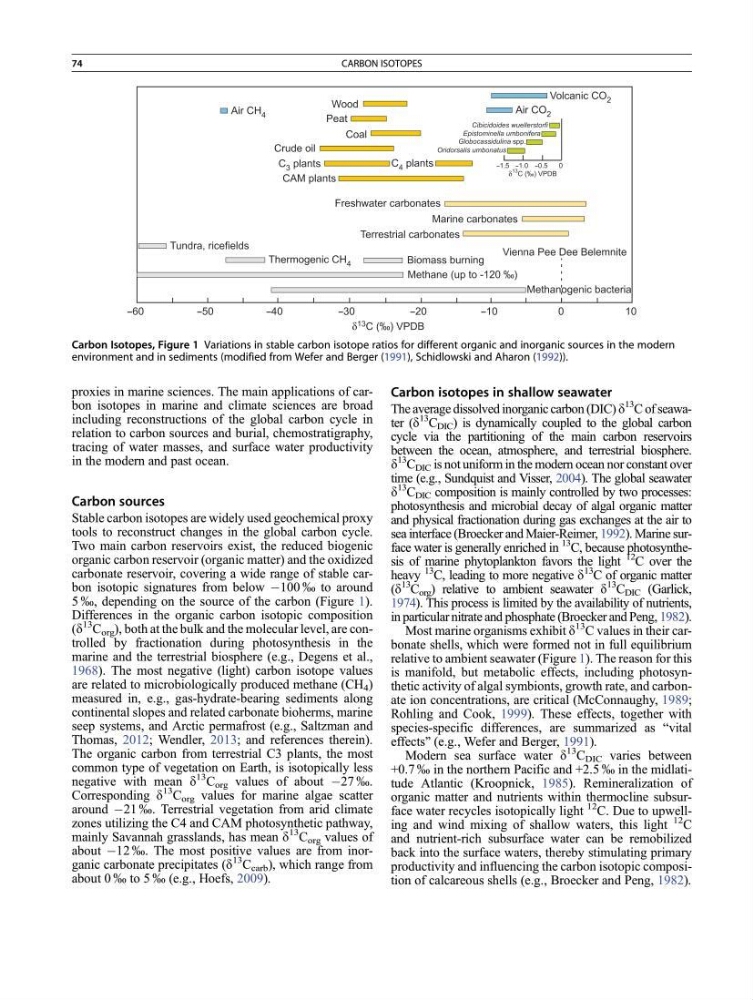
carbonate reservoir, covering a wide range of stable carbon isotopic signatures from below À100 % to around
5 %, depending on the source of the carbon (Figure 1).
Differences in the organic carbon isotopic composition
(d
13
C org ), both at the bulk and the molecular level, are controlled by fractionation during photosynthesis in the
marine and the terrestrial biosphere (e.g., Degens et al.,
1968). The most negative (light) carbon isotope values
are related to microbiologically produced methane (CH 4 )
measured in, e.g., gas-hydrate-bearing sediments along
continental slopes and related carbonate bioherms, marine
seep systems, and Arctic permafrost (e.g., Saltzman and
Thomas, 2012; Wendler, 2013; and references therein).
The organic carbon from terrestrial C3 plants, the most
common type of vegetation on Earth, is isotopically less
negative with mean d
13 C org values of about À27 %.
Corresponding d
13 C org values for marine algae scatter
around À21 %. Terrestrial vegetation from arid climate
zones utilizing the C4 and CAM photosynthetic pathway,
mainly Savannah grasslands, has mean d
13
C org values of
about À12 %. The most positive values are from inorganic carbonate precipitates (d
13
C carb ), which range from
about 0 % to 5 % (e.g., Hoefs, 2009).
Carbon isotopes in shallow seawater
The average dissolved inorganic carbon (DIC) d
13
C of seawater (d
13
C DIC ) is dynamically coupled to the global carbon
cycle via the partitioning of the main carbon reservoirs
between the ocean, atmosphere, and terrestrial biosphere.
d
13
C DIC is not uniform in the modern ocean nor constant over
time (e.g., Sundquist and Visser, 2004). The global seawater
d
13
C DIC composition is mainly controlled by two processes:
photosynthesis and microbial decay of algal organic matter
and physical fractionation during gas exchanges at the air to
sea interface (Broecker and Maier-Reimer, 1992). Marine surface water is generally enriched in
13
C, because photosynthesis of marine phytoplankton favors the light
12
C over the
heavy
13
C, leading to more negative d
13
C of organic matter
(d
13
C org ) relative to ambient seawater d
13
C DIC (Garlick,
1974). This process is limited by the availability of nutrients,
in particular nitrate and phosphate (Broecker and Peng, 1982).
Most marine organisms exhibit d
13 C values in their carbonate shells, which were formed not in full equilibrium
relative to ambient seawater (Figure 1). The reason for this
is manifold, but metabolic effects, including photosynthetic activity of algal symbionts, growth rate, and carbonate ion concentrations, are critical (McConnaughy, 1989;
Rohling and Cook, 1999). These effects, together with
species-specific differences, are summarized as “vital
effects” (e.g., Wefer and Berger, 1991).
Modern sea surface water d
13
C DIC varies between
+0.7 % in the northern Pacific and +2.5 % in the midlatitude Atlantic (Kroopnick, 1985). Remineralization of
organic matter and nutrients within thermocline subsurface water recycles isotopically light
12
C. Due to upwelling and wind mixing of shallow waters, this light
12
C
and nutrient-rich subsurface water can be remobilized
back into the surface waters, thereby stimulating primary
productivity and influencing the carbon isotopic composition of calcareous shells (e.g., Broecker and Peng, 1982).
δ
δ
Carbon Isotopes, Figure 1 Variations in stable carbon isotope ratios for different organic and inorganic sources in the modern
environment and in sediments (modified from Wefer and Berger (1991), Schidlowski and Aharon (1992)).
74
CARBON ISOTOPES
including reconstructions of the global carbon cycle in
relation to carbon sources and burial, chemostratigraphy,
tracing of water masses, and surface water productivity
in the modern and past ocean.
Carbon sources
Stable carbon isotopes are widely used geochemical proxy
tools to reconstruct changes in the global carbon cycle.
Two main carbon reservoirs exist, the reduced biogenic
organic carbon reservoir (organic matter) and the oxidized
carbonate reservoir, covering a wide range of stable carbon isotopic signatures from below À100 % to around
5 %, depending on the source of the carbon (Figure 1).
Differences in the organic carbon isotopic composition
(d
13
C org ), both at the bulk and the molecular level, are controlled by fractionation during photosynthesis in the
marine and the terrestrial biosphere (e.g., Degens et al.,
1968). The most negative (light) carbon isotope values
are related to microbiologically produced methane (CH 4 )
measured in, e.g., gas-hydrate-bearing sediments along
continental slopes and related carbonate bioherms, marine
seep systems, and Arctic permafrost (e.g., Saltzman and
Thomas, 2012; Wendler, 2013; and references therein).
The organic carbon from terrestrial C3 plants, the most
common type of vegetation on Earth, is isotopically less
negative with mean d
13 C org values of about À27 %.
Corresponding d
13 C org values for marine algae scatter
around À21 %. Terrestrial vegetation from arid climate
zones utilizing the C4 and CAM photosynthetic pathway,
mainly Savannah grasslands, has mean d
13
C org values of
about À12 %. The most positive values are from inorganic carbonate precipitates (d
13
C carb ), which range from
about 0 % to 5 % (e.g., Hoefs, 2009).
Carbon isotopes in shallow seawater
The average dissolved inorganic carbon (DIC) d
13
C of seawater (d
13
C DIC ) is dynamically coupled to the global carbon
cycle via the partitioning of the main carbon reservoirs
between the ocean, atmosphere, and terrestrial biosphere.
d
13
C DIC is not uniform in the modern ocean nor constant over
time (e.g., Sundquist and Visser, 2004). The global seawater
d
13
C DIC composition is mainly controlled by two processes:
photosynthesis and microbial decay of algal organic matter
and physical fractionation during gas exchanges at the air to
sea interface (Broecker and Maier-Reimer, 1992). Marine surface water is generally enriched in
13
C, because photosynthesis of marine phytoplankton favors the light
12
C over the
heavy
13
C, leading to more negative d
13
C of organic matter
(d
13
C org ) relative to ambient seawater d
13
C DIC (Garlick,
1974). This process is limited by the availability of nutrients,
in particular nitrate and phosphate (Broecker and Peng, 1982).
Most marine organisms exhibit d
13 C values in their carbonate shells, which were formed not in full equilibrium
relative to ambient seawater (Figure 1). The reason for this
is manifold, but metabolic effects, including photosynthetic activity of algal symbionts, growth rate, and carbonate ion concentrations, are critical (McConnaughy, 1989;
Rohling and Cook, 1999). These effects, together with
species-specific differences, are summarized as “vital
effects” (e.g., Wefer and Berger, 1991).
Modern sea surface water d
13
C DIC varies between
+0.7 % in the northern Pacific and +2.5 % in the midlatitude Atlantic (Kroopnick, 1985). Remineralization of
organic matter and nutrients within thermocline subsurface water recycles isotopically light
12
C. Due to upwelling and wind mixing of shallow waters, this light
12
C
and nutrient-rich subsurface water can be remobilized
back into the surface waters, thereby stimulating primary
productivity and influencing the carbon isotopic composition of calcareous shells (e.g., Broecker and Peng, 1982).
δ
δ
Carbon Isotopes, Figure 1 Variations in stable carbon isotope ratios for different organic and inorganic sources in the modern
environment and in sediments (modified from Wefer and Berger (1991), Schidlowski and Aharon (1992)).
74
CARBON ISOTOPES