

Like snowflakes on land, the skeletal parts and empty
shells (produced in surface waters) fall to the seafloor,
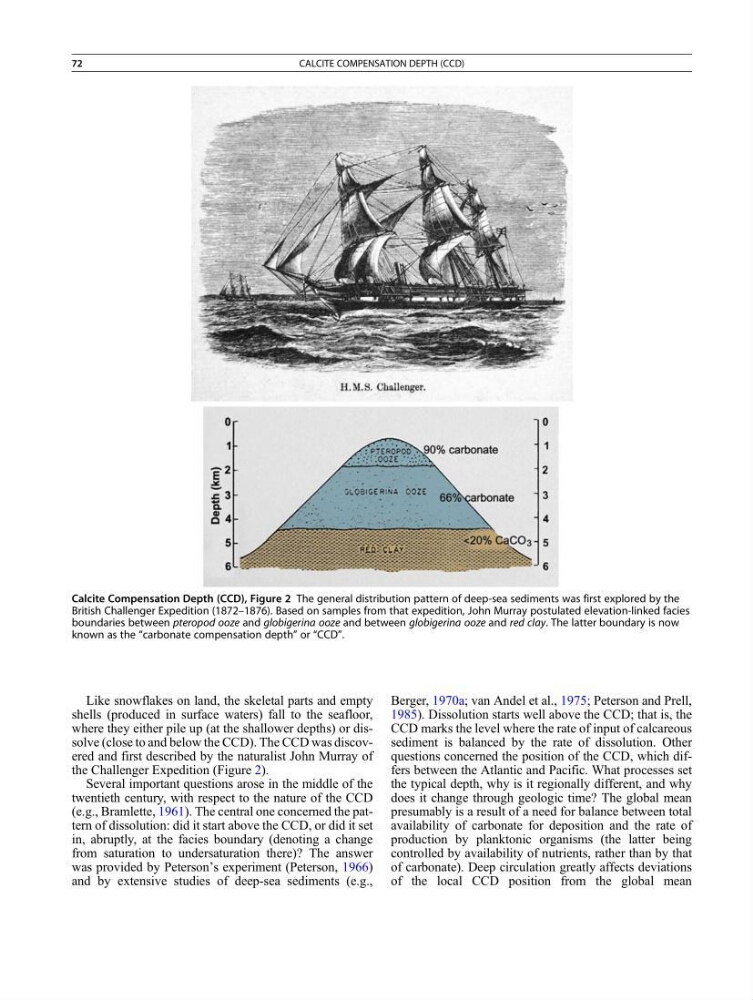
where they either pile up (at the shallower depths) or dissolve (close to and below the CCD). The CCD was discovered and first described by the naturalist John Murray of
the Challenger Expedition (Figure 2).
Several important questions arose in the middle of the
twentieth century, with respect to the nature of the CCD
(e.g., Bramlette, 1961). The central one concerned the pattern of dissolution: did it start above the CCD, or did it set
in, abruptly, at the facies boundary (denoting a change
from saturation to undersaturation there)? The answer
was provided by Peterson’s experiment (Peterson, 1966)
and by extensive studies of deep-sea sediments (e.g.,
Berger, 1970a; van Andel et al., 1975; Peterson and Prell,
1985). Dissolution starts well above the CCD; that is, the
CCD marks the level where the rate of input of calcareous
sediment is balanced by the rate of dissolution. Other
questions concerned the position of the CCD, which differs between the Atlantic and Pacific. What processes set
the typical depth, why is it regionally different, and why
does it change through geologic time? The global mean
presumably is a result of a need for balance between total
availability of carbonate for deposition and the rate of
production by planktonic organisms (the latter being
controlled by availability of nutrients, rather than by that
of carbonate). Deep circulation greatly affects deviations
of the local CCD position from the global mean
Calcite Compensation Depth (CCD), Figure 2 The general distribution pattern of deep-sea sediments was first explored by the
British Challenger Expedition (1872–1876). Based on samples from that expedition, John Murray postulated elevation-linked facies
boundaries between pteropod ooze and globigerina ooze and between globigerina ooze and red clay. The latter boundary is now
known as the “carbonate compensation depth” or “CCD”.
72
CALCITE COMPENSATION DEPTH (CCD)
shells (produced in surface waters) fall to the seafloor,
where they either pile up (at the shallower depths) or dissolve (close to and below the CCD). The CCD was discovered and first described by the naturalist John Murray of
the Challenger Expedition (Figure 2).
Several important questions arose in the middle of the
twentieth century, with respect to the nature of the CCD
(e.g., Bramlette, 1961). The central one concerned the pattern of dissolution: did it start above the CCD, or did it set
in, abruptly, at the facies boundary (denoting a change
from saturation to undersaturation there)? The answer
was provided by Peterson’s experiment (Peterson, 1966)
and by extensive studies of deep-sea sediments (e.g.,
Berger, 1970a; van Andel et al., 1975; Peterson and Prell,
1985). Dissolution starts well above the CCD; that is, the
CCD marks the level where the rate of input of calcareous
sediment is balanced by the rate of dissolution. Other
questions concerned the position of the CCD, which differs between the Atlantic and Pacific. What processes set
the typical depth, why is it regionally different, and why
does it change through geologic time? The global mean
presumably is a result of a need for balance between total
availability of carbonate for deposition and the rate of
production by planktonic organisms (the latter being
controlled by availability of nutrients, rather than by that
of carbonate). Deep circulation greatly affects deviations
of the local CCD position from the global mean
Calcite Compensation Depth (CCD), Figure 2 The general distribution pattern of deep-sea sediments was first explored by the
British Challenger Expedition (1872–1876). Based on samples from that expedition, John Murray postulated elevation-linked facies
boundaries between pteropod ooze and globigerina ooze and between globigerina ooze and red clay. The latter boundary is now
known as the “carbonate compensation depth” or “CCD”.
72
CALCITE COMPENSATION DEPTH (CCD)