

C
CALCITE COMPENSATION DEPTH (CCD)
Wolfgang H. Berger
Scripps Institution of Oceanography UCSD, La Jolla,
CA, USA
The carbonate compensation depth (CCD) is the dominant
facies boundary on the deep-sea floor. It separates calcareous from noncalcareous sediments, with the calcareous
deposits (“carbonate ooze”) restricted roughly to the
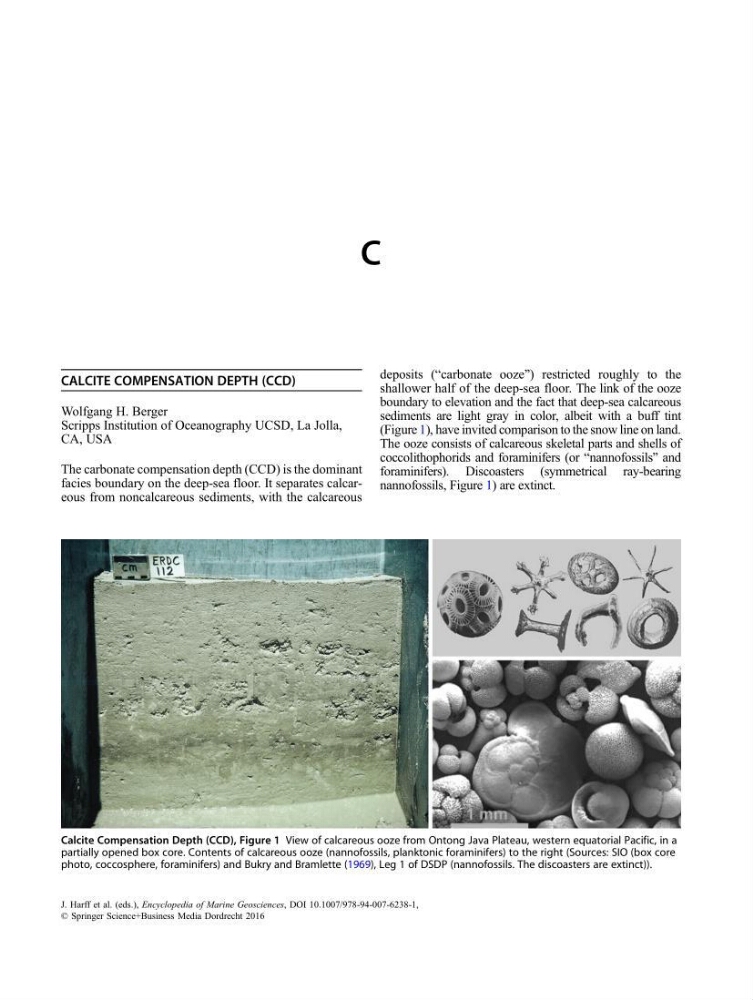
shallower half of the deep-sea floor. The link of the ooze
boundary to elevation and the fact that deep-sea calcareous
sediments are light gray in color, albeit with a buff tint
(Figure 1), have invited comparison to the snow line on land.
The ooze consists of calcareous skeletal parts and shells of
coccolithophorids and foraminifers (or “nannofossils” and
foraminifers). Discoasters (symmetrical ray-bearing
nannofossils, Figure 1) are extinct.
Calcite Compensation Depth (CCD), Figure 1 View of calcareous ooze from Ontong Java Plateau, western equatorial Pacific, in a
partially opened box core. Contents of calcareous ooze (nannofossils, planktonic foraminifers) to the right (Sources: SIO (box core
photo, coccosphere, foraminifers) and Bukry and Bramlette (1969), Leg 1 of DSDP (nannofossils. The discoasters are extinct)).
J. Harff et al. (eds.), Encyclopedia of Marine Geosciences, DOI 10.1007/978-94-007-6238-1,
© Springer Science+Business Media Dordrecht 2016
CALCITE COMPENSATION DEPTH (CCD)
Wolfgang H. Berger
Scripps Institution of Oceanography UCSD, La Jolla,
CA, USA
The carbonate compensation depth (CCD) is the dominant
facies boundary on the deep-sea floor. It separates calcareous from noncalcareous sediments, with the calcareous
deposits (“carbonate ooze”) restricted roughly to the
shallower half of the deep-sea floor. The link of the ooze
boundary to elevation and the fact that deep-sea calcareous
sediments are light gray in color, albeit with a buff tint
(Figure 1), have invited comparison to the snow line on land.
The ooze consists of calcareous skeletal parts and shells of
coccolithophorids and foraminifers (or “nannofossils” and
foraminifers). Discoasters (symmetrical ray-bearing
nannofossils, Figure 1) are extinct.
Calcite Compensation Depth (CCD), Figure 1 View of calcareous ooze from Ontong Java Plateau, western equatorial Pacific, in a
partially opened box core. Contents of calcareous ooze (nannofossils, planktonic foraminifers) to the right (Sources: SIO (box core
photo, coccosphere, foraminifers) and Bukry and Bramlette (1969), Leg 1 of DSDP (nannofossils. The discoasters are extinct)).
J. Harff et al. (eds.), Encyclopedia of Marine Geosciences, DOI 10.1007/978-94-007-6238-1,
© Springer Science+Business Media Dordrecht 2016