

63
coast
(polyp), generation that alternates with a free-swimming generative (medusa)
generation, though it depends on the species which of the generations dominates the life cycle. The polyps consist of a basal disk for attachment, a hollow
body stalk with the gastro-vascular cavity, and a mouth, around which a circle of tentacles. The polyps can form by means of asexual budding whole
colonies, other separate living polyps or medusa. In the latter cases the
process is called strobilation. The medusa is in principal an upside-down
polyp, with the stalk expanded to a large disk or umbrella, and the mouth
surrounded with sometimes very long tentacles hanging down. Cnidaria are
found in all seas and oceans with reef corals in the tropics and some jellyfish like Aurelia all over the northern hemisphere.
cnidoblast thread cell, ~Cnidaria.
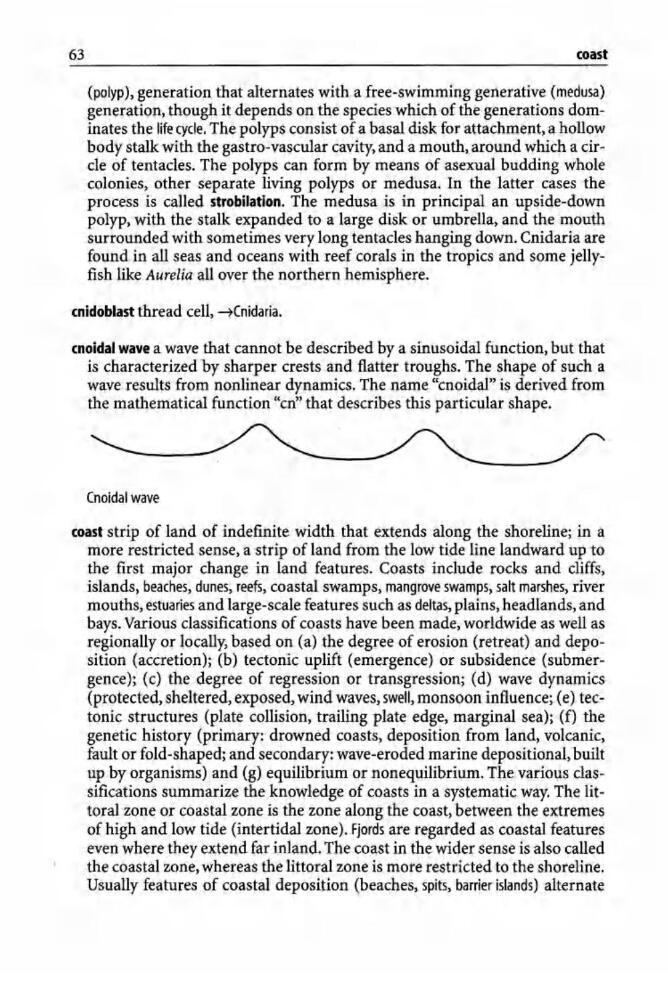
cnoidal wave a wave that cannot be described by a sinusoidal function, but that
is characterized by sharper crests and flatter troughs. The shape of such a
wave results from nonlinear dynamics. The name "cnoidal" is derived from
the mathematical function "en" that describes this particular shape.
Cnoidal wave
coast strip of land of indefinite width that extends along the shoreline; in a
more restricted sense, a strip of land from the low tide line landward up to
the first major change in land features. Coasts include rocks and cliffs,
islands, beaches, dunes, reefs, coastal swamps, mangrove swamps, salt marshes, river
mouths, estuaries and large-scale features such as deltas, plains, headlands, and
bays. Various classifications of coasts have been made, worldwide as well as
regionally or locally, based on (a) the degree of erosion (retreat) and deposition (accretion); (b) tectonic uplift (emergence) or subsidence (submergence); (c) the degree of regression or transgression; (d) wave dynamics
(protected, sheltered, exposed, wind waves, swell, monsoon influence; (e) tectonic structures (plate collision, trailing plate edge, marginal sea); (f) the
genetic history (primary: drowned coasts, deposition from land, volcanic,
fault or fold-shaped; and secondary: wave-eroded marine depositional, built
up by organisms) and (g) equilibrium or nonequilibrium. The various classifications summarize the knowledge of coasts in a systematic way. The littoral zone or coastal zone is the zone along the coast, between the extremes
of high and low tide (intertidal zone). Fjords are regarded as coastal features
even where they extend far inland. The coast in the wider sense is also called
the coastal zone, whereas the littoral zone is more restricted to the shoreline.
Usually features of coastal deposition (beaches, spits, barrier islands) alternate
coast
(polyp), generation that alternates with a free-swimming generative (medusa)
generation, though it depends on the species which of the generations dominates the life cycle. The polyps consist of a basal disk for attachment, a hollow
body stalk with the gastro-vascular cavity, and a mouth, around which a circle of tentacles. The polyps can form by means of asexual budding whole
colonies, other separate living polyps or medusa. In the latter cases the
process is called strobilation. The medusa is in principal an upside-down
polyp, with the stalk expanded to a large disk or umbrella, and the mouth
surrounded with sometimes very long tentacles hanging down. Cnidaria are
found in all seas and oceans with reef corals in the tropics and some jellyfish like Aurelia all over the northern hemisphere.
cnidoblast thread cell, ~Cnidaria.
cnoidal wave a wave that cannot be described by a sinusoidal function, but that
is characterized by sharper crests and flatter troughs. The shape of such a
wave results from nonlinear dynamics. The name "cnoidal" is derived from
the mathematical function "en" that describes this particular shape.
Cnoidal wave
coast strip of land of indefinite width that extends along the shoreline; in a
more restricted sense, a strip of land from the low tide line landward up to
the first major change in land features. Coasts include rocks and cliffs,
islands, beaches, dunes, reefs, coastal swamps, mangrove swamps, salt marshes, river
mouths, estuaries and large-scale features such as deltas, plains, headlands, and
bays. Various classifications of coasts have been made, worldwide as well as
regionally or locally, based on (a) the degree of erosion (retreat) and deposition (accretion); (b) tectonic uplift (emergence) or subsidence (submergence); (c) the degree of regression or transgression; (d) wave dynamics
(protected, sheltered, exposed, wind waves, swell, monsoon influence; (e) tectonic structures (plate collision, trailing plate edge, marginal sea); (f) the
genetic history (primary: drowned coasts, deposition from land, volcanic,
fault or fold-shaped; and secondary: wave-eroded marine depositional, built
up by organisms) and (g) equilibrium or nonequilibrium. The various classifications summarize the knowledge of coasts in a systematic way. The littoral zone or coastal zone is the zone along the coast, between the extremes
of high and low tide (intertidal zone). Fjords are regarded as coastal features
even where they extend far inland. The coast in the wider sense is also called
the coastal zone, whereas the littoral zone is more restricted to the shoreline.
Usually features of coastal deposition (beaches, spits, barrier islands) alternate