

climax community
62
climax community ~community.
clone an assemblage of genetically identical organisms derived by asexual or
vegetative multiplication from a single sexually derived individual. In
molecular biology a number of copies of a DNA fragment to be replicated by
a phage or plasmid.
closure problem the equations of hydrodynamics are nonlinear and thus couple
motions at different scales. One of the objectives of hydrodynamics is to
simplify these equations when focusing on a feature occurring at a particular scale. The impact of smaller-scale motions on the relevant scale is solved
by parametrization. In particular this applies to the parametrization of the
small-scale nonlinear terms in the momentum equation, the Reynolds stresses,
the description of which in terms oflarge-scale parameters is known as the
closure problem.
Clypeastroidea order of the class Echinoidea (phylum Echinodermata) with strongly
flattened test. Examples: true sand dollars, sea biscuit.
Cnidaria (syn. Coelenterata, cnidarians) comprising the Hydrozoa (hydropolyps),
Scyphozoa (jellyfish), Cubozoa (sea wasps), and Anthozoa (sea anemones, corals).
Solitary or colonial, sedentary or free-living animals which are fundamentally radially symmetrical. The body consists of two layers the ectoderm and
endoderm between which a connective tissue, the mesogloea, is lying. No coelom.
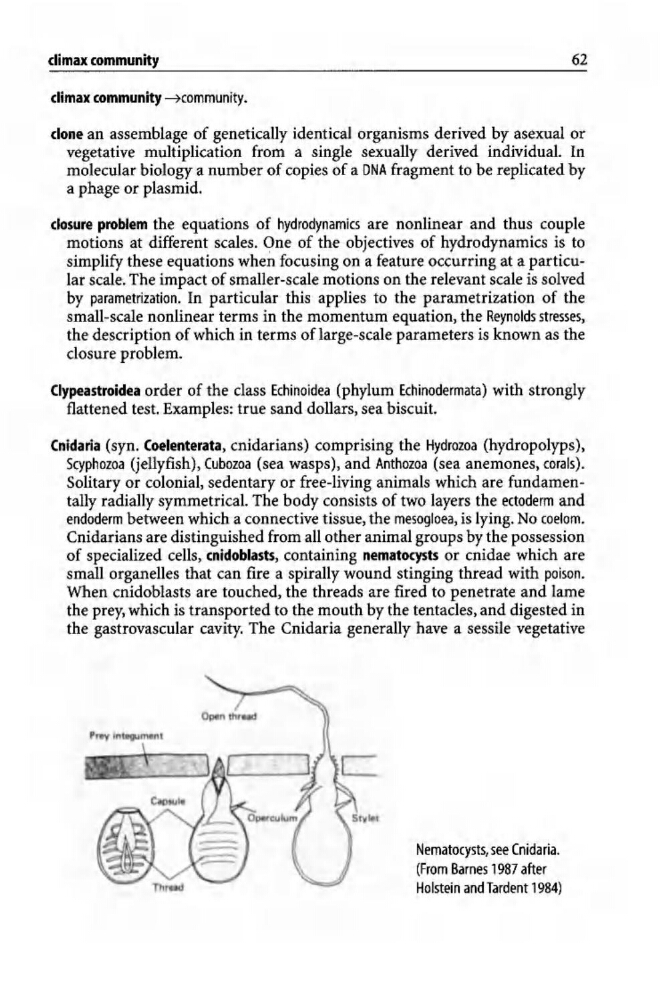
Cnidarians are distinguished from all other animal groups by the possession
of specialized cells, cnidoblasts, containing nematocysts or cnidae which are
small organelles that can fire a spirally wound stinging thread with poison.
When cnidoblasts are touched, the threads are fired to penetrate and lame
the prey, which is transported to the mouth by the tentacles, and digested in
the gastrovascular cavity. The Cnidaria generally have a sessile vegetative
Nematocysts, see Cnidaria.
(From Barnes 1987 after
Holstein and Tardent 1984)
62
climax community ~community.
clone an assemblage of genetically identical organisms derived by asexual or
vegetative multiplication from a single sexually derived individual. In
molecular biology a number of copies of a DNA fragment to be replicated by
a phage or plasmid.
closure problem the equations of hydrodynamics are nonlinear and thus couple
motions at different scales. One of the objectives of hydrodynamics is to
simplify these equations when focusing on a feature occurring at a particular scale. The impact of smaller-scale motions on the relevant scale is solved
by parametrization. In particular this applies to the parametrization of the
small-scale nonlinear terms in the momentum equation, the Reynolds stresses,
the description of which in terms oflarge-scale parameters is known as the
closure problem.
Clypeastroidea order of the class Echinoidea (phylum Echinodermata) with strongly
flattened test. Examples: true sand dollars, sea biscuit.
Cnidaria (syn. Coelenterata, cnidarians) comprising the Hydrozoa (hydropolyps),
Scyphozoa (jellyfish), Cubozoa (sea wasps), and Anthozoa (sea anemones, corals).
Solitary or colonial, sedentary or free-living animals which are fundamentally radially symmetrical. The body consists of two layers the ectoderm and
endoderm between which a connective tissue, the mesogloea, is lying. No coelom.
Cnidarians are distinguished from all other animal groups by the possession
of specialized cells, cnidoblasts, containing nematocysts or cnidae which are
small organelles that can fire a spirally wound stinging thread with poison.
When cnidoblasts are touched, the threads are fired to penetrate and lame
the prey, which is transported to the mouth by the tentacles, and digested in
the gastrovascular cavity. The Cnidaria generally have a sessile vegetative
Nematocysts, see Cnidaria.
(From Barnes 1987 after
Holstein and Tardent 1984)