

49
Cephalopoda
Cephalopoda (cephalopods) class of the phylum Mollusca, including Nautilus, cuttle-fish, squids, and octopods. Generally free-swimming raptorial mollusks,
among which are the largest of all invertebrates (the giant squid, with a
length of up to 16 m). Typical is the circle of arms or "tentacles" with rows
of suckers, on the head, which developed from the mollusk foot (~Mollusca).
They swim by jet propulsion: water is pressed out of the mantle cavity
through a funnel. The shell, external in Ammonoidea (extinct) and
Nautiloidea (almost extinct), is in other cephalopods reduced and internal,
or absent. Cephalopoda have a mouth with a horny bill, and highly developed eyes. In the skin are chromatophores which enable the animals to change
their color quickly (alarm response) and especially deep-sea species can
fin
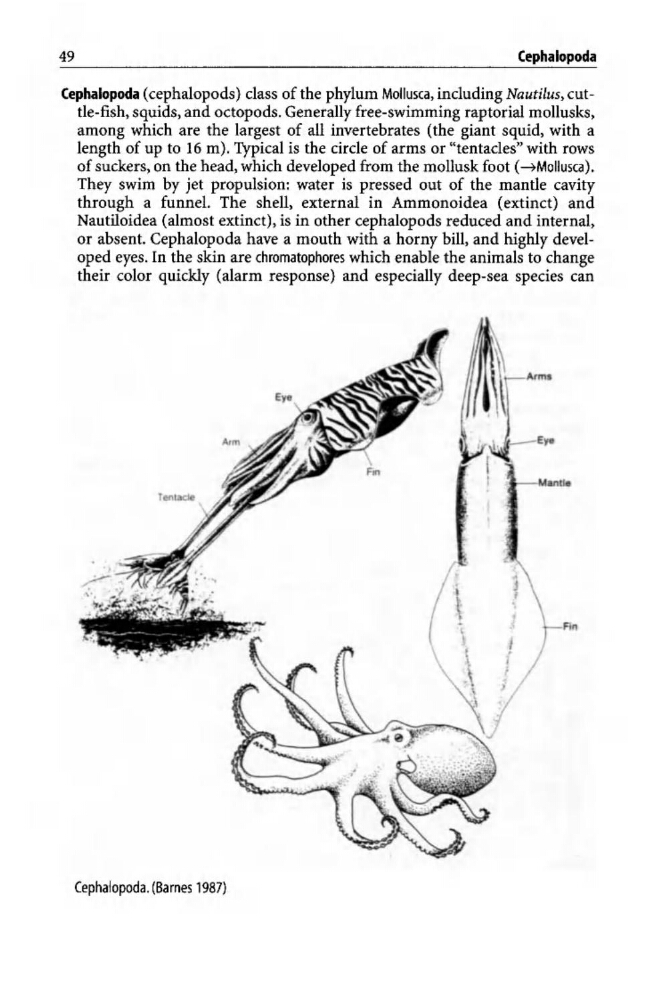
Cephalopoda. (Barnes 1987)
Cephalopoda
Cephalopoda (cephalopods) class of the phylum Mollusca, including Nautilus, cuttle-fish, squids, and octopods. Generally free-swimming raptorial mollusks,
among which are the largest of all invertebrates (the giant squid, with a
length of up to 16 m). Typical is the circle of arms or "tentacles" with rows
of suckers, on the head, which developed from the mollusk foot (~Mollusca).
They swim by jet propulsion: water is pressed out of the mantle cavity
through a funnel. The shell, external in Ammonoidea (extinct) and
Nautiloidea (almost extinct), is in other cephalopods reduced and internal,
or absent. Cephalopoda have a mouth with a horny bill, and highly developed eyes. In the skin are chromatophores which enable the animals to change
their color quickly (alarm response) and especially deep-sea species can
fin
Cephalopoda. (Barnes 1987)