

39
buoyancy
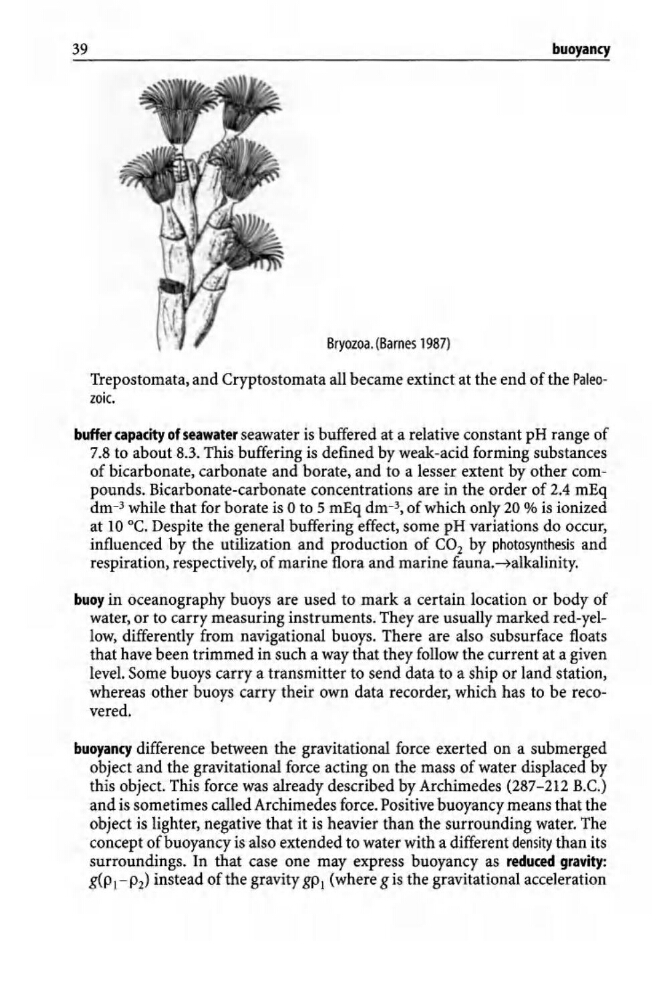
Bryozoa. (Barnes 1987)
Trepostomata, and Cryptostomata all became extinct at the end of the Paleozoic.
buffer capacity of seawater seawater is buffered at a relative constant pH range of
7.8 to about 8.3. This buffering is defined by weak-acid forming substances
of bicarbonate, carbonate and borate, and to a lesser extent by other compounds. Bicarbonate-carbonate concentrations are in the order of 2.4 mEq
dm- 3 while that for borate is 0 to 5 mEq dm- 3 , of which only 20 % is ionized
at 10°C. Despite the general buffering effect, some pH variations do occur,
influenced by the utilization and production of CO 2 by photosynthesis and
respiration, respectively, of marine flora and marine fauna. ~alkalinity.
buoy in oceanography buoys are used to mark a certain location or body of
water, or to carry measuring instruments. They are usually marked red-yellow, differently from navigational buoys. There are also subsurface floats
that have been trimmed in such a way that they follow the current at a given
level. Some buoys carry a transmitter to send data to a ship or land station,
whereas other buoys carry their own data recorder, which has to be recovered.
buoyancy difference between the gravitational force exerted on a submerged
object and the gravitational force acting on the mass of water displaced by
this object. This force was already described by Archimedes (287-212 B.C.)
and is sometimes called Archimedes force. Positive buoyancy means that the
object is lighter, negative that it is heavier than the surrounding water. The
concept of buoyancy is also extended to water with a different density than its
surroundings. In that case one may express buoyancy as reduced gravity:
g(Pl- P2) instead ofthe gravity gPI (where g is the gravitational acceleration
buoyancy
Bryozoa. (Barnes 1987)
Trepostomata, and Cryptostomata all became extinct at the end of the Paleozoic.
buffer capacity of seawater seawater is buffered at a relative constant pH range of
7.8 to about 8.3. This buffering is defined by weak-acid forming substances
of bicarbonate, carbonate and borate, and to a lesser extent by other compounds. Bicarbonate-carbonate concentrations are in the order of 2.4 mEq
dm- 3 while that for borate is 0 to 5 mEq dm- 3 , of which only 20 % is ionized
at 10°C. Despite the general buffering effect, some pH variations do occur,
influenced by the utilization and production of CO 2 by photosynthesis and
respiration, respectively, of marine flora and marine fauna. ~alkalinity.
buoy in oceanography buoys are used to mark a certain location or body of
water, or to carry measuring instruments. They are usually marked red-yellow, differently from navigational buoys. There are also subsurface floats
that have been trimmed in such a way that they follow the current at a given
level. Some buoys carry a transmitter to send data to a ship or land station,
whereas other buoys carry their own data recorder, which has to be recovered.
buoyancy difference between the gravitational force exerted on a submerged
object and the gravitational force acting on the mass of water displaced by
this object. This force was already described by Archimedes (287-212 B.C.)
and is sometimes called Archimedes force. Positive buoyancy means that the
object is lighter, negative that it is heavier than the surrounding water. The
concept of buoyancy is also extended to water with a different density than its
surroundings. In that case one may express buoyancy as reduced gravity:
g(Pl- P2) instead ofthe gravity gPI (where g is the gravitational acceleration