

329
turbidity
auriculae, ear-shaped organs. The intestine is a blind sac, the mouth is for
both ingestion and egestion. Most are bottom dwellers, and they can form a
substantial part of the meiobenthos.They feed on dead animals or are predators feeding on small Invertebrata, some on algae. They are common in marine
and freshwater, but due to their small size and difficult preservation, are
often overlooked. Some larger species are very colorful, and can be confused
with Nudibranchia.
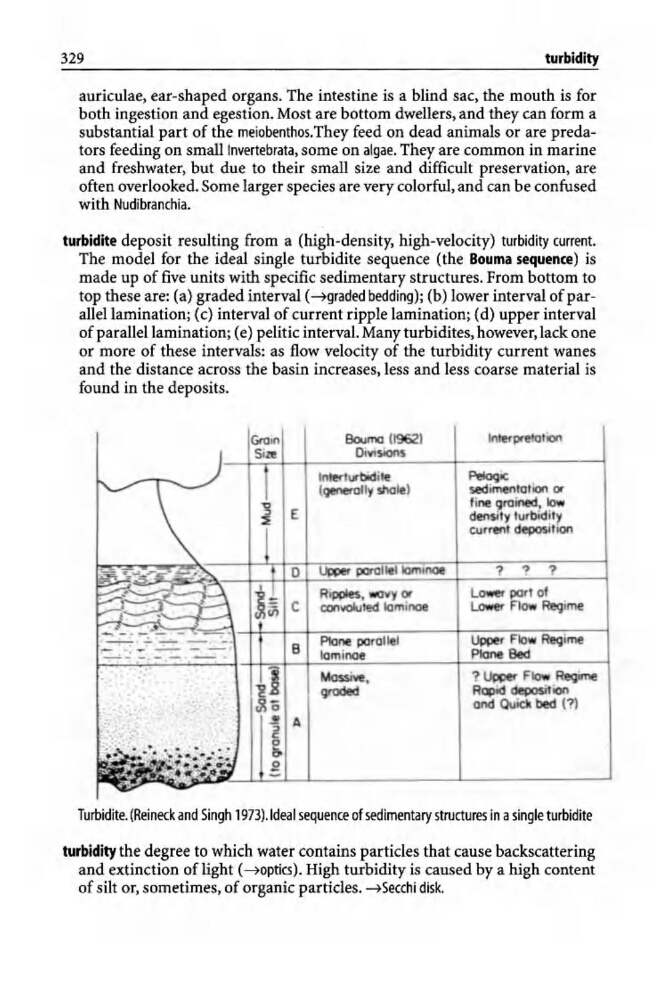
turbidite deposit resulting from a (high-density, high-velocity) turbidity current.
The model for the ideal single turbidite sequence (the Bouma sequence) is
made up of five units with specific sedimentary structures. From bottom to
top these are: (a) graded interval (~graded bedding); (b) lower interval of parallellamination; (c) interval of current ripple lamination; (d) upper interval
of parallel lamination; (e) pelitic interval. Many turbidites, however, lack one
or more of these intervals: as flow velocity of the turbidity current wanes
and the distance across the basin increases, less and less coarse material is
found in the deposits.
[)
C
B
~]
~o
'.
. • _ • :",:.::t
. . A
"5
c:
0
e;.
J!.
Soumo (
[)hnsions
Inlerlurbidile
(generally shale)
Upper parollellaminoe
Ripples, wavy 01
canllOluled lam inae
Plane porallel
laminae
Mossiw,
graded
In erprelation
PekJgIC
sedimentation 01
line grained, low
deosity lurbidity
current deposihan
? ? ?
Lower port al
Lower Flow RegIme
Upper Flaw Regime
Plane Bed
? Uppef F
R4!9H"11e
Rapid deposit ion
and Quick bed (?)
Turbidite. (Reineck and Singh 1973). Ideal sequence of sedimentary structures in a single turbidite
turbidity the degree to which water contains particles that cause backscattering
and extinction of light (~optics) . High turbidity is caused by a high content
of silt or, sometimes, of organic particles. ~Secchi disk.
turbidity
auriculae, ear-shaped organs. The intestine is a blind sac, the mouth is for
both ingestion and egestion. Most are bottom dwellers, and they can form a
substantial part of the meiobenthos.They feed on dead animals or are predators feeding on small Invertebrata, some on algae. They are common in marine
and freshwater, but due to their small size and difficult preservation, are
often overlooked. Some larger species are very colorful, and can be confused
with Nudibranchia.
turbidite deposit resulting from a (high-density, high-velocity) turbidity current.
The model for the ideal single turbidite sequence (the Bouma sequence) is
made up of five units with specific sedimentary structures. From bottom to
top these are: (a) graded interval (~graded bedding); (b) lower interval of parallellamination; (c) interval of current ripple lamination; (d) upper interval
of parallel lamination; (e) pelitic interval. Many turbidites, however, lack one
or more of these intervals: as flow velocity of the turbidity current wanes
and the distance across the basin increases, less and less coarse material is
found in the deposits.
[)
C
B
~]
~o
'.
. • _ • :",:.::t
. . A
"5
c:
0
e;.
J!.
Soumo (
[)hnsions
Inlerlurbidile
(generally shale)
Upper parollellaminoe
Ripples, wavy 01
canllOluled lam inae
Plane porallel
laminae
Mossiw,
graded
In erprelation
PekJgIC
sedimentation 01
line grained, low
deosity lurbidity
current deposihan
? ? ?
Lower port al
Lower Flow RegIme
Upper Flaw Regime
Plane Bed
? Uppef F
R4!9H"11e
Rapid deposit ion
and Quick bed (?)
Turbidite. (Reineck and Singh 1973). Ideal sequence of sedimentary structures in a single turbidite
turbidity the degree to which water contains particles that cause backscattering
and extinction of light (~optics) . High turbidity is caused by a high content
of silt or, sometimes, of organic particles. ~Secchi disk.