

slush
298
slush ~ice.
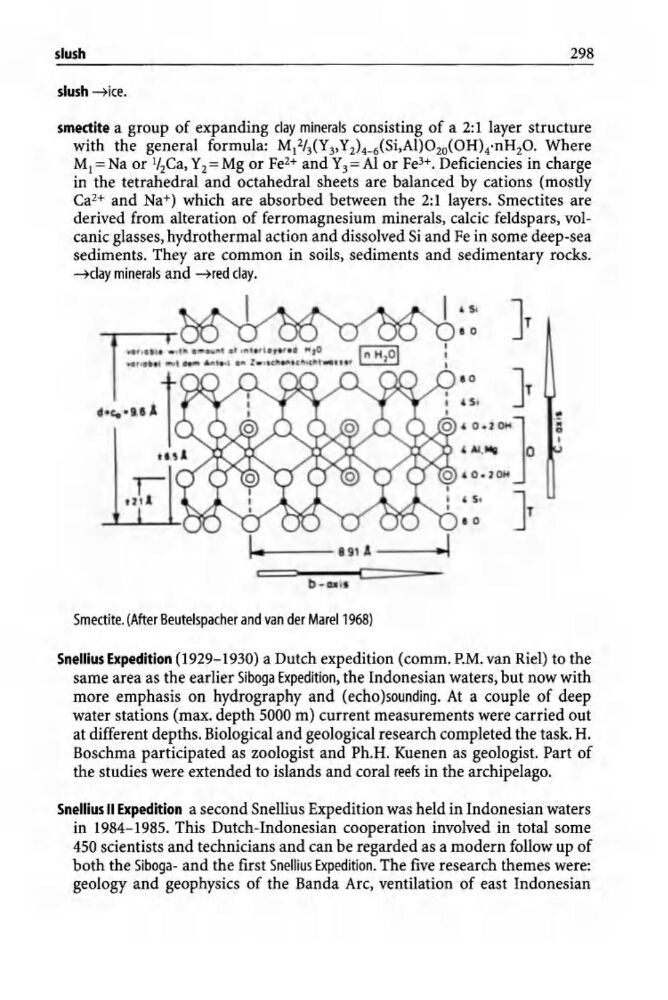
smectite a group of expanding clay minerals consisting of a 2:1 layer structure
with the general formula: M12/3(Y3'Y2)4_6(Si,Al)02o(OH)4·nH20. Where
Ml =Na or 1/2Ca, Y2=Mg or Fe 2 + and Y 3 =Al or Fe3+. Deficiencies in charge
in the tetrahedral and octahedral sheets are balanced by cations (mostly
Ca2+ and Na+) which are absorbed between the 2:1 layers. Smectites are
derived from alteration of ferromagnesium minerals, calcic feldspars, volcanic glasses, hydrothermal action and dissolved Si and Fe in some deep-sea
sediments. They are common in soils, sediments and sedimentary rocks.
~clay minerals and ~red clay.
1 ... .. - - - - 891 A ---~
b om ... C
Smectite. (After Beutelspacher and van der Marel1968)
, 5 •
JT
• 0
to
}
, s.
".'~J ,AI..... 0
'O.lOH
, S •
}
• 0
- ;; " I
Snellius Expedition (1929-1930) a Dutch expedition (comm. P.M. van Riel) to the
same area as the earlier Siboga Expedition, the Indonesian waters, but now with
more emphasis on hydrography and (echo)sounding. At a couple of deep
water stations (max. depth 5000 m) current measurements were carried out
at different depths. Biological and geological research completed the task. H.
Boschma participated as zoologist and Ph.H. Kuenen as geologist. Part of
the studies were extended to islands and coral reefs in the archipelago.
Snellius II Expedition a second Snellius Expedition was held in Indonesian waters
in 1984-1985. This Dutch-Indonesian cooperation involved in total some
450 scientists and technicians and can be regarded as a modern follow up of
both the Siboga- and the first Snellius Expedition. The five research themes were:
geology and geophysics of the Banda Arc, ventilation of east Indonesian
298
slush ~ice.
smectite a group of expanding clay minerals consisting of a 2:1 layer structure
with the general formula: M12/3(Y3'Y2)4_6(Si,Al)02o(OH)4·nH20. Where
Ml =Na or 1/2Ca, Y2=Mg or Fe 2 + and Y 3 =Al or Fe3+. Deficiencies in charge
in the tetrahedral and octahedral sheets are balanced by cations (mostly
Ca2+ and Na+) which are absorbed between the 2:1 layers. Smectites are
derived from alteration of ferromagnesium minerals, calcic feldspars, volcanic glasses, hydrothermal action and dissolved Si and Fe in some deep-sea
sediments. They are common in soils, sediments and sedimentary rocks.
~clay minerals and ~red clay.
1 ... .. - - - - 891 A ---~
b om ... C
Smectite. (After Beutelspacher and van der Marel1968)
, 5 •
JT
• 0
to
}
, s.
".'~J ,AI..... 0
'O.lOH
, S •
}
• 0
- ;; " I
Snellius Expedition (1929-1930) a Dutch expedition (comm. P.M. van Riel) to the
same area as the earlier Siboga Expedition, the Indonesian waters, but now with
more emphasis on hydrography and (echo)sounding. At a couple of deep
water stations (max. depth 5000 m) current measurements were carried out
at different depths. Biological and geological research completed the task. H.
Boschma participated as zoologist and Ph.H. Kuenen as geologist. Part of
the studies were extended to islands and coral reefs in the archipelago.
Snellius II Expedition a second Snellius Expedition was held in Indonesian waters
in 1984-1985. This Dutch-Indonesian cooperation involved in total some
450 scientists and technicians and can be regarded as a modern follow up of
both the Siboga- and the first Snellius Expedition. The five research themes were:
geology and geophysics of the Banda Arc, ventilation of east Indonesian