

287
sediment transport
sediment-gravity flow mass movement of sediment induced by gravity. Four
main types are distinguished on the basis of the internal support of the sediment within the flow; (a) debris flow: grains are supported by a dense mixture of water and clay with a finite cohesion; (b) fluidized sediment flow (often
loosely packed sand): grains are supported by the pore fluid within the sediment (as a result of upward flow of fluid), causing sediment to move downslope (even on gentle slopes) as a traction carpet; (c) grain flow: the sediment
is supported by direct grain to grain interactions; (d) the turbidite: the sediment is supported by the turbulent flow of water, ~turbidity current.
sediment ridge ~sediment drift.
sediment transport individual particles can be transported in three different
ways: (a) traction (rolling/sliding; Le., constantly in contact with the bottom;
(b) saltation (jumping; Le., with intermittent contact); and (c) in suspension
(no contact with the bottom); corresponding sediment load classifications
are bedload, saltation load, and suspension load. Subaqueous mass movements of sediment include, for instance, sediment-gravity flows, turbidites, rockfalls, and slumps. Slumping is a relatively common phenomenon that occurs
when a slope becomes unstable: sediment slides down the slope (usually
along a curved shear plane) as a more or less consistent mass. Besides these
types there is marine glacial transport, in which (often coarse-grained) sediment is transported by ice drifts, and eolian transport, which is not strictly
speaking marine transport, ~dust.
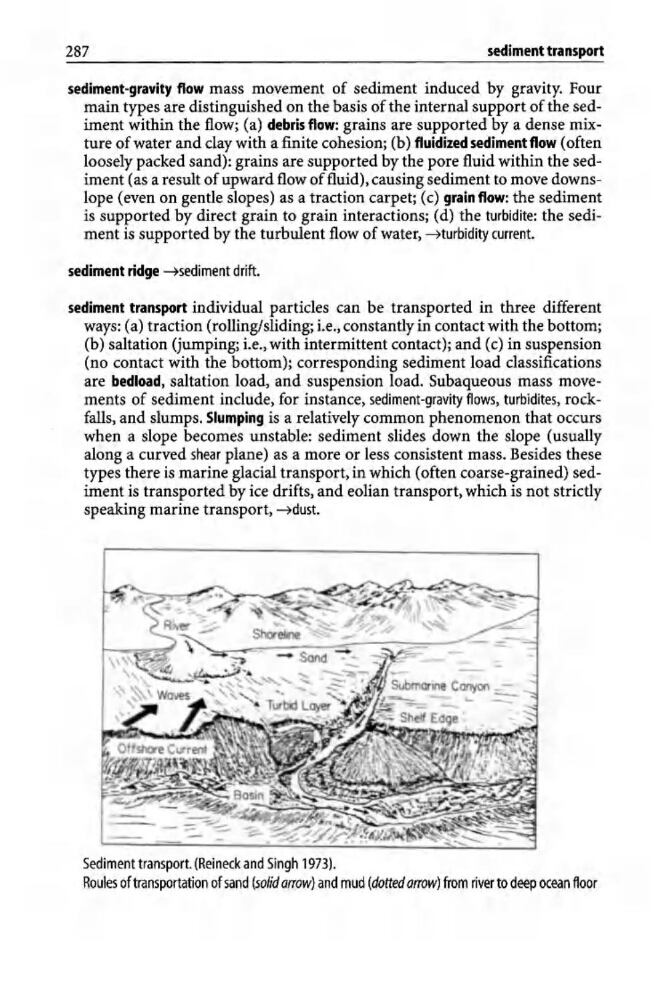
Sediment transport. (Reineck and Singh 1973).
Roules of transportation of sand (solid arrow) and mud (dotted arrow) from river to deep ocean floor
sediment transport
sediment-gravity flow mass movement of sediment induced by gravity. Four
main types are distinguished on the basis of the internal support of the sediment within the flow; (a) debris flow: grains are supported by a dense mixture of water and clay with a finite cohesion; (b) fluidized sediment flow (often
loosely packed sand): grains are supported by the pore fluid within the sediment (as a result of upward flow of fluid), causing sediment to move downslope (even on gentle slopes) as a traction carpet; (c) grain flow: the sediment
is supported by direct grain to grain interactions; (d) the turbidite: the sediment is supported by the turbulent flow of water, ~turbidity current.
sediment ridge ~sediment drift.
sediment transport individual particles can be transported in three different
ways: (a) traction (rolling/sliding; Le., constantly in contact with the bottom;
(b) saltation (jumping; Le., with intermittent contact); and (c) in suspension
(no contact with the bottom); corresponding sediment load classifications
are bedload, saltation load, and suspension load. Subaqueous mass movements of sediment include, for instance, sediment-gravity flows, turbidites, rockfalls, and slumps. Slumping is a relatively common phenomenon that occurs
when a slope becomes unstable: sediment slides down the slope (usually
along a curved shear plane) as a more or less consistent mass. Besides these
types there is marine glacial transport, in which (often coarse-grained) sediment is transported by ice drifts, and eolian transport, which is not strictly
speaking marine transport, ~dust.
Sediment transport. (Reineck and Singh 1973).
Roules of transportation of sand (solid arrow) and mud (dotted arrow) from river to deep ocean floor