

sediment drift
286
STREAM POWEfl
~.O
~
ANTIllJIIES
~
RAPID FLOW
,o~~.~x;'V~ LowJRE~
LFLOWI
-""'-"'-'- -
0 .01
0 .1
;:.::::::=
I
MEGA RIPPLES
~ I~;
; _ _
PLME BED
-- o ~ SMALL R1PPL£S
o
o_ z
0-4
0 .6
0.8
mm
MEDIAN FALL DIAMETER
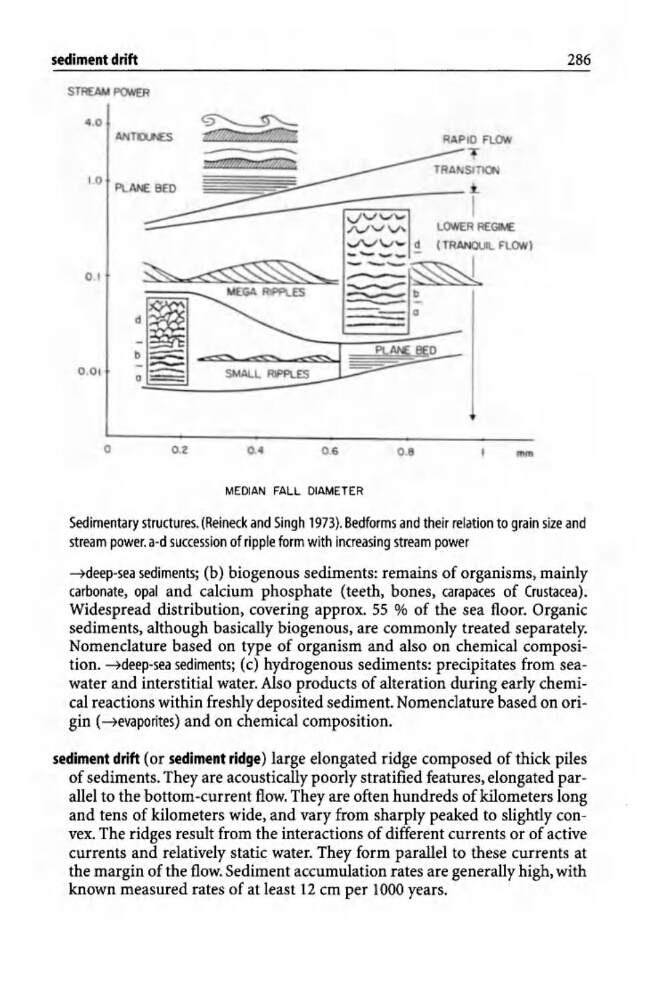
Sedimentary structures. (Reineck and Singh 1973). Bedforms and their relation to grain size and
stream power. a-d succession of ripple form with increasing stream power
-tdeep-sea sediments; (b) biogenous sediments: remains of organisms, mainly
carbonate, opal and calcium phosphate (teeth, bones, carapaces of Crustacea).
Widespread distribution, covering approx. SS % of the sea floor. Organic
sediments, although basically biogenous, are commonly treated separately.
Nomenclature based on type of organism and also on chemical composition. -tdeep-sea sediments; (c) hydrogenous sediments: precipitates from seawater and interstitial water. Also products of alteration during early chemical reactions within freshly deposited sediment. Nomenclature based on origin (-tevaporites) and on chemical composition.
sediment drift (or sediment ridge) large elongated ridge composed of thick piles
of sediments. They are acoustically poorly stratified features, elongated parallel to the bottom-current flow. They are often hundreds of kilometers long
and tens of kilometers wide, and vary from sharply peaked to slightly convex. The ridges result from the interactions of different currents or of active
currents and relatively static water. They form parallel to these currents at
the margin of the flow. Sediment accumulation rates are generally high, with
known measured rates of at least 12 cm per 1000 years.
286
STREAM POWEfl
~.O
~
ANTIllJIIES
~
RAPID FLOW
,o~~.~x;'V~ LowJRE~
LFLOWI
-""'-"'-'- -
0 .01
0 .1
;:.::::::=
I
MEGA RIPPLES
~ I~;
; _ _
PLME BED
-- o ~ SMALL R1PPL£S
o
o_ z
0-4
0 .6
0.8
mm
MEDIAN FALL DIAMETER
Sedimentary structures. (Reineck and Singh 1973). Bedforms and their relation to grain size and
stream power. a-d succession of ripple form with increasing stream power
-tdeep-sea sediments; (b) biogenous sediments: remains of organisms, mainly
carbonate, opal and calcium phosphate (teeth, bones, carapaces of Crustacea).
Widespread distribution, covering approx. SS % of the sea floor. Organic
sediments, although basically biogenous, are commonly treated separately.
Nomenclature based on type of organism and also on chemical composition. -tdeep-sea sediments; (c) hydrogenous sediments: precipitates from seawater and interstitial water. Also products of alteration during early chemical reactions within freshly deposited sediment. Nomenclature based on origin (-tevaporites) and on chemical composition.
sediment drift (or sediment ridge) large elongated ridge composed of thick piles
of sediments. They are acoustically poorly stratified features, elongated parallel to the bottom-current flow. They are often hundreds of kilometers long
and tens of kilometers wide, and vary from sharply peaked to slightly convex. The ridges result from the interactions of different currents or of active
currents and relatively static water. They form parallel to these currents at
the margin of the flow. Sediment accumulation rates are generally high, with
known measured rates of at least 12 cm per 1000 years.