

245
Porifera (sponges)
populations only the adults have reproductive capacities. An important property of such a population is its generation time: the time between the appearance (birth) of the most juvenile stage and the moment that this cohort of
organisms has reached the adult stage and has produced offspring.
population parameters (1) (math.) describe the properties of a mathematically
defined population and include population mean (~), variance (S2) and standard deviation (s). Variance and standard deviation are a measure of variability in the population. Population parameters can be estimated by corresponding statistics (---7statistics); (2) (bioi.) the specific values which characterize a population in time and space. They concern density or abundance, age
distribution, birth rate or natality, death rate or mortality, and carrying capacity.
Porcupine Expeditions (1869 and 1870) a follow-up of the Lightning Expedition of 1868,
cruising in 1869 between Scotland and Rockall under scientific command of
Gwyn Jeffreys, a well-known malacologist and benthic dredger. The dredge
was successfully used down to 1476 fathoms. A second cruise in 1869 under command ofWyville Thomson dredged down to 2435 fathoms in the Bay of Biscay
and abundant and divers life was found in the deepest dredge -haul up to then.
In 1879 the Porcupine cruised the Mediterranean; dredging results were poor,
leading to the belief that the deeper Mediterranean was nearly azoic, as
observed already by Forbes during the Aegean Sea Expedition (1840-1841).
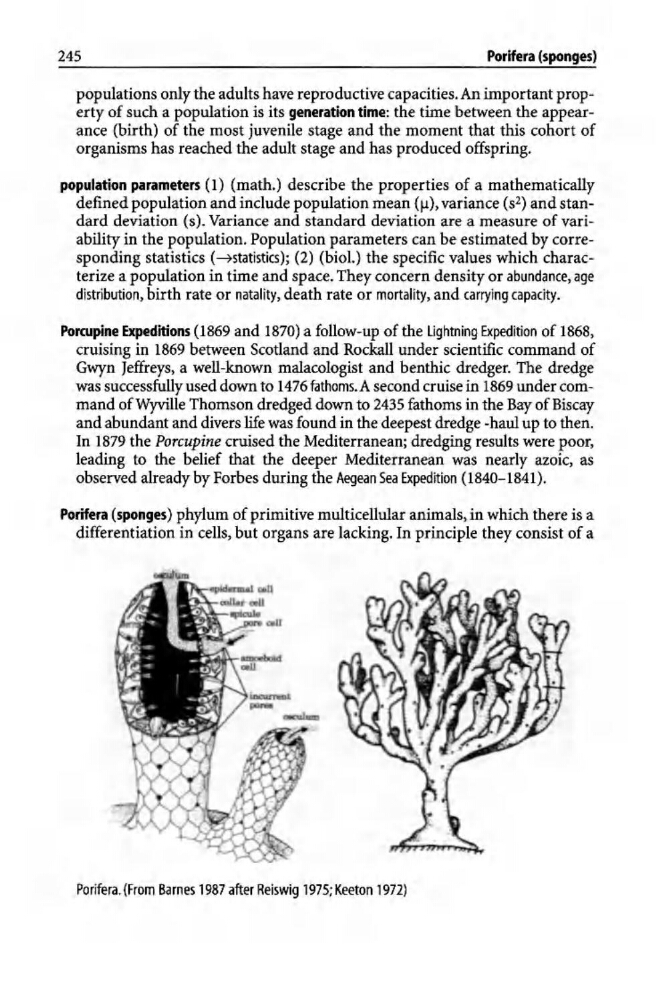
Porifera (sponges) phylum of primitive multicellular animals, in which there is a
differentiation in cells, but organs are lacking. In principle they consist of a
Porifera. (From Barnes 1987 after Reiswig 1975; Keeton 1972)
Porifera (sponges)
populations only the adults have reproductive capacities. An important property of such a population is its generation time: the time between the appearance (birth) of the most juvenile stage and the moment that this cohort of
organisms has reached the adult stage and has produced offspring.
population parameters (1) (math.) describe the properties of a mathematically
defined population and include population mean (~), variance (S2) and standard deviation (s). Variance and standard deviation are a measure of variability in the population. Population parameters can be estimated by corresponding statistics (---7statistics); (2) (bioi.) the specific values which characterize a population in time and space. They concern density or abundance, age
distribution, birth rate or natality, death rate or mortality, and carrying capacity.
Porcupine Expeditions (1869 and 1870) a follow-up of the Lightning Expedition of 1868,
cruising in 1869 between Scotland and Rockall under scientific command of
Gwyn Jeffreys, a well-known malacologist and benthic dredger. The dredge
was successfully used down to 1476 fathoms. A second cruise in 1869 under command ofWyville Thomson dredged down to 2435 fathoms in the Bay of Biscay
and abundant and divers life was found in the deepest dredge -haul up to then.
In 1879 the Porcupine cruised the Mediterranean; dredging results were poor,
leading to the belief that the deeper Mediterranean was nearly azoic, as
observed already by Forbes during the Aegean Sea Expedition (1840-1841).
Porifera (sponges) phylum of primitive multicellular animals, in which there is a
differentiation in cells, but organs are lacking. In principle they consist of a
Porifera. (From Barnes 1987 after Reiswig 1975; Keeton 1972)