

polysaccharides
244
I •
.... 11
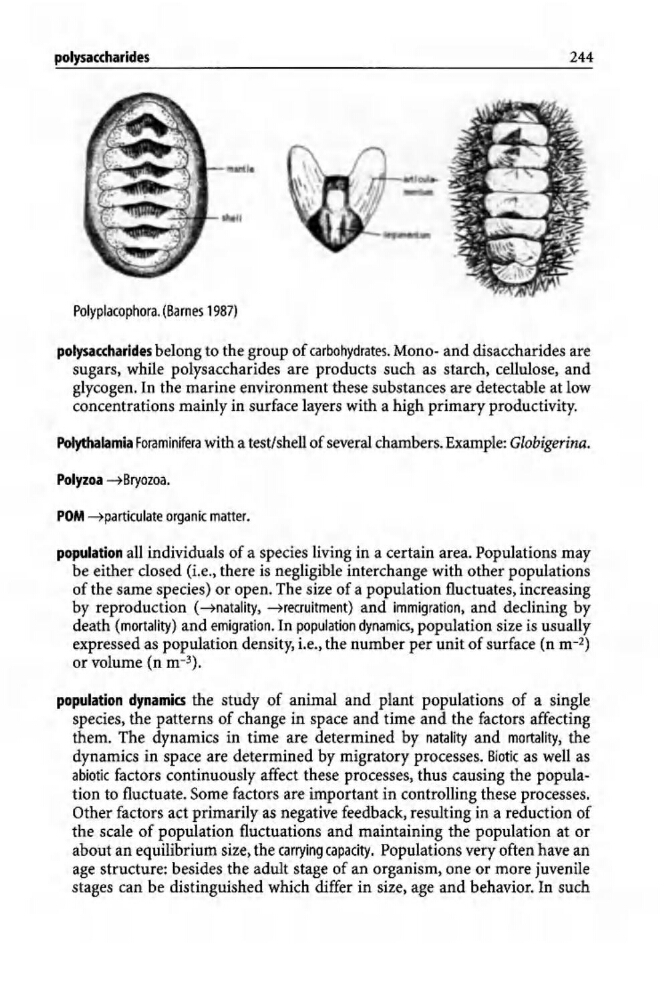
Polyplacophora. (Barnes 1987)
polysaccharides belong to the group of carbohydrates. Mono- and disaccharides are
sugars, while polysaccharides are products such as starch, cellulose, and
glycogen. In the marine environment these substances are detectable at low
concentrations mainly in surface layers with a high primary productivity.
Polythalamia Foraminifera with a test/shell of several chambers. Example: Globigerina.
Polyzoa -tBryozoa.
POM -tparticulate organic matter.
population all individuals of a species living in a certain area. Populations may
be either closed (i.e., there is negligible interchange with other populations
of the same species) or open. The size of a population fluctuates, increasing
by reproduction (-tnatality, -trecruitment) and immigration, and declining by
death (mortality) and emigration. In population dynamics, population size is usually
expressed as population density, i.e., the number per unit of surface (n m- 2 )
or volume (n m-3).
population dynamics the study of animal and plant populations of a single
species, the patterns of change in space and time and the factors affecting
them. The dynamics in time are determined by natality and mortality, the
dynamics in space are determined by migratory processes. Biotic as well as
abiotic factors continuously affect these processes, thus causing the population to fluctuate. Some factors are important in controlling these processes.
Other factors act primarily as negative feedback, resulting in a reduction of
the scale of population fluctuations and maintaining the population at or
about an equilibrium size, the carrying capacity. Populations very often have an
age structure: besides the adult stage of an organism, one or more juvenile
stages can be distinguished which differ in size, age and behavior. In such
244
I •
.... 11
Polyplacophora. (Barnes 1987)
polysaccharides belong to the group of carbohydrates. Mono- and disaccharides are
sugars, while polysaccharides are products such as starch, cellulose, and
glycogen. In the marine environment these substances are detectable at low
concentrations mainly in surface layers with a high primary productivity.
Polythalamia Foraminifera with a test/shell of several chambers. Example: Globigerina.
Polyzoa -tBryozoa.
POM -tparticulate organic matter.
population all individuals of a species living in a certain area. Populations may
be either closed (i.e., there is negligible interchange with other populations
of the same species) or open. The size of a population fluctuates, increasing
by reproduction (-tnatality, -trecruitment) and immigration, and declining by
death (mortality) and emigration. In population dynamics, population size is usually
expressed as population density, i.e., the number per unit of surface (n m- 2 )
or volume (n m-3).
population dynamics the study of animal and plant populations of a single
species, the patterns of change in space and time and the factors affecting
them. The dynamics in time are determined by natality and mortality, the
dynamics in space are determined by migratory processes. Biotic as well as
abiotic factors continuously affect these processes, thus causing the population to fluctuate. Some factors are important in controlling these processes.
Other factors act primarily as negative feedback, resulting in a reduction of
the scale of population fluctuations and maintaining the population at or
about an equilibrium size, the carrying capacity. Populations very often have an
age structure: besides the adult stage of an organism, one or more juvenile
stages can be distinguished which differ in size, age and behavior. In such