

aphotic zone
14
aphotic zone ocean layer deeper than where enough sunlight for photosynthesis
can penetrate. Begins, depending on the turbidity, at a depth of several meters
(coastal) to several hundred meters (open ocean).
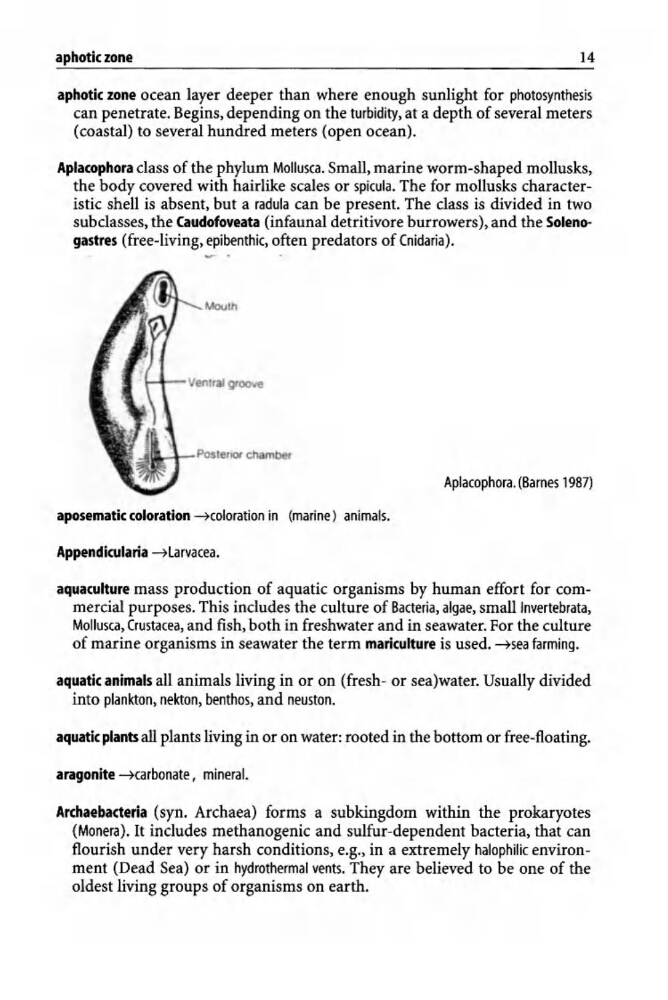
Aplacophora class of the phylum Mollusca. Small, marine worm-shaped mollusks,
the body covered with hairlike scales or spicula. The for mollusks characteristic shell is absent, but a radula can be present. The class is divided in two
subclasses, the Caudofoveata (infaunal detritivore burrowers), and the Solenogastres (free-living, epibenthic, often predators of Cnidaria).
Aplacophora. (Barnes 1987)
aposematic coloration --7coloration in (marine) animals.
Appendicularia --7Larvacea.
aquaculture mass production of aquatic organisms by human effort for commercial purposes. This includes the culture of Bacteria, algae, small Invertebrata,
Mollusca, Crustacea, and fish, both in freshwater and in seawater. For the culture
of marine organisms in seawater the term mariculture is used. --7sea farming.
aquatic animals all animals living in or on (fresh- or sea)water. Usually divided
into plankton, nekton, benthos, and neuston.
aquatic plants all plants living in or on water: rooted in the bottom or free-floating.
aragonite --7carbonate, mineral.
Archaebacteria (syn. Archaea) forms a subkingdom within the prokaryotes
(Monera). It includes methanogenic and sulfur-dependent bacteria, that can
flourish under very harsh conditions, e.g., in a extremely halophilic environment (Dead Sea) or in hydrothermal vents. They are believed to be one of the
oldest living groups of organisms on earth.
14
aphotic zone ocean layer deeper than where enough sunlight for photosynthesis
can penetrate. Begins, depending on the turbidity, at a depth of several meters
(coastal) to several hundred meters (open ocean).
Aplacophora class of the phylum Mollusca. Small, marine worm-shaped mollusks,
the body covered with hairlike scales or spicula. The for mollusks characteristic shell is absent, but a radula can be present. The class is divided in two
subclasses, the Caudofoveata (infaunal detritivore burrowers), and the Solenogastres (free-living, epibenthic, often predators of Cnidaria).
Aplacophora. (Barnes 1987)
aposematic coloration --7coloration in (marine) animals.
Appendicularia --7Larvacea.
aquaculture mass production of aquatic organisms by human effort for commercial purposes. This includes the culture of Bacteria, algae, small Invertebrata,
Mollusca, Crustacea, and fish, both in freshwater and in seawater. For the culture
of marine organisms in seawater the term mariculture is used. --7sea farming.
aquatic animals all animals living in or on (fresh- or sea)water. Usually divided
into plankton, nekton, benthos, and neuston.
aquatic plants all plants living in or on water: rooted in the bottom or free-floating.
aragonite --7carbonate, mineral.
Archaebacteria (syn. Archaea) forms a subkingdom within the prokaryotes
(Monera). It includes methanogenic and sulfur-dependent bacteria, that can
flourish under very harsh conditions, e.g., in a extremely halophilic environment (Dead Sea) or in hydrothermal vents. They are believed to be one of the
oldest living groups of organisms on earth.