

181
Lotka-Volterra equations
D is the depth. Differences in depth cause variations in the velocity and long
waves are therefore refracted by topography. For many long waves, having
wave lengths of the deformation radius, the effect of the Coriolis force cannot be
neglected, and this causes different types of waves such as Kelvin waves and
Sverdrup waves.
lophophore a food-catching tentacular organ present in four phyla (Bryozoa, Entoprocta, Phoronida, and Brachiopoda), often grouped together as the Lophophorata.
It is a circular or horseshoe-shaped fold of the body wall, that encircles the
mouth and bears numerous ciliated tentacles.
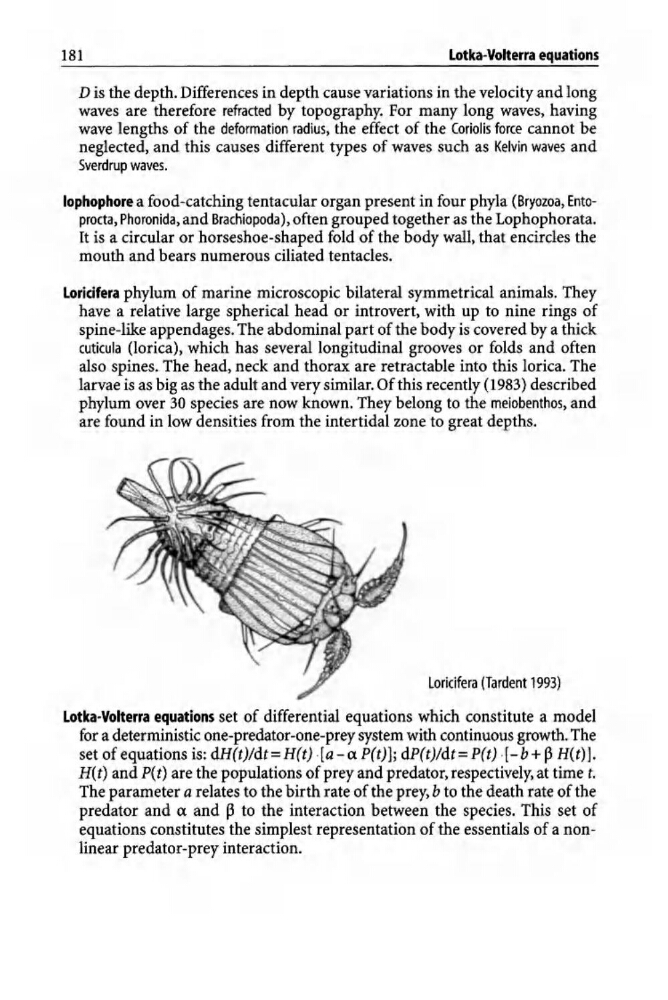
Loricifera phylum of marine microscopic bilateral symmetrical animals. They
have a relative large spherical head or introvert, with up to nine rings of
spine-like appendages. The abdominal part of the body is covered by a thick
cuticula (lorica), which has several longitudinal grooves or folds and often
also spines. The head, neck and thorax are retractable into this lorica. The
larvae is as big as the adult and very similar. Of this recently (1983) described
phylum over 30 species are now known. They belong to the meiobenthos, and
are found in low densities from the intertidal zone to great depths.
Loricifera (Tardent 1993)
Lotka-Volterra equations set of differential equations which constitute a model
for a deterministic one-predator-one-prey system with continuous growth. The
set of equations is: dH(t)ldt= H(t) [a - a p(t)]; dP(t)ldt= P(t)[- b+ ~ H(t)].
H(t) and P(t) are the populations of prey and predator, respectively, at time t.
The parameter a relates to the birth rate of the prey, b to the death rate of the
predator and a and ~ to the interaction between the species. This set of
equations constitutes the simplest representation of the essentials of a nonlinear predator-prey interaction.
Lotka-Volterra equations
D is the depth. Differences in depth cause variations in the velocity and long
waves are therefore refracted by topography. For many long waves, having
wave lengths of the deformation radius, the effect of the Coriolis force cannot be
neglected, and this causes different types of waves such as Kelvin waves and
Sverdrup waves.
lophophore a food-catching tentacular organ present in four phyla (Bryozoa, Entoprocta, Phoronida, and Brachiopoda), often grouped together as the Lophophorata.
It is a circular or horseshoe-shaped fold of the body wall, that encircles the
mouth and bears numerous ciliated tentacles.
Loricifera phylum of marine microscopic bilateral symmetrical animals. They
have a relative large spherical head or introvert, with up to nine rings of
spine-like appendages. The abdominal part of the body is covered by a thick
cuticula (lorica), which has several longitudinal grooves or folds and often
also spines. The head, neck and thorax are retractable into this lorica. The
larvae is as big as the adult and very similar. Of this recently (1983) described
phylum over 30 species are now known. They belong to the meiobenthos, and
are found in low densities from the intertidal zone to great depths.
Loricifera (Tardent 1993)
Lotka-Volterra equations set of differential equations which constitute a model
for a deterministic one-predator-one-prey system with continuous growth. The
set of equations is: dH(t)ldt= H(t) [a - a p(t)]; dP(t)ldt= P(t)[- b+ ~ H(t)].
H(t) and P(t) are the populations of prey and predator, respectively, at time t.
The parameter a relates to the birth rate of the prey, b to the death rate of the
predator and a and ~ to the interaction between the species. This set of
equations constitutes the simplest representation of the essentials of a nonlinear predator-prey interaction.