

149
Hemichordata
Heincke's law empirical relation, formulated in 1913 by the German marine biologist Heincke (1852-1929), relating the distribution of a fish species with
water depth. According to Heincke's law the size of the individuals of a certain fish species increases with increasing water depth and distance from the
coast. Based on studies of the Dutch marine biologist Redeke (1873-1945)
published in 1904.
Heliozoa class of the phylum Actinopoda of the kingdom Protoctista (formerly seen
as an order of the subphylum Sarcodina of the Protozoa). Spherical predaceous
heterotrophic unicellular organisms, primarily living in freshwater.
Characteristic are the needle-like pseudopodia, radiating from the cell.
Sometimes with skeleton of siliceous material. In freshwater as well as in
marine habitats they are recorded from polar to subtropical regions, and
they live planktonic or benthic in shallow water.
Hemichordata phylum of marine benthic worm-like animals. It forms, together
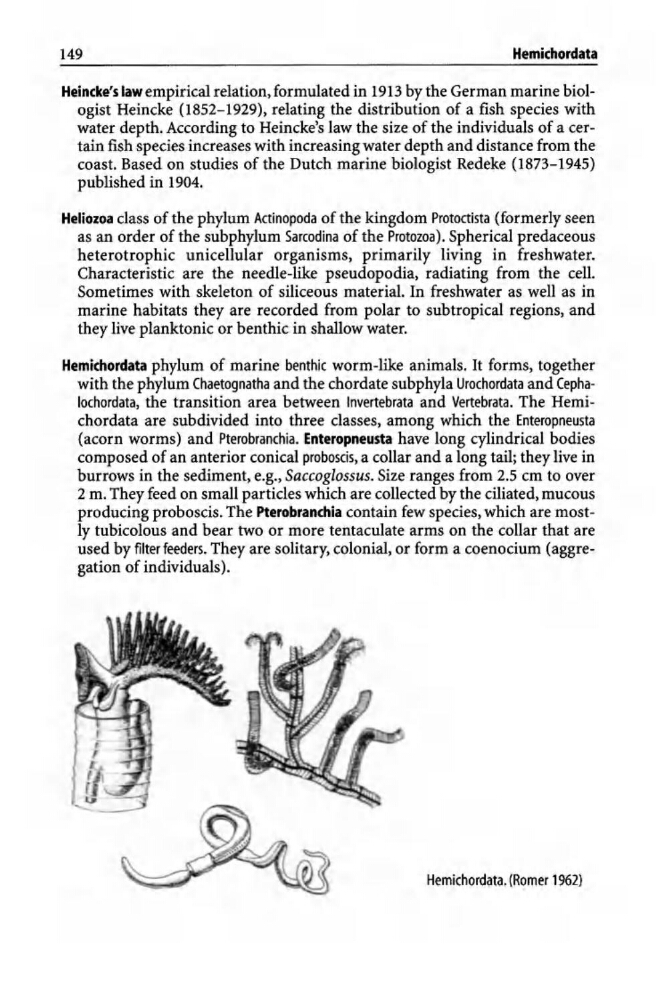
with the phylum Chaetognatha and the chordate subphyla Urochordata and Cephalochordata, the transition area between Invertebrata and Vertebrata. The Hemichordata are subdivided into three classes, among which the Enteropneusta
(acorn worms) and Pterobranchia. Enteropneusta have long cylindrical bodies
composed of an anterior conical proboscis, a collar and a long tail; they live in
burrows in the sediment, e.g., Saccoglossus. Size ranges from 2.5 cm to over
2 m. They feed on small particles which are collected by the ciliated, mucous
producing proboscis. The Pterobranchia contain few species, which are mostly tubicolous and bear two or more tentaculate arms on the collar that are
used by filter feeders. They are solitary, colonial, or form a coenocium (aggregation of individuals).
Hemichordata. (Romer 1962)
Hemichordata
Heincke's law empirical relation, formulated in 1913 by the German marine biologist Heincke (1852-1929), relating the distribution of a fish species with
water depth. According to Heincke's law the size of the individuals of a certain fish species increases with increasing water depth and distance from the
coast. Based on studies of the Dutch marine biologist Redeke (1873-1945)
published in 1904.
Heliozoa class of the phylum Actinopoda of the kingdom Protoctista (formerly seen
as an order of the subphylum Sarcodina of the Protozoa). Spherical predaceous
heterotrophic unicellular organisms, primarily living in freshwater.
Characteristic are the needle-like pseudopodia, radiating from the cell.
Sometimes with skeleton of siliceous material. In freshwater as well as in
marine habitats they are recorded from polar to subtropical regions, and
they live planktonic or benthic in shallow water.
Hemichordata phylum of marine benthic worm-like animals. It forms, together
with the phylum Chaetognatha and the chordate subphyla Urochordata and Cephalochordata, the transition area between Invertebrata and Vertebrata. The Hemichordata are subdivided into three classes, among which the Enteropneusta
(acorn worms) and Pterobranchia. Enteropneusta have long cylindrical bodies
composed of an anterior conical proboscis, a collar and a long tail; they live in
burrows in the sediment, e.g., Saccoglossus. Size ranges from 2.5 cm to over
2 m. They feed on small particles which are collected by the ciliated, mucous
producing proboscis. The Pterobranchia contain few species, which are mostly tubicolous and bear two or more tentaculate arms on the collar that are
used by filter feeders. They are solitary, colonial, or form a coenocium (aggregation of individuals).
Hemichordata. (Romer 1962)