

Harpacticoidea
148
moment in the future (provided that conditions are unchanged). From these
analyses, considered over a larger area, it appears that the dynamic response
of a sea area is more important than the effect of the local tidal potential. In
most areas the tides are of a semidiurnal character, although in some seas diurnal tides predominate. When in a monthly alternation diurnal and semidiurnal tides occur, one speaks of mixed tides. Yet in semidiurnal tides the diurnal components cause a diurnal inequality. In shallow seas also so-called
shallow water tides occur, nonlinearly generated harmonics of the principal
tidal components.
Harpacticoidea -tCopepoda.
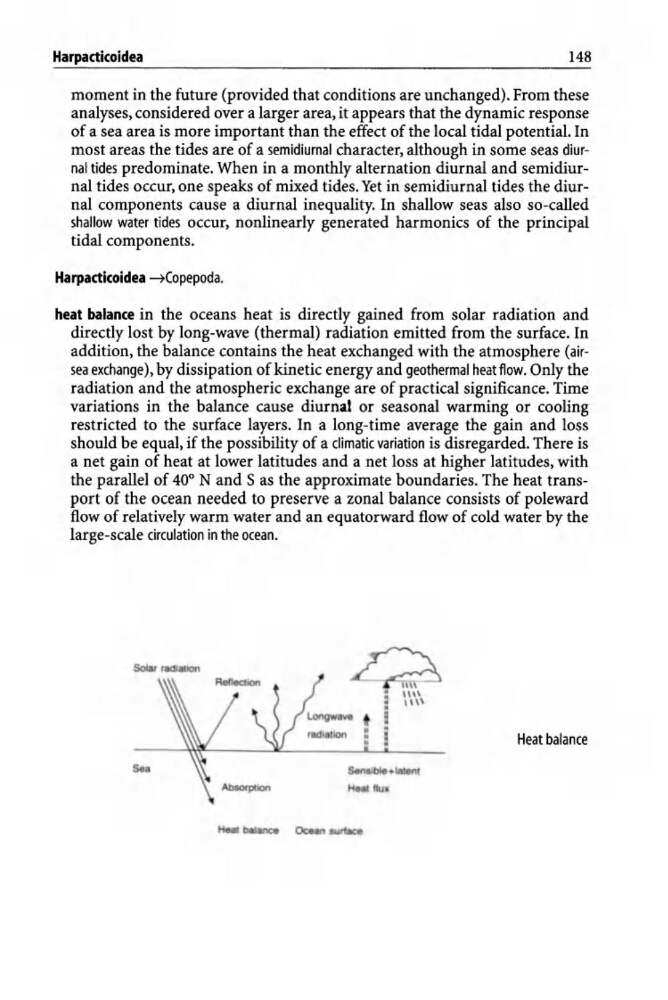
heat balance in the oceans heat is directly gained from solar radiation and
directly lost by long-wave (thermal) radiation emitted from the surface. In
addition, the balance contains the heat exchanged with the atmosphere (airsea exchange), by dissipation of kinetic energy and geothermal heat flow. Only the
radiation and the atmospheric exchange are of practical significance. Time
variations in the balance cause diurnal or seasonal warming or cooling
restricted to the surface layers. In a long-time average the gain and loss
should be equal, if the possibility of a climatic variation is disregarded. There is
a net gain of heat at lower latitudes and a net loss at higher latitudes, with
the parallel of 40° Nand S as the approximate boundaries. The heat transport of the ocean needed to preserve a zonal balance consists of poleward
flow of relatively warm water and an equatorward flow of cold water by the
large-scale circulation in the ocean.
Heat balance
148
moment in the future (provided that conditions are unchanged). From these
analyses, considered over a larger area, it appears that the dynamic response
of a sea area is more important than the effect of the local tidal potential. In
most areas the tides are of a semidiurnal character, although in some seas diurnal tides predominate. When in a monthly alternation diurnal and semidiurnal tides occur, one speaks of mixed tides. Yet in semidiurnal tides the diurnal components cause a diurnal inequality. In shallow seas also so-called
shallow water tides occur, nonlinearly generated harmonics of the principal
tidal components.
Harpacticoidea -tCopepoda.
heat balance in the oceans heat is directly gained from solar radiation and
directly lost by long-wave (thermal) radiation emitted from the surface. In
addition, the balance contains the heat exchanged with the atmosphere (airsea exchange), by dissipation of kinetic energy and geothermal heat flow. Only the
radiation and the atmospheric exchange are of practical significance. Time
variations in the balance cause diurnal or seasonal warming or cooling
restricted to the surface layers. In a long-time average the gain and loss
should be equal, if the possibility of a climatic variation is disregarded. There is
a net gain of heat at lower latitudes and a net loss at higher latitudes, with
the parallel of 40° Nand S as the approximate boundaries. The heat transport of the ocean needed to preserve a zonal balance consists of poleward
flow of relatively warm water and an equatorward flow of cold water by the
large-scale circulation in the ocean.
Heat balance