

131
Fram Expedition
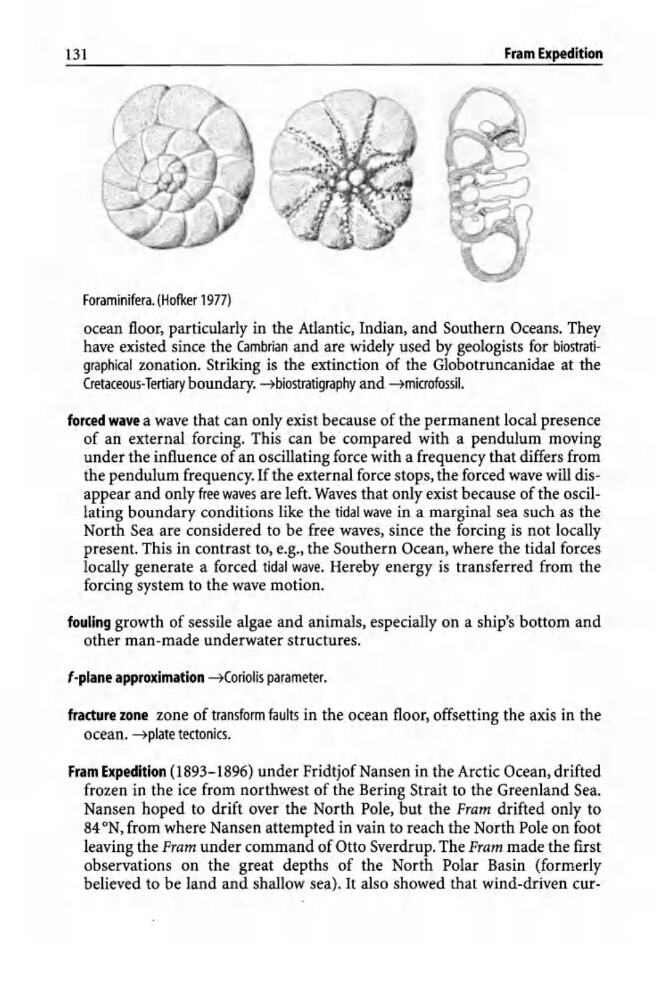
Foraminifera. (Hofker 1977)
ocean floor, particularly in the Atlantic, Indian, and Southern Oceans. They
have existed since the Cambrian and are widely used by geologists for biostratigraphical zonation. Striking is the extinction of the Globotruncanidae at the
Cretaceous-Tertiary boundary. ~biostratigraphy and ~microfossil.
forced wave a wave that can only exist because of the permanent local presence
of an external forcing. This can be compared with a pendulum moving
under the influence of an oscillating force with a frequency that differs from
the pendulum frequency. If the external force stops, the forced wave will disappear and only free waves are left. Waves that only exist because of the oscillating boundary conditions like the tidal wave in a marginal sea such as the
North Sea are considered to be free waves, since the forcing is not locally
present. This in contrast to, e.g., the Southern Ocean, where the tidal forces
locally generate a forced tidal wave. Hereby energy is transferred from the
forcing system to the wave motion.
fouling growth of sessile algae and animals, especially on a ship's bottom and
other man-made underwater structures.
f-plane approximation ~Coriolis parameter.
fracture zone zone of transform faults in the ocean floor, offsetting the axis in the
ocean. ~plate tectonics.
Fram Expedition (1893-1896) under Fridtjof Nansen in the Arctic Ocean, drifted
frozen in the ice from northwest of the Bering Strait to the Greenland Sea.
Nansen hoped to drift over the North Pole, but the Pram drifted only to
84 ON, from where Nansen attempted in vain to reach the North Pole on foot
leaving the Pram under command of Otto Sverdrup. The Pram made the first
observations on the great depths of the North Polar Basin (formerly
believed to be land and shallow sea). It also showed that wind-driven cur-
Fram Expedition
Foraminifera. (Hofker 1977)
ocean floor, particularly in the Atlantic, Indian, and Southern Oceans. They
have existed since the Cambrian and are widely used by geologists for biostratigraphical zonation. Striking is the extinction of the Globotruncanidae at the
Cretaceous-Tertiary boundary. ~biostratigraphy and ~microfossil.
forced wave a wave that can only exist because of the permanent local presence
of an external forcing. This can be compared with a pendulum moving
under the influence of an oscillating force with a frequency that differs from
the pendulum frequency. If the external force stops, the forced wave will disappear and only free waves are left. Waves that only exist because of the oscillating boundary conditions like the tidal wave in a marginal sea such as the
North Sea are considered to be free waves, since the forcing is not locally
present. This in contrast to, e.g., the Southern Ocean, where the tidal forces
locally generate a forced tidal wave. Hereby energy is transferred from the
forcing system to the wave motion.
fouling growth of sessile algae and animals, especially on a ship's bottom and
other man-made underwater structures.
f-plane approximation ~Coriolis parameter.
fracture zone zone of transform faults in the ocean floor, offsetting the axis in the
ocean. ~plate tectonics.
Fram Expedition (1893-1896) under Fridtjof Nansen in the Arctic Ocean, drifted
frozen in the ice from northwest of the Bering Strait to the Greenland Sea.
Nansen hoped to drift over the North Pole, but the Pram drifted only to
84 ON, from where Nansen attempted in vain to reach the North Pole on foot
leaving the Pram under command of Otto Sverdrup. The Pram made the first
observations on the great depths of the North Polar Basin (formerly
believed to be land and shallow sea). It also showed that wind-driven cur-