

digestion
92
tion coefficient K d , supposing that a kind of equilibrium may occur between substances dissolved in pore water and substances sorbed to sediment particles.
digestion the enzymatic breakdown of food substances to molecules which can
be absorbed and used in cellular processes ofliving organisms. The degradation of large ingested molecules takes place by the cleavage of chemical
bonds, almost without exception by hydrolysis, the addition of a water molecule across the bonds.
digestive enzymes organic catalytic substances functioning in the breakdown of
food substances by cleaving molecular bonds in the substrate. Digestive
enzymes are very specific, acting only on certain substrates. So, there are
many carbohydrases (carbohydrate-digesting enzymes), proteases (proteolytic enzymes) and lipases (fat-degrading enzymes). They work best outside the cell, for their optimum pHs lie either on the acidic or basic side,
while the cell interior constantly requires an almost neutral pH (about 7.4).
dimethyl sulfide (DMS), the most abundant volatile sulfur compound in seawater.
In most cases DMS is of biogenic origin with as precursor ~-dimethyl sulfonioproprionate (DMSP): (CH3)2S+CH2COO-. In the air DMS undergoes
photochemical oxidation to sulfate and thus contributes to the low pH of
rain. On a yearly basis the global marine sulfur flux is in the range of 30 to
17010 12 g S y-I, which is in the same order of magnitude as anthropogenic
fluxes from fossil fuel burning.
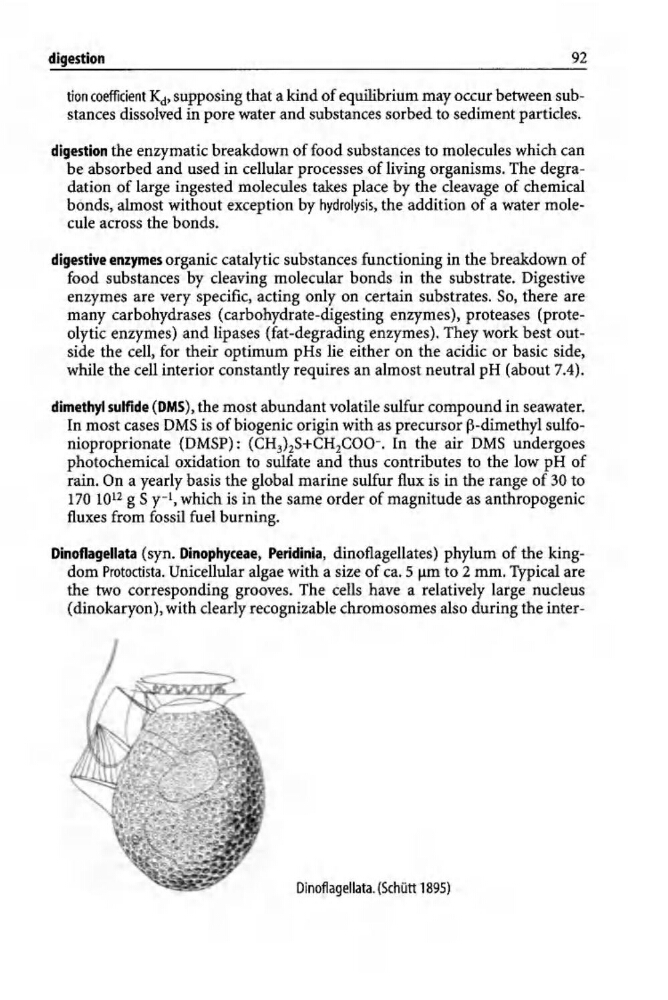
Dinoflagellata (syn. Dinophyceae, Peridinia, dinoflagellates) phylum of the kingdom Protoctista. Unicellular algae with a size of ca. 5 Ilm to 2 mm. Typical are
the two corresponding grooves. The cells have a relatively large nucleus
(dinokaryon), with dearly recognizable chromosomes also during the interDinoflagellata. (SchOtt 1895)
92
tion coefficient K d , supposing that a kind of equilibrium may occur between substances dissolved in pore water and substances sorbed to sediment particles.
digestion the enzymatic breakdown of food substances to molecules which can
be absorbed and used in cellular processes ofliving organisms. The degradation of large ingested molecules takes place by the cleavage of chemical
bonds, almost without exception by hydrolysis, the addition of a water molecule across the bonds.
digestive enzymes organic catalytic substances functioning in the breakdown of
food substances by cleaving molecular bonds in the substrate. Digestive
enzymes are very specific, acting only on certain substrates. So, there are
many carbohydrases (carbohydrate-digesting enzymes), proteases (proteolytic enzymes) and lipases (fat-degrading enzymes). They work best outside the cell, for their optimum pHs lie either on the acidic or basic side,
while the cell interior constantly requires an almost neutral pH (about 7.4).
dimethyl sulfide (DMS), the most abundant volatile sulfur compound in seawater.
In most cases DMS is of biogenic origin with as precursor ~-dimethyl sulfonioproprionate (DMSP): (CH3)2S+CH2COO-. In the air DMS undergoes
photochemical oxidation to sulfate and thus contributes to the low pH of
rain. On a yearly basis the global marine sulfur flux is in the range of 30 to
17010 12 g S y-I, which is in the same order of magnitude as anthropogenic
fluxes from fossil fuel burning.
Dinoflagellata (syn. Dinophyceae, Peridinia, dinoflagellates) phylum of the kingdom Protoctista. Unicellular algae with a size of ca. 5 Ilm to 2 mm. Typical are
the two corresponding grooves. The cells have a relatively large nucleus
(dinokaryon), with dearly recognizable chromosomes also during the interDinoflagellata. (SchOtt 1895)