

160
R.H. Charlier and Chr. P. De Meyer
The term wave power has been used in studies dealing with harnessing it to
produce power : P is the power per unit crest length delivered to the coast when
waves break upon reaching the nearshore.
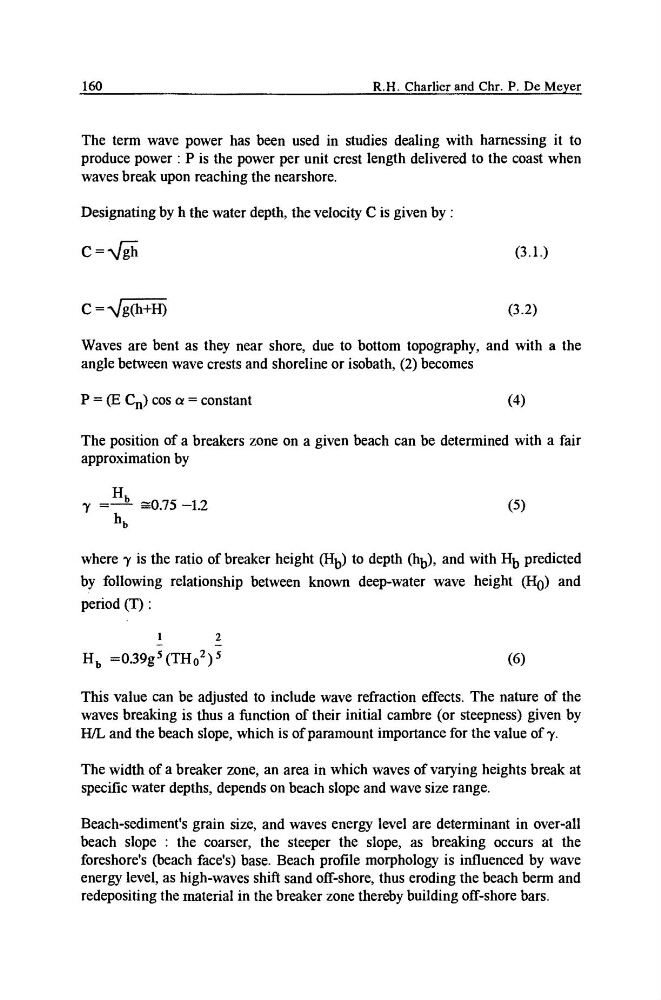
Designating by h the water depth, the velocity C is given by :
C=%f~
(3.1.)
C = "N/g(h+H)
(3.2)
Waves are bent as they near shore, due to bottom topography, and with a the
angle between wave crests and shoreline or isobath, (2) becomes
P = (E Cn) cos ~ = constant
(4)
The position of a breakers zone on a given beach can be determined with a fair
approximation by
n b
3' =
---0.75 -1.2
hb
(5)
where "t is the ratio of breaker height (Hb) to depth (hb), and with H b predicted
by following relationship between known deep-water wave height (H0) and
period (T) :
1
2
Hb =0.39gS (THo 2) 5
(6)
This value can be adjusted to include wave refraction effects. The nature of the
waves breaking is thus a function of their initial cambre (or steepness) given by
H/L and the beach slope, which is of paramount importance for the value of 7.
The width of a breaker zone, an area in which waves of varying heights break at
specific water depths, depends on beach slope and wave size range.
Beach-sediment's grain size, and waves energy level are determinant in over-all
beach slope : the coarser, the steeper the slope, as breaking occurs at the
foreshore's (beach face's) base. Beach profile morphology is influenced by wave
energy level, as high-waves shift sand off-shore, thus eroding the beach berm and
redepositing the material in the breaker zone thereby building off-shore bars.
R.H. Charlier and Chr. P. De Meyer
The term wave power has been used in studies dealing with harnessing it to
produce power : P is the power per unit crest length delivered to the coast when
waves break upon reaching the nearshore.
Designating by h the water depth, the velocity C is given by :
C=%f~
(3.1.)
C = "N/g(h+H)
(3.2)
Waves are bent as they near shore, due to bottom topography, and with a the
angle between wave crests and shoreline or isobath, (2) becomes
P = (E Cn) cos ~ = constant
(4)
The position of a breakers zone on a given beach can be determined with a fair
approximation by
n b
3' =
---0.75 -1.2
hb
(5)
where "t is the ratio of breaker height (Hb) to depth (hb), and with H b predicted
by following relationship between known deep-water wave height (H0) and
period (T) :
1
2
Hb =0.39gS (THo 2) 5
(6)
This value can be adjusted to include wave refraction effects. The nature of the
waves breaking is thus a function of their initial cambre (or steepness) given by
H/L and the beach slope, which is of paramount importance for the value of 7.
The width of a breaker zone, an area in which waves of varying heights break at
specific water depths, depends on beach slope and wave size range.
Beach-sediment's grain size, and waves energy level are determinant in over-all
beach slope : the coarser, the steeper the slope, as breaking occurs at the
foreshore's (beach face's) base. Beach profile morphology is influenced by wave
energy level, as high-waves shift sand off-shore, thus eroding the beach berm and
redepositing the material in the breaker zone thereby building off-shore bars.