

IV. Retreating Shorelines
159
The supply of beach sediment is affected by an area's coastal geology which
determines the initial conditions for littoral processes. Pre-existing natural beach
topographies influence sediment transport within the surf zone. A close
relationship exists between scales, frequencies and intensities of surf-zone motion
and present morphology. In a beach's sediment budget the losses, or debits,
include longshore transport downdrifl, wind transport out of area, off-shore
transport, deposition in submarine gullies, troughs and canyons, solution and
abrasion, and mining.
2
Waves
Waves are of several types. Each has a specific impact on the coastal lands upon
which such waves break. Tsunami are rare and, therefore even if very destructive,
they are not a significant factor in coastal erosion.
2.1
Wind-Waves
Wind-generated waves can be a primary cause of erosion themselves, or, due to
the energy they have stored, they can create various nearshore currents and
develop specific sand transport patterns. The amount of energy stored depends on
the duration of the storm that produced the waves and the extent of the fetch area.
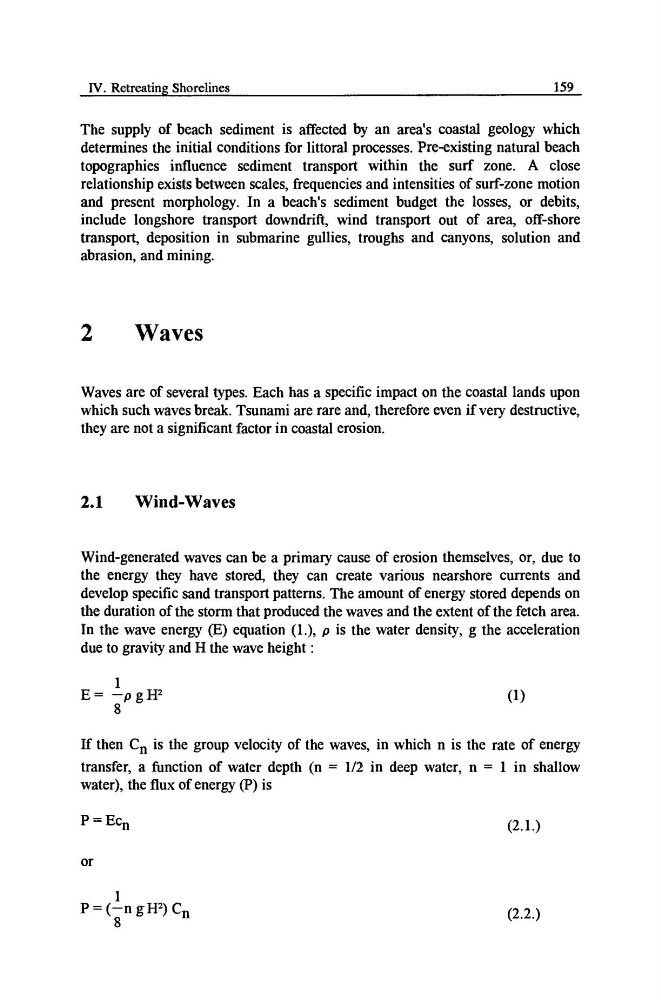
In the wave energy (E) equation (1.), p is the water density, g the acceleration
due to gravity and H the wave height :
1
E = --O gH 2
(1)
8
If then C n is the group velocity of the waves, in which n is the rate of energy
transfer, a function of water depth (n = 1/2 in deep water, n = 1 in shallow
water), the flux of energy (P) is
P = Ecn
(2.1.)
or
1
P =(--ng H:) Cn
(2.2.)
8
159
The supply of beach sediment is affected by an area's coastal geology which
determines the initial conditions for littoral processes. Pre-existing natural beach
topographies influence sediment transport within the surf zone. A close
relationship exists between scales, frequencies and intensities of surf-zone motion
and present morphology. In a beach's sediment budget the losses, or debits,
include longshore transport downdrifl, wind transport out of area, off-shore
transport, deposition in submarine gullies, troughs and canyons, solution and
abrasion, and mining.
2
Waves
Waves are of several types. Each has a specific impact on the coastal lands upon
which such waves break. Tsunami are rare and, therefore even if very destructive,
they are not a significant factor in coastal erosion.
2.1
Wind-Waves
Wind-generated waves can be a primary cause of erosion themselves, or, due to
the energy they have stored, they can create various nearshore currents and
develop specific sand transport patterns. The amount of energy stored depends on
the duration of the storm that produced the waves and the extent of the fetch area.
In the wave energy (E) equation (1.), p is the water density, g the acceleration
due to gravity and H the wave height :
1
E = --O gH 2
(1)
8
If then C n is the group velocity of the waves, in which n is the rate of energy
transfer, a function of water depth (n = 1/2 in deep water, n = 1 in shallow
water), the flux of energy (P) is
P = Ecn
(2.1.)
or
1
P =(--ng H:) Cn
(2.2.)
8