

114
...........
R.H. Charlier and Chr. P. De Meyer
It is observed that the CERC-formula is valid only for relatively long and straight
beaches, where the alongshore differences in the breaking wave heights are only
small. Moreover the formula does not account for currents which are not
generated by breaking waves, such as tidal currents. If such currents are
important other transport formula should be used.
2.2
Bijker formula
To obtain a model for the longshore transport, which takes into account the effect
of tidal or other types of currents, a transport formula can be combined with a
model for the longshore current. Bijker (1967) proposed a formula for bed load
due to waves and currents, which is based upon the formula of Kalinske-Frijlink
for bed load due to currents only. From that a formulation for the increase of the
bottom shear stress by waves has been developed. Afterwards Bijker (1968) has
added to the bed load a distribution of the suspended load, which is based upon
the Einstein-Rouse concentration vertical. Tiffs model has until now frequently
been applied at the Delft (The Netherlands) Hydraulics Laboratory. Bijker
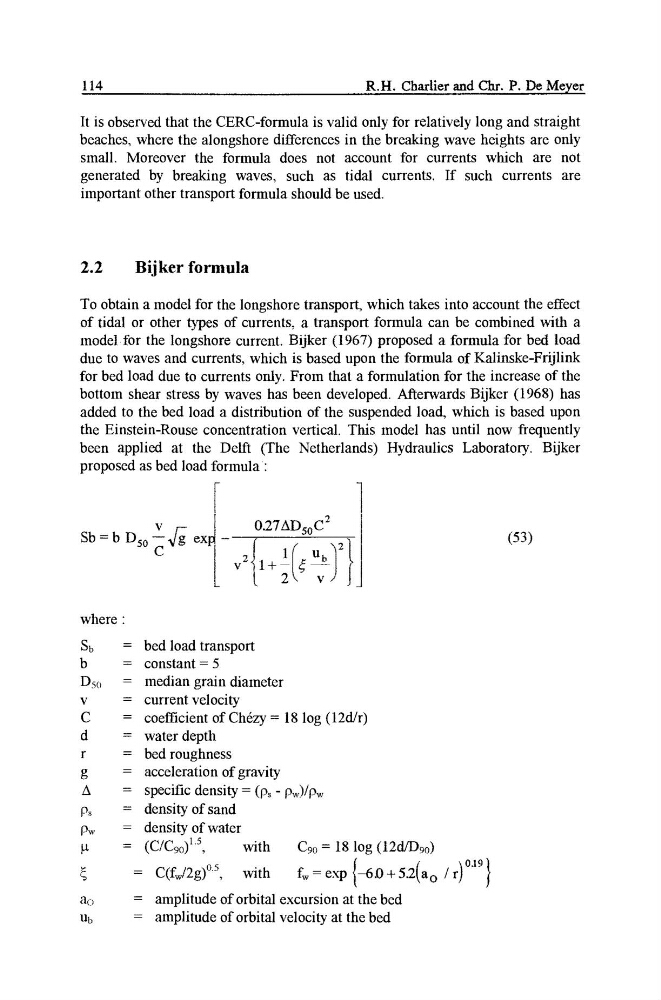
proposed as bed load formula:
v
~[
i.27AD5oC2
Sb = b Dso
ex -
(53)
l+ I u l l
2\
vJ J
where :
Sb
=
b
=
Dso =
V
=
C
=
d
=
r
=
g
=
A
=
Ps
=
9w
=
=
=
ao
=
uu
=
bed load transport
constant = 5
median grain diameter
current velocity
coefficient of Ch6zy = 18 log (12d/r)
water depth
bed roughness
acceleration of gravity
specific density = (ps - 9w)/P~
density of sand
density of water
(C/C9o) 15,
with
C9o = 18 log (12d/Dgo)
C(fw/2g) °5, with
fw= exp {-6.0+5.2(ao /r) 0"19}
amplitude of orbital excursion at the bed
amplitude of orbital velocity at the bed
...........
R.H. Charlier and Chr. P. De Meyer
It is observed that the CERC-formula is valid only for relatively long and straight
beaches, where the alongshore differences in the breaking wave heights are only
small. Moreover the formula does not account for currents which are not
generated by breaking waves, such as tidal currents. If such currents are
important other transport formula should be used.
2.2
Bijker formula
To obtain a model for the longshore transport, which takes into account the effect
of tidal or other types of currents, a transport formula can be combined with a
model for the longshore current. Bijker (1967) proposed a formula for bed load
due to waves and currents, which is based upon the formula of Kalinske-Frijlink
for bed load due to currents only. From that a formulation for the increase of the
bottom shear stress by waves has been developed. Afterwards Bijker (1968) has
added to the bed load a distribution of the suspended load, which is based upon
the Einstein-Rouse concentration vertical. Tiffs model has until now frequently
been applied at the Delft (The Netherlands) Hydraulics Laboratory. Bijker
proposed as bed load formula:
v
~[
i.27AD5oC2
Sb = b Dso
ex -
(53)
l+ I u l l
2\
vJ J
where :
Sb
=
b
=
Dso =
V
=
C
=
d
=
r
=
g
=
A
=
Ps
=
9w
=
=
=
ao
=
uu
=
bed load transport
constant = 5
median grain diameter
current velocity
coefficient of Ch6zy = 18 log (12d/r)
water depth
bed roughness
acceleration of gravity
specific density = (ps - 9w)/P~
density of sand
density of water
(C/C9o) 15,
with
C9o = 18 log (12d/Dgo)
C(fw/2g) °5, with
fw= exp {-6.0+5.2(ao /r) 0"19}
amplitude of orbital excursion at the bed
amplitude of orbital velocity at the bed