

III. Sediment Transport
2
Longshore Transport
2.1
CERC-Formula
113
The early ideas of Watts (1954) and Inman and Bagnold (1963) have led to the
well-known CERC-formula. This type of approach is energy-based and relates
the sediment transport to the energy released with the breaking process of the
waves. According to Bagnold's concept sediment is transported by grain-to-grain
interaction (bed load) and by the stream via turbulent diffusion (suspended load).
In principle Bagnold tried to determine the fraction of the total stream energy
spent to transport bed load and suspended load in the form of efficiency factors.
Applied to oscillatory flow Bagnold reasoned that the local rate of energy
dissipation is responsible for stirring-up the sediment and that an arbitrary flow,
for example the longshore current transports this sediment in the direction of the
current.
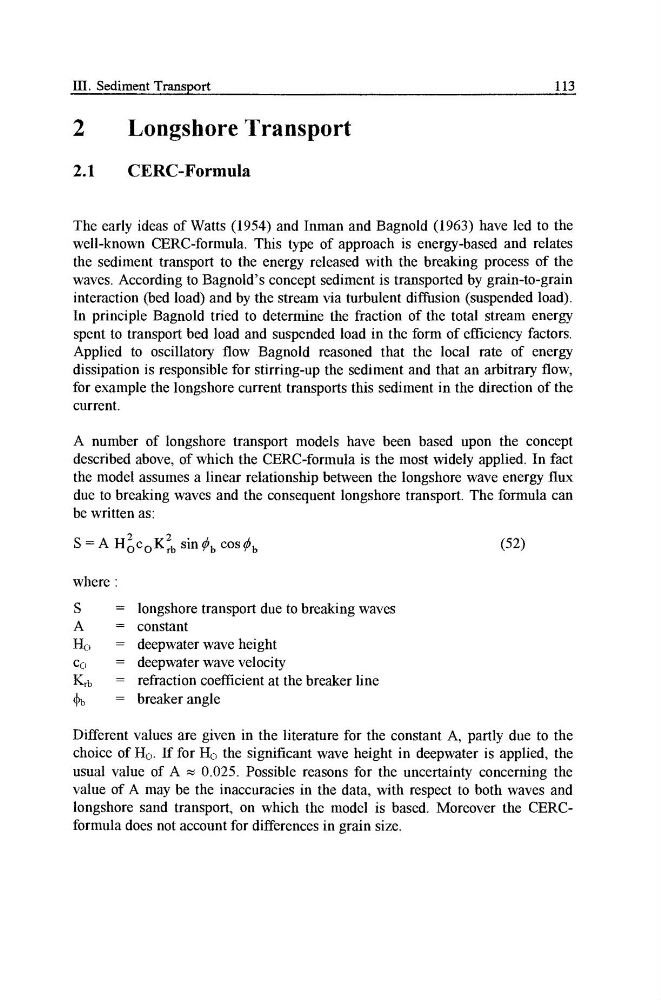
A number of longshore transport models have been based upon the concept
described above, of which the CERC-formula is the most widely applied. In fact
the model assumes a linear relationship between the longshore wave energy flux
due to breaking waves and the consequent longshore transport. The formula can
be written as:
2
2 sin ~b b cos ~b b
S =A HocoK~b
(52)
where :
S
=
A
=
H O
C 0
=
K,-B
=
+b
=
longshore transport due to breaking waves
constant
deepwater wave height
deepwater wave velocity
refraction coefficient at the breaker line
breaker angle
Different values are given in the literature for the constant A, partly due to the
choice of Ho. If :for Ho the significant wave height in deepwater is applied, the
usual value of A .~ 0.025. Possible reasons for the uncertainty concerning the
value of A may be the inaccuracies in the data, with respect to both waves and
longshore sand transport, on which the model is based. Moreover the CERCformula does not account for differences in grain size.
2
Longshore Transport
2.1
CERC-Formula
113
The early ideas of Watts (1954) and Inman and Bagnold (1963) have led to the
well-known CERC-formula. This type of approach is energy-based and relates
the sediment transport to the energy released with the breaking process of the
waves. According to Bagnold's concept sediment is transported by grain-to-grain
interaction (bed load) and by the stream via turbulent diffusion (suspended load).
In principle Bagnold tried to determine the fraction of the total stream energy
spent to transport bed load and suspended load in the form of efficiency factors.
Applied to oscillatory flow Bagnold reasoned that the local rate of energy
dissipation is responsible for stirring-up the sediment and that an arbitrary flow,
for example the longshore current transports this sediment in the direction of the
current.
A number of longshore transport models have been based upon the concept
described above, of which the CERC-formula is the most widely applied. In fact
the model assumes a linear relationship between the longshore wave energy flux
due to breaking waves and the consequent longshore transport. The formula can
be written as:
2
2 sin ~b b cos ~b b
S =A HocoK~b
(52)
where :
S
=
A
=
H O
C 0
=
K,-B
=
+b
=
longshore transport due to breaking waves
constant
deepwater wave height
deepwater wave velocity
refraction coefficient at the breaker line
breaker angle
Different values are given in the literature for the constant A, partly due to the
choice of Ho. If :for Ho the significant wave height in deepwater is applied, the
usual value of A .~ 0.025. Possible reasons for the uncertainty concerning the
value of A may be the inaccuracies in the data, with respect to both waves and
longshore sand transport, on which the model is based. Moreover the CERCformula does not account for differences in grain size.