

HI. Sediment Transport
115
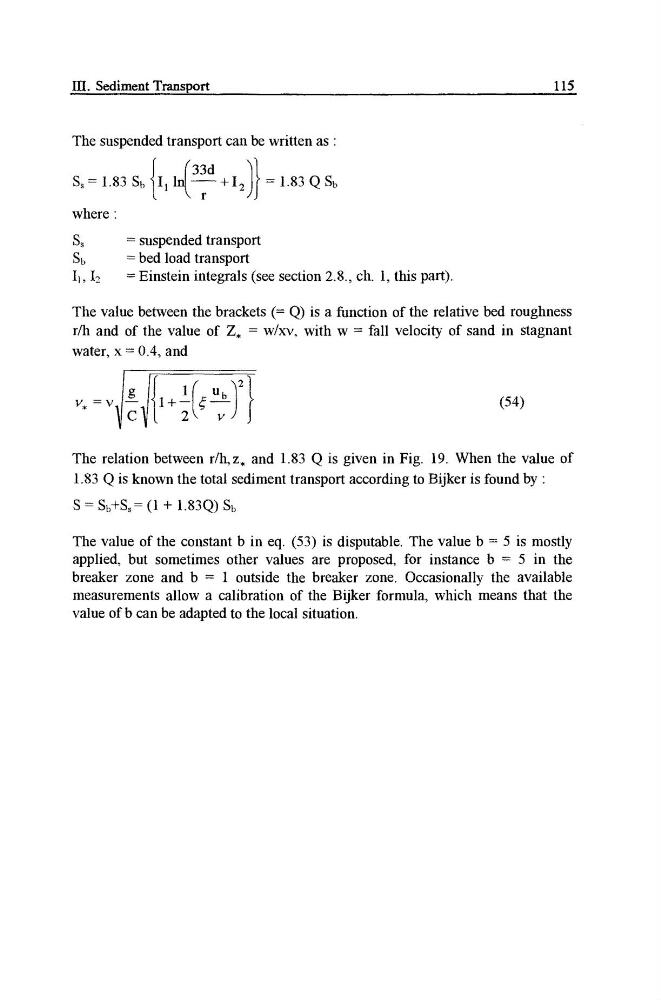
The suspended transport can be written as :
S~ = 1.83 Sb {I1 1~+Iz)) = 1.83 Q Sb
where :
S~
= suspended transport
Sb
= bed load transport
I1, I~
= Einstein integrals (see section 2.8, ch. 1, this part).
Tile value between the brackets (= Q) is a function of the relative bed roughness
r/h and of the value of Z. = w/xv, with w = fall velocity of sand in stagnant
water, x = 0.4, and
jglt
v. = v
t +
~
(54)
The relation between r/h,z, and 1.83 Q is given in Fig, 19. When the value of
1.83 Q is known the total sediment transport according to Bijker is found by :
S = Sb+Ss = (1 + 1.83Q) Sb
The value of the constant b in eq. (53) is disputable. The value b = 5 is mostly
applied, but sometimes other values are proposed, for instance b = 5 in the
breaker zone and b = 1 outside the breaker zone. Occasionally the available
measurements allow a calibration of the Bijker formula, which means that the
value of b can be adapted to the local situation.
115
The suspended transport can be written as :
S~ = 1.83 Sb {I1 1~+Iz)) = 1.83 Q Sb
where :
S~
= suspended transport
Sb
= bed load transport
I1, I~
= Einstein integrals (see section 2.8, ch. 1, this part).
Tile value between the brackets (= Q) is a function of the relative bed roughness
r/h and of the value of Z. = w/xv, with w = fall velocity of sand in stagnant
water, x = 0.4, and
jglt
v. = v
t +
~
(54)
The relation between r/h,z, and 1.83 Q is given in Fig, 19. When the value of
1.83 Q is known the total sediment transport according to Bijker is found by :
S = Sb+Ss = (1 + 1.83Q) Sb
The value of the constant b in eq. (53) is disputable. The value b = 5 is mostly
applied, but sometimes other values are proposed, for instance b = 5 in the
breaker zone and b = 1 outside the breaker zone. Occasionally the available
measurements allow a calibration of the Bijker formula, which means that the
value of b can be adapted to the local situation.