

11 Applications of an Oil Drift and Fate Model for Fairway Design
405
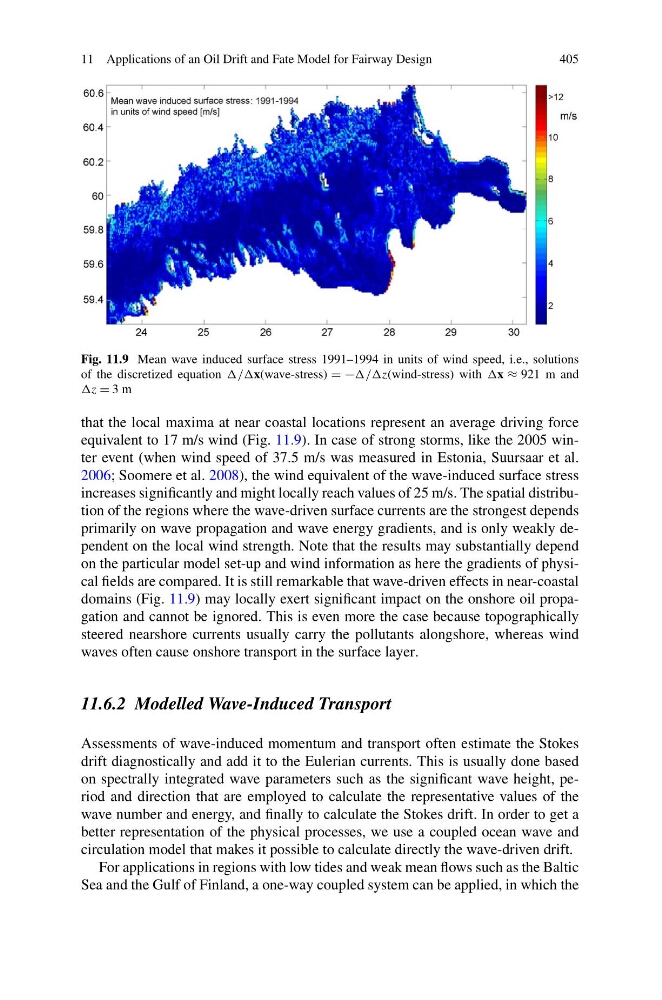
Fig. 11.9 Mean wave induced surface stress 1991–1994 in units of wind speed, i.e., solutions
of the discretized equation = − with x ≈ 921 m and
z = 3 m
that the local maxima at near coastal locations represent an average driving force
equivalent to 17 m/s wind (Fig. 11.9). In case of strong storms, like the 2005 winter event (when wind speed of 37.5 m/s was measured in Estonia, Suursaar et al.
2006; Soomere et al. 2008), the wind equivalent of the wave-induced surface stress
increases significantly and might locally reach values of 25 m/s. The spatial distribution of the regions where the wave-driven surface currents are the strongest depends
primarily on wave propagation and wave energy gradients, and is only weakly dependent on the local wind strength. Note that the results may substantially depend
on the particular model set-up and wind information as here the gradients of physical fields are compared. It is still remarkable that wave-driven effects in near-coastal
domains (Fig. 11.9) may locally exert significant impact on the onshore oil propagation and cannot be ignored. This is even more the case because topographically
steered nearshore currents usually carry the pollutants alongshore, whereas wind
waves often cause onshore transport in the surface layer.
11.6.2 Modelled Wave-Induced Transport
Assessments of wave-induced momentum and transport often estimate the Stokes
drift diagnostically and add it to the Eulerian currents. This is usually done based
on spectrally integrated wave parameters such as the significant wave height, period and direction that are employed to calculate the representative values of the
wave number and energy, and finally to calculate the Stokes drift. In order to get a
better representation of the physical processes, we use a coupled ocean wave and
circulation model that makes it possible to calculate directly the wave-driven drift.
For applications in regions with low tides and weak mean flows such as the Baltic
Sea and the Gulf of Finland, a one-way coupled system can be applied, in which the
405
Fig. 11.9 Mean wave induced surface stress 1991–1994 in units of wind speed, i.e., solutions
of the discretized equation = − with x ≈ 921 m and
z = 3 m
that the local maxima at near coastal locations represent an average driving force
equivalent to 17 m/s wind (Fig. 11.9). In case of strong storms, like the 2005 winter event (when wind speed of 37.5 m/s was measured in Estonia, Suursaar et al.
2006; Soomere et al. 2008), the wind equivalent of the wave-induced surface stress
increases significantly and might locally reach values of 25 m/s. The spatial distribution of the regions where the wave-driven surface currents are the strongest depends
primarily on wave propagation and wave energy gradients, and is only weakly dependent on the local wind strength. Note that the results may substantially depend
on the particular model set-up and wind information as here the gradients of physical fields are compared. It is still remarkable that wave-driven effects in near-coastal
domains (Fig. 11.9) may locally exert significant impact on the onshore oil propagation and cannot be ignored. This is even more the case because topographically
steered nearshore currents usually carry the pollutants alongshore, whereas wind
waves often cause onshore transport in the surface layer.
11.6.2 Modelled Wave-Induced Transport
Assessments of wave-induced momentum and transport often estimate the Stokes
drift diagnostically and add it to the Eulerian currents. This is usually done based
on spectrally integrated wave parameters such as the significant wave height, period and direction that are employed to calculate the representative values of the
wave number and energy, and finally to calculate the Stokes drift. In order to get a
better representation of the physical processes, we use a coupled ocean wave and
circulation model that makes it possible to calculate directly the wave-driven drift.
For applications in regions with low tides and weak mean flows such as the Baltic
Sea and the Gulf of Finland, a one-way coupled system can be applied, in which the