

404
J. Murawski and J. Woge Nielsen
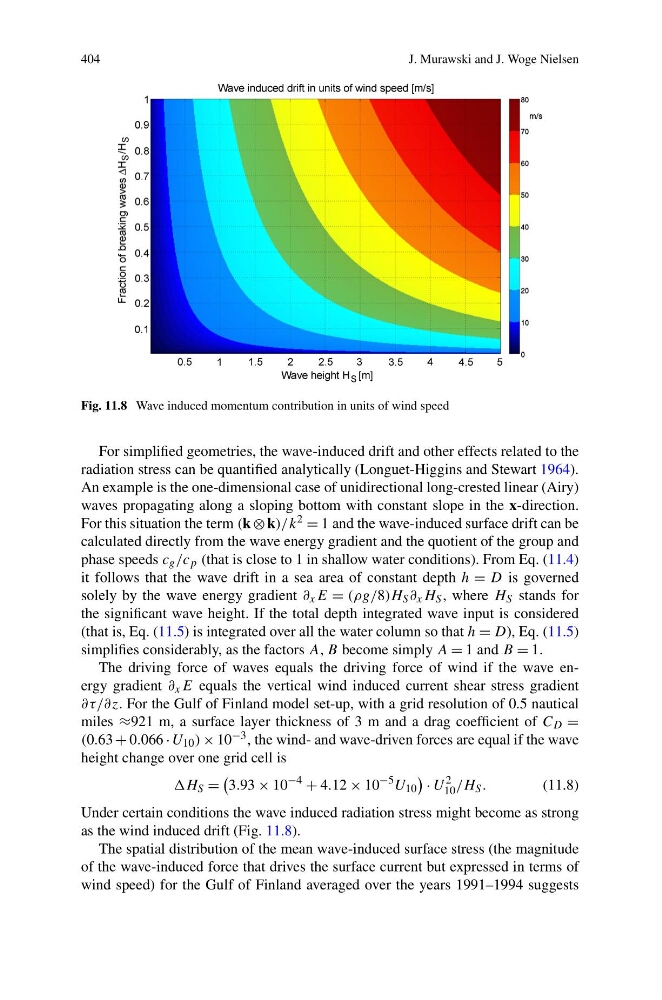
Fig. 11.8 Wave induced momentum contribution in units of wind speed
For simplified geometries, the wave-induced drift and other effects related to the
radiation stress can be quantified analytically (Longuet-Higgins and Stewart 1964).
An example is the one-dimensional case of unidirectional long-crested linear (Airy)
waves propagating along a sloping bottom with constant slope in the x-direction.
For this situation the term (k ⊗ k)/k 2 = 1 and the wave-induced surface drift can be
calculated directly from the wave energy gradient and the quotient of the group and
phase speeds c g /c p (that is close to 1 in shallow water conditions). From Eq. (11.4)
it follows that the wave drift in a sea area of constant depth h = D is governed
solely by the wave energy gradient ∂ x E = (ρg/8)H S ∂ x H S , where H S stands for
the significant wave height. If the total depth integrated wave input is considered
(that is, Eq. (11.5) is integrated over all the water column so that h = D), Eq. (11.5)
simplifies considerably, as the factors A, B become simply A = 1 and B = 1.
The driving force of waves equals the driving force of wind if the wave energy gradient ∂ x E equals the vertical wind induced current shear stress gradient
∂τ/∂z. For the Gulf of Finland model set-up, with a grid resolution of 0.5 nautical
miles ≈921 m, a surface layer thickness of 3 m and a drag coefficient of C D =
(0.63 + 0.066 · U 10 ) × 10 −3 , the wind- and wave-driven forces are equal if the wave
height change over one grid cell is
H S =
3.93 × 10
−4
+ 4.12 × 10
−5 U 10
· U
2
10 /H S .
(11.8)
Under certain conditions the wave induced radiation stress might become as strong
as the wind induced drift (Fig. 11.8).
The spatial distribution of the mean wave-induced surface stress (the magnitude
of the wave-induced force that drives the surface current but expressed in terms of
wind speed) for the Gulf of Finland averaged over the years 1991–1994 suggests
J. Murawski and J. Woge Nielsen
Fig. 11.8 Wave induced momentum contribution in units of wind speed
For simplified geometries, the wave-induced drift and other effects related to the
radiation stress can be quantified analytically (Longuet-Higgins and Stewart 1964).
An example is the one-dimensional case of unidirectional long-crested linear (Airy)
waves propagating along a sloping bottom with constant slope in the x-direction.
For this situation the term (k ⊗ k)/k 2 = 1 and the wave-induced surface drift can be
calculated directly from the wave energy gradient and the quotient of the group and
phase speeds c g /c p (that is close to 1 in shallow water conditions). From Eq. (11.4)
it follows that the wave drift in a sea area of constant depth h = D is governed
solely by the wave energy gradient ∂ x E = (ρg/8)H S ∂ x H S , where H S stands for
the significant wave height. If the total depth integrated wave input is considered
(that is, Eq. (11.5) is integrated over all the water column so that h = D), Eq. (11.5)
simplifies considerably, as the factors A, B become simply A = 1 and B = 1.
The driving force of waves equals the driving force of wind if the wave energy gradient ∂ x E equals the vertical wind induced current shear stress gradient
∂τ/∂z. For the Gulf of Finland model set-up, with a grid resolution of 0.5 nautical
miles ≈921 m, a surface layer thickness of 3 m and a drag coefficient of C D =
(0.63 + 0.066 · U 10 ) × 10 −3 , the wind- and wave-driven forces are equal if the wave
height change over one grid cell is
H S =
3.93 × 10
−4
+ 4.12 × 10
−5 U 10
· U
2
10 /H S .
(11.8)
Under certain conditions the wave induced radiation stress might become as strong
as the wind induced drift (Fig. 11.8).
The spatial distribution of the mean wave-induced surface stress (the magnitude
of the wave-induced force that drives the surface current but expressed in terms of
wind speed) for the Gulf of Finland averaged over the years 1991–1994 suggests