

336
T. Soomere
(i, j ) indicate the grid cell in Cartesian coordinates, m is the sequential number of
particles in this cell and k is the number of time window. For example, setting the
variable p mk
ij = 0 initially and switching it to 1 when the particle hits the nearshore
for the first time, is convenient for estimates of the probability of coastal hits (Andrejev et al. 2010, 2011). A zero value of p mk
ij at the end of a time window means
that the particle has only been offshore or has left the test area through the open
boundary.
The time during which the particle has drifted in the basin without touching the
coast can be measured by assigning to another variable a mk
ij the time elapsed from
the beginning of simulations until the particle hits a nearshore for the first time. If the
particle does not hit the coast, a mk
ij is assigned the length of the time window. The
results of this method applied for sea areas with an open boundary may substantially
depend on how exactly the particles that drift out of the computational area are
handled (Soomere et al. 2011c).
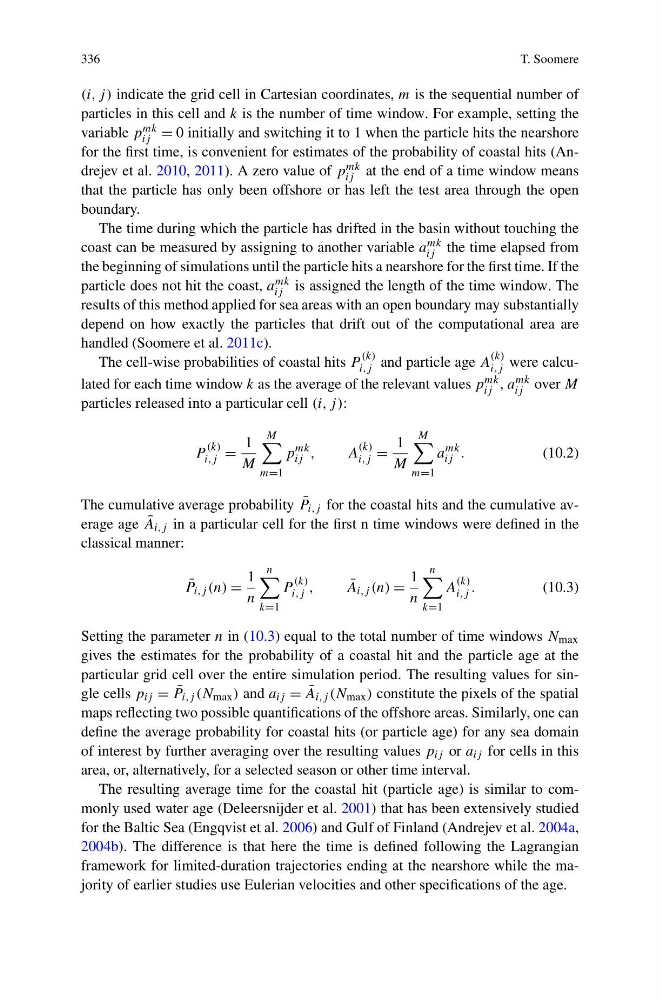
The cell-wise probabilities of coastal hits P
(k)
i,j and particle age A
(k)
i,j were calculated for each time window k as the average of the relevant values p mk
ij , a mk
ij over M
particles released into a particular cell (i, j ):
P
(k)
i,j =
1
M
M
m=1
p
mk
ij ,
A
(k)
i,j =
1
M
M
m=1
a
mk
ij .
(10.2)
The cumulative average probability ¯
P i,j for the coastal hits and the cumulative average age ¯
A i,j in a particular cell for the first n time windows were defined in the
classical manner:
¯
P i,j (n) =
1
n
n
k=1
P
(k)
i,j ,
¯
A i,j (n) =
1
n
n
k=1
A
(k)
i,j .
(10.3)
Setting the parameter n in (10.3) equal to the total number of time windows N max
gives the estimates for the probability of a coastal hit and the particle age at the
particular grid cell over the entire simulation period. The resulting values for single cells p ij = ¯
P i,j (N max ) and a ij = ¯
A i,j (N max ) constitute the pixels of the spatial
maps reflecting two possible quantifications of the offshore areas. Similarly, one can
define the average probability for coastal hits (or particle age) for any sea domain
of interest by further averaging over the resulting values p ij or a ij for cells in this
area, or, alternatively, for a selected season or other time interval.
The resulting average time for the coastal hit (particle age) is similar to commonly used water age (Deleersnijder et al. 2001) that has been extensively studied
for the Baltic Sea (Engqvist et al. 2006) and Gulf of Finland (Andrejev et al. 2004a,
2004b). The difference is that here the time is defined following the Lagrangian
framework for limited-duration trajectories ending at the nearshore while the majority of earlier studies use Eulerian velocities and other specifications of the age.
T. Soomere
(i, j ) indicate the grid cell in Cartesian coordinates, m is the sequential number of
particles in this cell and k is the number of time window. For example, setting the
variable p mk
ij = 0 initially and switching it to 1 when the particle hits the nearshore
for the first time, is convenient for estimates of the probability of coastal hits (Andrejev et al. 2010, 2011). A zero value of p mk
ij at the end of a time window means
that the particle has only been offshore or has left the test area through the open
boundary.
The time during which the particle has drifted in the basin without touching the
coast can be measured by assigning to another variable a mk
ij the time elapsed from
the beginning of simulations until the particle hits a nearshore for the first time. If the
particle does not hit the coast, a mk
ij is assigned the length of the time window. The
results of this method applied for sea areas with an open boundary may substantially
depend on how exactly the particles that drift out of the computational area are
handled (Soomere et al. 2011c).
The cell-wise probabilities of coastal hits P
(k)
i,j and particle age A
(k)
i,j were calculated for each time window k as the average of the relevant values p mk
ij , a mk
ij over M
particles released into a particular cell (i, j ):
P
(k)
i,j =
1
M
M
m=1
p
mk
ij ,
A
(k)
i,j =
1
M
M
m=1
a
mk
ij .
(10.2)
The cumulative average probability ¯
P i,j for the coastal hits and the cumulative average age ¯
A i,j in a particular cell for the first n time windows were defined in the
classical manner:
¯
P i,j (n) =
1
n
n
k=1
P
(k)
i,j ,
¯
A i,j (n) =
1
n
n
k=1
A
(k)
i,j .
(10.3)
Setting the parameter n in (10.3) equal to the total number of time windows N max
gives the estimates for the probability of a coastal hit and the particle age at the
particular grid cell over the entire simulation period. The resulting values for single cells p ij = ¯
P i,j (N max ) and a ij = ¯
A i,j (N max ) constitute the pixels of the spatial
maps reflecting two possible quantifications of the offshore areas. Similarly, one can
define the average probability for coastal hits (or particle age) for any sea domain
of interest by further averaging over the resulting values p ij or a ij for cells in this
area, or, alternatively, for a selected season or other time interval.
The resulting average time for the coastal hit (particle age) is similar to commonly used water age (Deleersnijder et al. 2001) that has been extensively studied
for the Baltic Sea (Engqvist et al. 2006) and Gulf of Finland (Andrejev et al. 2004a,
2004b). The difference is that here the time is defined following the Lagrangian
framework for limited-duration trajectories ending at the nearshore while the majority of earlier studies use Eulerian velocities and other specifications of the age.