

9 Statistics of Lagrangian Transport Reveals Hidden Features of Velocity Fields
309
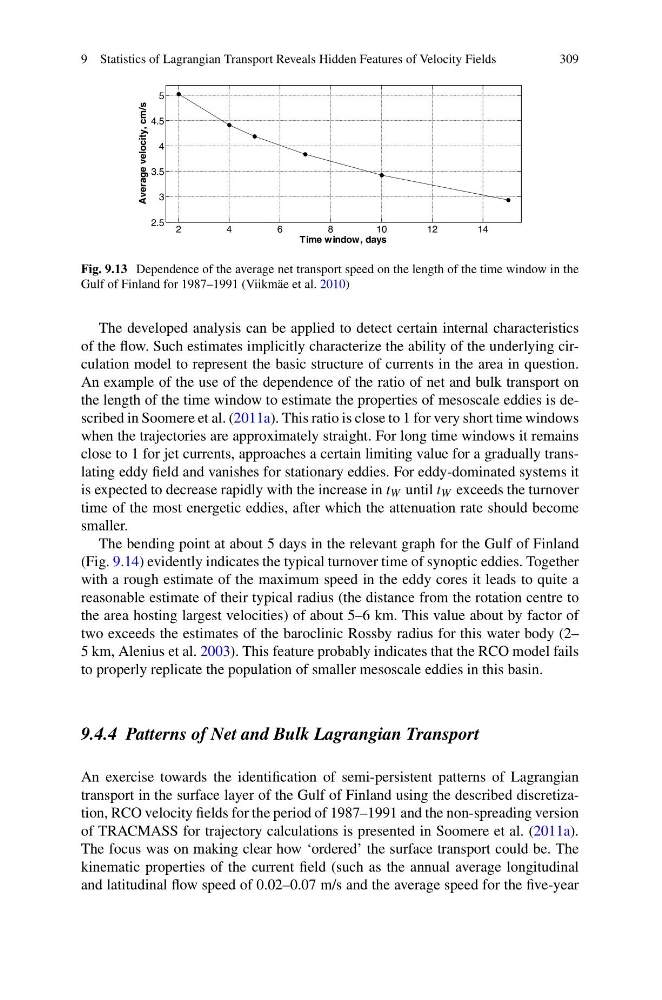
Fig. 9.13 Dependence of the average net transport speed on the length of the time window in the
Gulf of Finland for 1987–1991 (Viikmäe et al. 2010)
The developed analysis can be applied to detect certain internal characteristics
of the flow. Such estimates implicitly characterize the ability of the underlying circulation model to represent the basic structure of currents in the area in question.
An example of the use of the dependence of the ratio of net and bulk transport on
the length of the time window to estimate the properties of mesoscale eddies is described in Soomere et al. (2011a). This ratio is close to 1 for very short time windows
when the trajectories are approximately straight. For long time windows it remains
close to 1 for jet currents, approaches a certain limiting value for a gradually translating eddy field and vanishes for stationary eddies. For eddy-dominated systems it
is expected to decrease rapidly with the increase in t W until t W exceeds the turnover
time of the most energetic eddies, after which the attenuation rate should become
smaller.
The bending point at about 5 days in the relevant graph for the Gulf of Finland
(Fig. 9.14) evidently indicates the typical turnover time of synoptic eddies. Together
with a rough estimate of the maximum speed in the eddy cores it leads to quite a
reasonable estimate of their typical radius (the distance from the rotation centre to
the area hosting largest velocities) of about 5–6 km. This value about by factor of
two exceeds the estimates of the baroclinic Rossby radius for this water body (2–
5 km, Alenius et al. 2003). This feature probably indicates that the RCO model fails
to properly replicate the population of smaller mesoscale eddies in this basin.
9.4.4 Patterns of Net and Bulk Lagrangian Transport
An exercise towards the identification of semi-persistent patterns of Lagrangian
transport in the surface layer of the Gulf of Finland using the described discretization, RCO velocity fields for the period of 1987–1991 and the non-spreading version
of TRACMASS for trajectory calculations is presented in Soomere et al. (2011a).
The focus was on making clear how ‘ordered’ the surface transport could be. The
kinematic properties of the current field (such as the annual average longitudinal
and latitudinal flow speed of 0.02–0.07 m/s and the average speed for the five-year
309
Fig. 9.13 Dependence of the average net transport speed on the length of the time window in the
Gulf of Finland for 1987–1991 (Viikmäe et al. 2010)
The developed analysis can be applied to detect certain internal characteristics
of the flow. Such estimates implicitly characterize the ability of the underlying circulation model to represent the basic structure of currents in the area in question.
An example of the use of the dependence of the ratio of net and bulk transport on
the length of the time window to estimate the properties of mesoscale eddies is described in Soomere et al. (2011a). This ratio is close to 1 for very short time windows
when the trajectories are approximately straight. For long time windows it remains
close to 1 for jet currents, approaches a certain limiting value for a gradually translating eddy field and vanishes for stationary eddies. For eddy-dominated systems it
is expected to decrease rapidly with the increase in t W until t W exceeds the turnover
time of the most energetic eddies, after which the attenuation rate should become
smaller.
The bending point at about 5 days in the relevant graph for the Gulf of Finland
(Fig. 9.14) evidently indicates the typical turnover time of synoptic eddies. Together
with a rough estimate of the maximum speed in the eddy cores it leads to quite a
reasonable estimate of their typical radius (the distance from the rotation centre to
the area hosting largest velocities) of about 5–6 km. This value about by factor of
two exceeds the estimates of the baroclinic Rossby radius for this water body (2–
5 km, Alenius et al. 2003). This feature probably indicates that the RCO model fails
to properly replicate the population of smaller mesoscale eddies in this basin.
9.4.4 Patterns of Net and Bulk Lagrangian Transport
An exercise towards the identification of semi-persistent patterns of Lagrangian
transport in the surface layer of the Gulf of Finland using the described discretization, RCO velocity fields for the period of 1987–1991 and the non-spreading version
of TRACMASS for trajectory calculations is presented in Soomere et al. (2011a).
The focus was on making clear how ‘ordered’ the surface transport could be. The
kinematic properties of the current field (such as the annual average longitudinal
and latitudinal flow speed of 0.02–0.07 m/s and the average speed for the five-year