

304
T. Soomere
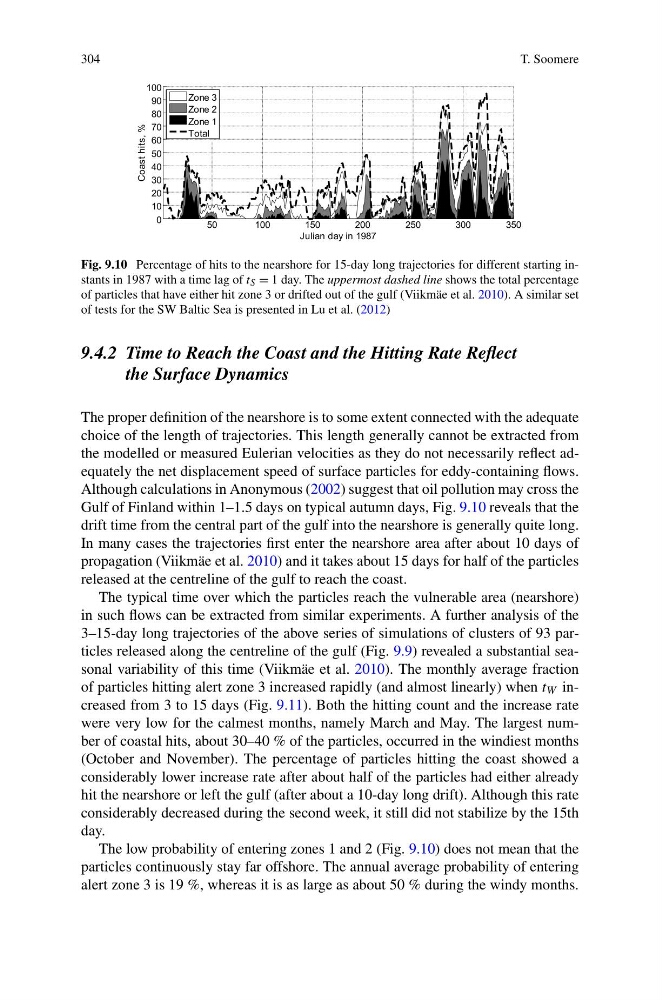
Fig. 9.10 Percentage of hits to the nearshore for 15-day long trajectories for different starting instants in 1987 with a time lag of t S = 1 day. The uppermost dashed line shows the total percentage
of particles that have either hit zone 3 or drifted out of the gulf (Viikmäe et al. 2010). A similar set
of tests for the SW Baltic Sea is presented in Lu et al. (2012)
9.4.2 Time to Reach the Coast and the Hitting Rate Reflect
the Surface Dynamics
The proper definition of the nearshore is to some extent connected with the adequate
choice of the length of trajectories. This length generally cannot be extracted from
the modelled or measured Eulerian velocities as they do not necessarily reflect adequately the net displacement speed of surface particles for eddy-containing flows.
Although calculations in Anonymous (2002) suggest that oil pollution may cross the
Gulf of Finland within 1–1.5 days on typical autumn days, Fig. 9.10 reveals that the
drift time from the central part of the gulf into the nearshore is generally quite long.
In many cases the trajectories first enter the nearshore area after about 10 days of
propagation (Viikmäe et al. 2010) and it takes about 15 days for half of the particles
released at the centreline of the gulf to reach the coast.
The typical time over which the particles reach the vulnerable area (nearshore)
in such flows can be extracted from similar experiments. A further analysis of the
3–15-day long trajectories of the above series of simulations of clusters of 93 particles released along the centreline of the gulf (Fig. 9.9) revealed a substantial seasonal variability of this time (Viikmäe et al. 2010). The monthly average fraction
of particles hitting alert zone 3 increased rapidly (and almost linearly) when t W increased from 3 to 15 days (Fig. 9.11). Both the hitting count and the increase rate
were very low for the calmest months, namely March and May. The largest number of coastal hits, about 30–40 % of the particles, occurred in the windiest months
(October and November). The percentage of particles hitting the coast showed a
considerably lower increase rate after about half of the particles had either already
hit the nearshore or left the gulf (after about a 10-day long drift). Although this rate
considerably decreased during the second week, it still did not stabilize by the 15th
day.
The low probability of entering zones 1 and 2 (Fig. 9.10) does not mean that the
particles continuously stay far offshore. The annual average probability of entering
alert zone 3 is 19 %, whereas it is as large as about 50 % during the windy months.
T. Soomere
Fig. 9.10 Percentage of hits to the nearshore for 15-day long trajectories for different starting instants in 1987 with a time lag of t S = 1 day. The uppermost dashed line shows the total percentage
of particles that have either hit zone 3 or drifted out of the gulf (Viikmäe et al. 2010). A similar set
of tests for the SW Baltic Sea is presented in Lu et al. (2012)
9.4.2 Time to Reach the Coast and the Hitting Rate Reflect
the Surface Dynamics
The proper definition of the nearshore is to some extent connected with the adequate
choice of the length of trajectories. This length generally cannot be extracted from
the modelled or measured Eulerian velocities as they do not necessarily reflect adequately the net displacement speed of surface particles for eddy-containing flows.
Although calculations in Anonymous (2002) suggest that oil pollution may cross the
Gulf of Finland within 1–1.5 days on typical autumn days, Fig. 9.10 reveals that the
drift time from the central part of the gulf into the nearshore is generally quite long.
In many cases the trajectories first enter the nearshore area after about 10 days of
propagation (Viikmäe et al. 2010) and it takes about 15 days for half of the particles
released at the centreline of the gulf to reach the coast.
The typical time over which the particles reach the vulnerable area (nearshore)
in such flows can be extracted from similar experiments. A further analysis of the
3–15-day long trajectories of the above series of simulations of clusters of 93 particles released along the centreline of the gulf (Fig. 9.9) revealed a substantial seasonal variability of this time (Viikmäe et al. 2010). The monthly average fraction
of particles hitting alert zone 3 increased rapidly (and almost linearly) when t W increased from 3 to 15 days (Fig. 9.11). Both the hitting count and the increase rate
were very low for the calmest months, namely March and May. The largest number of coastal hits, about 30–40 % of the particles, occurred in the windiest months
(October and November). The percentage of particles hitting the coast showed a
considerably lower increase rate after about half of the particles had either already
hit the nearshore or left the gulf (after about a 10-day long drift). Although this rate
considerably decreased during the second week, it still did not stabilize by the 15th
day.
The low probability of entering zones 1 and 2 (Fig. 9.10) does not mean that the
particles continuously stay far offshore. The annual average probability of entering
alert zone 3 is 19 %, whereas it is as large as about 50 % during the windy months.