

9 Statistics of Lagrangian Transport Reveals Hidden Features of Velocity Fields
305
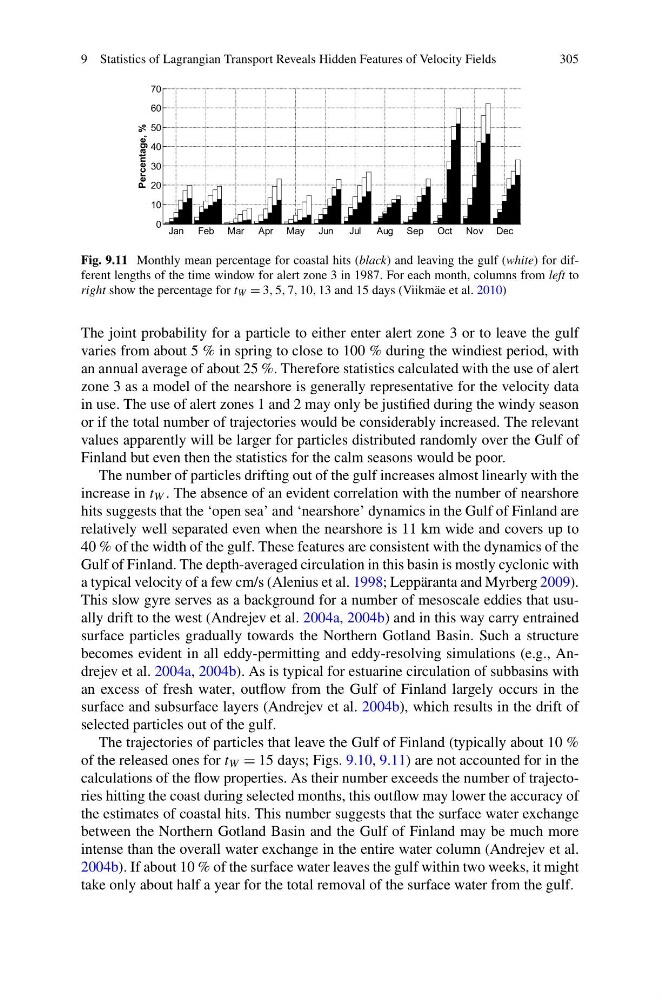
Fig. 9.11 Monthly mean percentage for coastal hits (black) and leaving the gulf (white) for different lengths of the time window for alert zone 3 in 1987. For each month, columns from left to
right show the percentage for t W = 3, 5, 7, 10, 13 and 15 days (Viikmäe et al. 2010)
The joint probability for a particle to either enter alert zone 3 or to leave the gulf
varies from about 5 % in spring to close to 100 % during the windiest period, with
an annual average of about 25 %. Therefore statistics calculated with the use of alert
zone 3 as a model of the nearshore is generally representative for the velocity data
in use. The use of alert zones 1 and 2 may only be justified during the windy season
or if the total number of trajectories would be considerably increased. The relevant
values apparently will be larger for particles distributed randomly over the Gulf of
Finland but even then the statistics for the calm seasons would be poor.
The number of particles drifting out of the gulf increases almost linearly with the
increase in t W . The absence of an evident correlation with the number of nearshore
hits suggests that the ‘open sea’ and ‘nearshore’ dynamics in the Gulf of Finland are
relatively well separated even when the nearshore is 11 km wide and covers up to
40 % of the width of the gulf. These features are consistent with the dynamics of the
Gulf of Finland. The depth-averaged circulation in this basin is mostly cyclonic with
a typical velocity of a few cm/s (Alenius et al. 1998; Leppäranta and Myrberg 2009).
This slow gyre serves as a background for a number of mesoscale eddies that usually drift to the west (Andrejev et al. 2004a, 2004b) and in this way carry entrained
surface particles gradually towards the Northern Gotland Basin. Such a structure
becomes evident in all eddy-permitting and eddy-resolving simulations (e.g., Andrejev et al. 2004a, 2004b). As is typical for estuarine circulation of subbasins with
an excess of fresh water, outflow from the Gulf of Finland largely occurs in the
surface and subsurface layers (Andrejev et al. 2004b), which results in the drift of
selected particles out of the gulf.
The trajectories of particles that leave the Gulf of Finland (typically about 10 %
of the released ones for t W = 15 days; Figs. 9.10, 9.11) are not accounted for in the
calculations of the flow properties. As their number exceeds the number of trajectories hitting the coast during selected months, this outflow may lower the accuracy of
the estimates of coastal hits. This number suggests that the surface water exchange
between the Northern Gotland Basin and the Gulf of Finland may be much more
intense than the overall water exchange in the entire water column (Andrejev et al.
2004b). If about 10 % of the surface water leaves the gulf within two weeks, it might
take only about half a year for the total removal of the surface water from the gulf.
305
Fig. 9.11 Monthly mean percentage for coastal hits (black) and leaving the gulf (white) for different lengths of the time window for alert zone 3 in 1987. For each month, columns from left to
right show the percentage for t W = 3, 5, 7, 10, 13 and 15 days (Viikmäe et al. 2010)
The joint probability for a particle to either enter alert zone 3 or to leave the gulf
varies from about 5 % in spring to close to 100 % during the windiest period, with
an annual average of about 25 %. Therefore statistics calculated with the use of alert
zone 3 as a model of the nearshore is generally representative for the velocity data
in use. The use of alert zones 1 and 2 may only be justified during the windy season
or if the total number of trajectories would be considerably increased. The relevant
values apparently will be larger for particles distributed randomly over the Gulf of
Finland but even then the statistics for the calm seasons would be poor.
The number of particles drifting out of the gulf increases almost linearly with the
increase in t W . The absence of an evident correlation with the number of nearshore
hits suggests that the ‘open sea’ and ‘nearshore’ dynamics in the Gulf of Finland are
relatively well separated even when the nearshore is 11 km wide and covers up to
40 % of the width of the gulf. These features are consistent with the dynamics of the
Gulf of Finland. The depth-averaged circulation in this basin is mostly cyclonic with
a typical velocity of a few cm/s (Alenius et al. 1998; Leppäranta and Myrberg 2009).
This slow gyre serves as a background for a number of mesoscale eddies that usually drift to the west (Andrejev et al. 2004a, 2004b) and in this way carry entrained
surface particles gradually towards the Northern Gotland Basin. Such a structure
becomes evident in all eddy-permitting and eddy-resolving simulations (e.g., Andrejev et al. 2004a, 2004b). As is typical for estuarine circulation of subbasins with
an excess of fresh water, outflow from the Gulf of Finland largely occurs in the
surface and subsurface layers (Andrejev et al. 2004b), which results in the drift of
selected particles out of the gulf.
The trajectories of particles that leave the Gulf of Finland (typically about 10 %
of the released ones for t W = 15 days; Figs. 9.10, 9.11) are not accounted for in the
calculations of the flow properties. As their number exceeds the number of trajectories hitting the coast during selected months, this outflow may lower the accuracy of
the estimates of coastal hits. This number suggests that the surface water exchange
between the Northern Gotland Basin and the Gulf of Finland may be much more
intense than the overall water exchange in the entire water column (Andrejev et al.
2004b). If about 10 % of the surface water leaves the gulf within two weeks, it might
take only about half a year for the total removal of the surface water from the gulf.