

9 Statistics of Lagrangian Transport Reveals Hidden Features of Velocity Fields
291
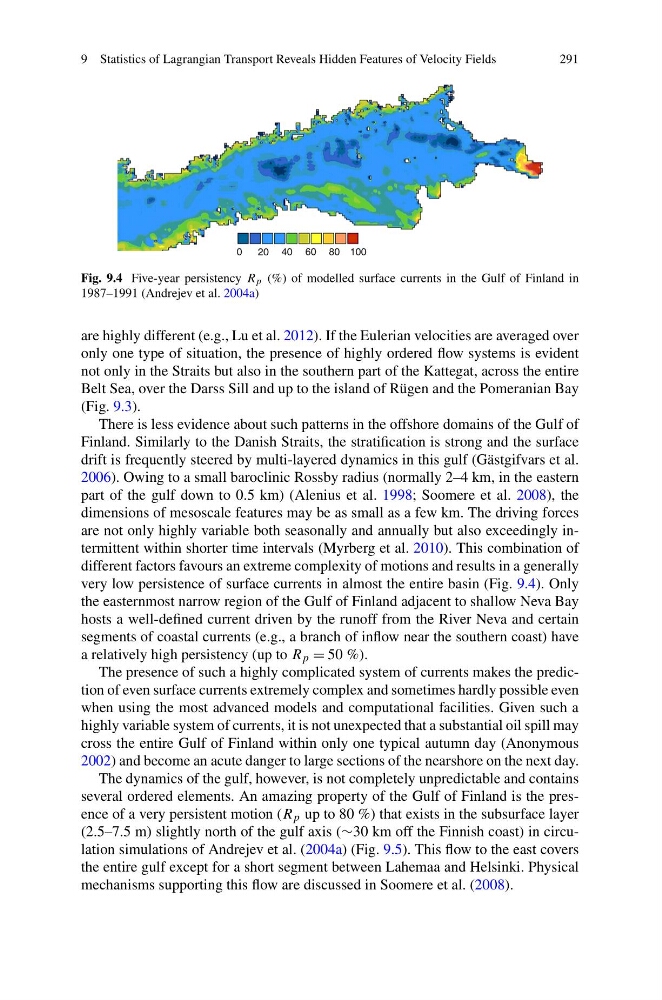
Fig. 9.4 Five-year persistency R p (%) of modelled surface currents in the Gulf of Finland in
1987–1991 (Andrejev et al. 2004a)
are highly different (e.g., Lu et al. 2012). If the Eulerian velocities are averaged over
only one type of situation, the presence of highly ordered flow systems is evident
not only in the Straits but also in the southern part of the Kattegat, across the entire
Belt Sea, over the Darss Sill and up to the island of Rügen and the Pomeranian Bay
(Fig. 9.3).
There is less evidence about such patterns in the offshore domains of the Gulf of
Finland. Similarly to the Danish Straits, the stratification is strong and the surface
drift is frequently steered by multi-layered dynamics in this gulf (Gästgifvars et al.
2006). Owing to a small baroclinic Rossby radius (normally 2–4 km, in the eastern
part of the gulf down to 0.5 km) (Alenius et al. 1998; Soomere et al. 2008), the
dimensions of mesoscale features may be as small as a few km. The driving forces
are not only highly variable both seasonally and annually but also exceedingly intermittent within shorter time intervals (Myrberg et al. 2010). This combination of
different factors favours an extreme complexity of motions and results in a generally
very low persistence of surface currents in almost the entire basin (Fig. 9.4). Only
the easternmost narrow region of the Gulf of Finland adjacent to shallow Neva Bay
hosts a well-defined current driven by the runoff from the River Neva and certain
segments of coastal currents (e.g., a branch of inflow near the southern coast) have
a relatively high persistency (up to R p = 50 %).
The presence of such a highly complicated system of currents makes the prediction of even surface currents extremely complex and sometimes hardly possible even
when using the most advanced models and computational facilities. Given such a
highly variable system of currents, it is not unexpected that a substantial oil spill may
cross the entire Gulf of Finland within only one typical autumn day (Anonymous
2002) and become an acute danger to large sections of the nearshore on the next day.
The dynamics of the gulf, however, is not completely unpredictable and contains
several ordered elements. An amazing property of the Gulf of Finland is the presence of a very persistent motion (R p up to 80 %) that exists in the subsurface layer
(2.5–7.5 m) slightly north of the gulf axis (∼30 km off the Finnish coast) in circulation simulations of Andrejev et al. (2004a) (Fig. 9.5). This flow to the east covers
the entire gulf except for a short segment between Lahemaa and Helsinki. Physical
mechanisms supporting this flow are discussed in Soomere et al. (2008).
291
Fig. 9.4 Five-year persistency R p (%) of modelled surface currents in the Gulf of Finland in
1987–1991 (Andrejev et al. 2004a)
are highly different (e.g., Lu et al. 2012). If the Eulerian velocities are averaged over
only one type of situation, the presence of highly ordered flow systems is evident
not only in the Straits but also in the southern part of the Kattegat, across the entire
Belt Sea, over the Darss Sill and up to the island of Rügen and the Pomeranian Bay
(Fig. 9.3).
There is less evidence about such patterns in the offshore domains of the Gulf of
Finland. Similarly to the Danish Straits, the stratification is strong and the surface
drift is frequently steered by multi-layered dynamics in this gulf (Gästgifvars et al.
2006). Owing to a small baroclinic Rossby radius (normally 2–4 km, in the eastern
part of the gulf down to 0.5 km) (Alenius et al. 1998; Soomere et al. 2008), the
dimensions of mesoscale features may be as small as a few km. The driving forces
are not only highly variable both seasonally and annually but also exceedingly intermittent within shorter time intervals (Myrberg et al. 2010). This combination of
different factors favours an extreme complexity of motions and results in a generally
very low persistence of surface currents in almost the entire basin (Fig. 9.4). Only
the easternmost narrow region of the Gulf of Finland adjacent to shallow Neva Bay
hosts a well-defined current driven by the runoff from the River Neva and certain
segments of coastal currents (e.g., a branch of inflow near the southern coast) have
a relatively high persistency (up to R p = 50 %).
The presence of such a highly complicated system of currents makes the prediction of even surface currents extremely complex and sometimes hardly possible even
when using the most advanced models and computational facilities. Given such a
highly variable system of currents, it is not unexpected that a substantial oil spill may
cross the entire Gulf of Finland within only one typical autumn day (Anonymous
2002) and become an acute danger to large sections of the nearshore on the next day.
The dynamics of the gulf, however, is not completely unpredictable and contains
several ordered elements. An amazing property of the Gulf of Finland is the presence of a very persistent motion (R p up to 80 %) that exists in the subsurface layer
(2.5–7.5 m) slightly north of the gulf axis (∼30 km off the Finnish coast) in circulation simulations of Andrejev et al. (2004a) (Fig. 9.5). This flow to the east covers
the entire gulf except for a short segment between Lahemaa and Helsinki. Physical
mechanisms supporting this flow are discussed in Soomere et al. (2008).