

292
T. Soomere
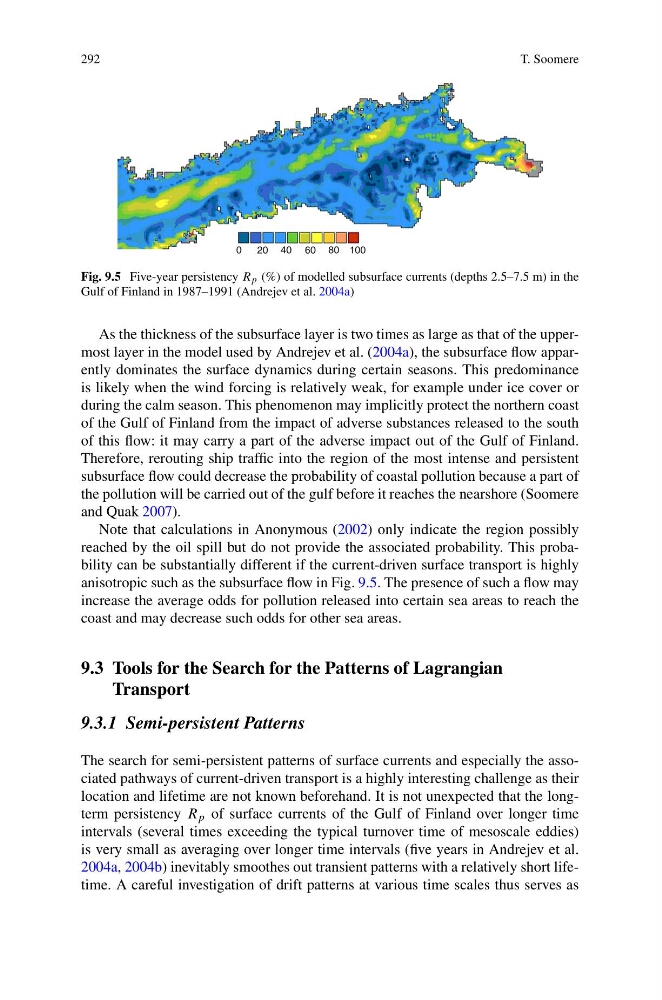
Fig. 9.5 Five-year persistency R p (%) of modelled subsurface currents (depths 2.5–7.5 m) in the
Gulf of Finland in 1987–1991 (Andrejev et al. 2004a)
As the thickness of the subsurface layer is two times as large as that of the uppermost layer in the model used by Andrejev et al. (2004a), the subsurface flow apparently dominates the surface dynamics during certain seasons. This predominance
is likely when the wind forcing is relatively weak, for example under ice cover or
during the calm season. This phenomenon may implicitly protect the northern coast
of the Gulf of Finland from the impact of adverse substances released to the south
of this flow: it may carry a part of the adverse impact out of the Gulf of Finland.
Therefore, rerouting ship traffic into the region of the most intense and persistent
subsurface flow could decrease the probability of coastal pollution because a part of
the pollution will be carried out of the gulf before it reaches the nearshore (Soomere
and Quak 2007).
Note that calculations in Anonymous (2002) only indicate the region possibly
reached by the oil spill but do not provide the associated probability. This probability can be substantially different if the current-driven surface transport is highly
anisotropic such as the subsurface flow in Fig. 9.5. The presence of such a flow may
increase the average odds for pollution released into certain sea areas to reach the
coast and may decrease such odds for other sea areas.
9.3 Tools for the Search for the Patterns of Lagrangian
Transport
9.3.1 Semi-persistent Patterns
The search for semi-persistent patterns of surface currents and especially the associated pathways of current-driven transport is a highly interesting challenge as their
location and lifetime are not known beforehand. It is not unexpected that the longterm persistency R p of surface currents of the Gulf of Finland over longer time
intervals (several times exceeding the typical turnover time of mesoscale eddies)
is very small as averaging over longer time intervals (five years in Andrejev et al.
2004a, 2004b) inevitably smoothes out transient patterns with a relatively short lifetime. A careful investigation of drift patterns at various time scales thus serves as
T. Soomere
Fig. 9.5 Five-year persistency R p (%) of modelled subsurface currents (depths 2.5–7.5 m) in the
Gulf of Finland in 1987–1991 (Andrejev et al. 2004a)
As the thickness of the subsurface layer is two times as large as that of the uppermost layer in the model used by Andrejev et al. (2004a), the subsurface flow apparently dominates the surface dynamics during certain seasons. This predominance
is likely when the wind forcing is relatively weak, for example under ice cover or
during the calm season. This phenomenon may implicitly protect the northern coast
of the Gulf of Finland from the impact of adverse substances released to the south
of this flow: it may carry a part of the adverse impact out of the Gulf of Finland.
Therefore, rerouting ship traffic into the region of the most intense and persistent
subsurface flow could decrease the probability of coastal pollution because a part of
the pollution will be carried out of the gulf before it reaches the nearshore (Soomere
and Quak 2007).
Note that calculations in Anonymous (2002) only indicate the region possibly
reached by the oil spill but do not provide the associated probability. This probability can be substantially different if the current-driven surface transport is highly
anisotropic such as the subsurface flow in Fig. 9.5. The presence of such a flow may
increase the average odds for pollution released into certain sea areas to reach the
coast and may decrease such odds for other sea areas.
9.3 Tools for the Search for the Patterns of Lagrangian
Transport
9.3.1 Semi-persistent Patterns
The search for semi-persistent patterns of surface currents and especially the associated pathways of current-driven transport is a highly interesting challenge as their
location and lifetime are not known beforehand. It is not unexpected that the longterm persistency R p of surface currents of the Gulf of Finland over longer time
intervals (several times exceeding the typical turnover time of mesoscale eddies)
is very small as averaging over longer time intervals (five years in Andrejev et al.
2004a, 2004b) inevitably smoothes out transient patterns with a relatively short lifetime. A careful investigation of drift patterns at various time scales thus serves as