

8 Trajectories and Spreading of Observed and Simulated Drifters in the Baltic Sea
273
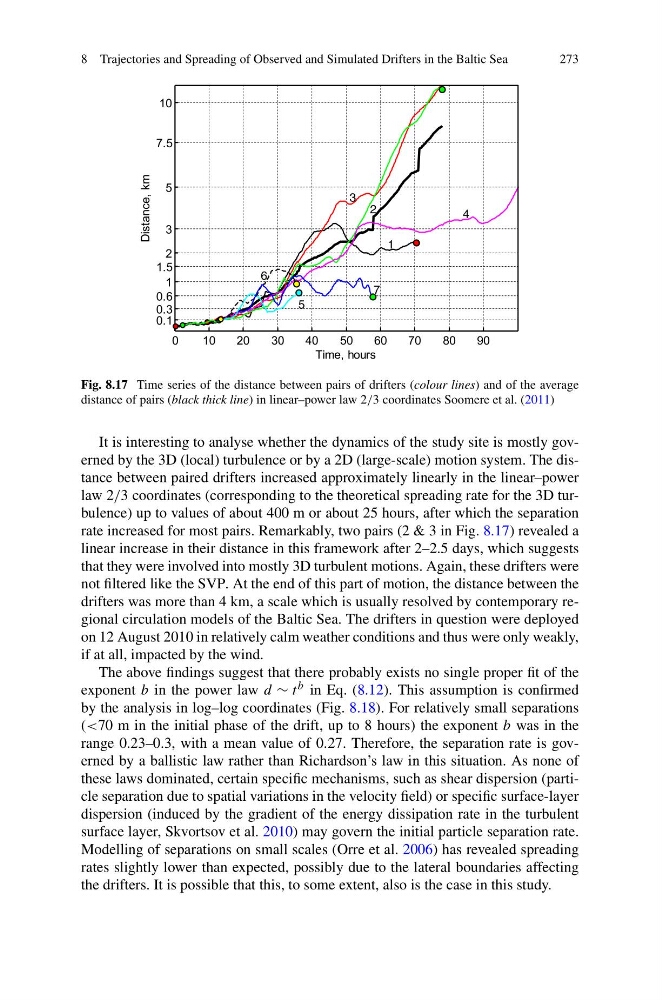
Fig. 8.17 Time series of the distance between pairs of drifters (colour lines) and of the average
distance of pairs (black thick line) in linear–power law 2/3 coordinates Soomere et al. (2011)
It is interesting to analyse whether the dynamics of the study site is mostly governed by the 3D (local) turbulence or by a 2D (large-scale) motion system. The distance between paired drifters increased approximately linearly in the linear–power
law 2/3 coordinates (corresponding to the theoretical spreading rate for the 3D turbulence) up to values of about 400 m or about 25 hours, after which the separation
rate increased for most pairs. Remarkably, two pairs (2 & 3 in Fig. 8.17) revealed a
linear increase in their distance in this framework after 2–2.5 days, which suggests
that they were involved into mostly 3D turbulent motions. Again, these drifters were
not filtered like the SVP. At the end of this part of motion, the distance between the
drifters was more than 4 km, a scale which is usually resolved by contemporary regional circulation models of the Baltic Sea. The drifters in question were deployed
on 12 August 2010 in relatively calm weather conditions and thus were only weakly,
if at all, impacted by the wind.
The above findings suggest that there probably exists no single proper fit of the
exponent b in the power law d ∼ t b in Eq. (8.12). This assumption is confirmed
by the analysis in log–log coordinates (Fig. 8.18). For relatively small separations
(<70 m in the initial phase of the drift, up to 8 hours) the exponent b was in the
range 0.23–0.3, with a mean value of 0.27. Therefore, the separation rate is governed by a ballistic law rather than Richardson’s law in this situation. As none of
these laws dominated, certain specific mechanisms, such as shear dispersion (particle separation due to spatial variations in the velocity field) or specific surface-layer
dispersion (induced by the gradient of the energy dissipation rate in the turbulent
surface layer, Skvortsov et al. 2010) may govern the initial particle separation rate.
Modelling of separations on small scales (Orre et al. 2006) has revealed spreading
rates slightly lower than expected, possibly due to the lateral boundaries affecting
the drifters. It is possible that this, to some extent, also is the case in this study.
273
Fig. 8.17 Time series of the distance between pairs of drifters (colour lines) and of the average
distance of pairs (black thick line) in linear–power law 2/3 coordinates Soomere et al. (2011)
It is interesting to analyse whether the dynamics of the study site is mostly governed by the 3D (local) turbulence or by a 2D (large-scale) motion system. The distance between paired drifters increased approximately linearly in the linear–power
law 2/3 coordinates (corresponding to the theoretical spreading rate for the 3D turbulence) up to values of about 400 m or about 25 hours, after which the separation
rate increased for most pairs. Remarkably, two pairs (2 & 3 in Fig. 8.17) revealed a
linear increase in their distance in this framework after 2–2.5 days, which suggests
that they were involved into mostly 3D turbulent motions. Again, these drifters were
not filtered like the SVP. At the end of this part of motion, the distance between the
drifters was more than 4 km, a scale which is usually resolved by contemporary regional circulation models of the Baltic Sea. The drifters in question were deployed
on 12 August 2010 in relatively calm weather conditions and thus were only weakly,
if at all, impacted by the wind.
The above findings suggest that there probably exists no single proper fit of the
exponent b in the power law d ∼ t b in Eq. (8.12). This assumption is confirmed
by the analysis in log–log coordinates (Fig. 8.18). For relatively small separations
(<70 m in the initial phase of the drift, up to 8 hours) the exponent b was in the
range 0.23–0.3, with a mean value of 0.27. Therefore, the separation rate is governed by a ballistic law rather than Richardson’s law in this situation. As none of
these laws dominated, certain specific mechanisms, such as shear dispersion (particle separation due to spatial variations in the velocity field) or specific surface-layer
dispersion (induced by the gradient of the energy dissipation rate in the turbulent
surface layer, Skvortsov et al. 2010) may govern the initial particle separation rate.
Modelling of separations on small scales (Orre et al. 2006) has revealed spreading
rates slightly lower than expected, possibly due to the lateral boundaries affecting
the drifters. It is possible that this, to some extent, also is the case in this study.