

256
J. Kjellsson et al.
In our data set, the RCO model has been run in hindcast mode using atmospheric
forcing from the ERA-40 reanalysis (Uppala et al. 2005) and observed river runoff.
The ERA-40 fields have been downscaled to the RCO model grid by using them
as input for the regional atmospheric model RCA. Winds have subsequently been
corrected to include some gustiness (Höglund et al. 2009). Several studies have validated the RCO model output data against observations of temperature, sea surface
height, and salinity. Meier (2002) used data from four separate stations in the Baltic
Sea, and found that the model data agreed reasonably well. See Chap. 4 for a detailed
overview of many features of this model. In the present study, the output data of the
RCO model, including temperature, salinity, and three-dimensional (3D) velocity,
were available every 6 hours for June 1961–May 2005.
The TRACMASS trajectories are computed off-line, that is, after the fields from
the RCO model have been integrated and stored. This allows for faster and less
memory consuming computations. A thorough discussion of the pro’s and con’s of
the on-line and off-line methods of trajectory calculations is presented in Chap. 7.
The simulated trajectories were not fully Lagrangian: to mimic the motion of the
drifters, only horizontal components of the velocities were used to calculate the
advection of the particles. The velocity of advection was evaluated as a weighted
average of the modelled currents for depths between 12 and 18 m. The simulated
drifters were locked at the depth of 15 m. To simulate (the impact of) drifter stranding, any model drifter that at some time instant reached a depth shallower than 18 m
was considered as stranded and the relevant data was removed from the statistics.
The TRACMASS code includes tunable parameterizations of subgrid-scale turbulence and diffusion to imitate subgrid-scale motions (Döös and Engqvist 2007;
Döös et al. 2011). The turbulence scheme adds a random perturbation to the velocity fields, while the diffusion scheme adds a random perturbation to the position. In
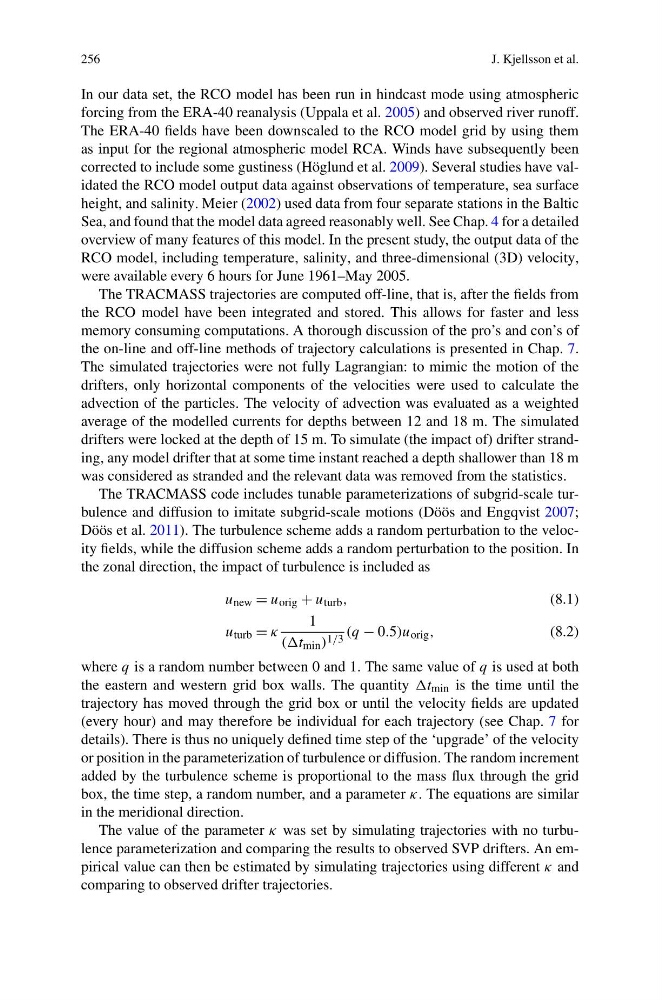
the zonal direction, the impact of turbulence is included as
u new = u orig + u turb ,
(8.1)
u turb = κ
1
((t min ) 1/3 (q − 0.5)u orig ,
(8.2)
where q is a random number between 0 and 1. The same value of q is used at both
the eastern and western grid box walls. The quantity t min is the time until the
trajectory has moved through the grid box or until the velocity fields are updated
(every hour) and may therefore be individual for each trajectory (see Chap. 7 for
details). There is thus no uniquely defined time step of the ‘upgrade’ of the velocity
or position in the parameterization of turbulence or diffusion. The random increment
added by the turbulence scheme is proportional to the mass flux through the grid
box, the time step, a random number, and a parameter κ. The equations are similar
in the meridional direction.
The value of the parameter κ was set by simulating trajectories with no turbulence parameterization and comparing the results to observed SVP drifters. An empirical value can then be estimated by simulating trajectories using different κ and
comparing to observed drifter trajectories.
J. Kjellsson et al.
In our data set, the RCO model has been run in hindcast mode using atmospheric
forcing from the ERA-40 reanalysis (Uppala et al. 2005) and observed river runoff.
The ERA-40 fields have been downscaled to the RCO model grid by using them
as input for the regional atmospheric model RCA. Winds have subsequently been
corrected to include some gustiness (Höglund et al. 2009). Several studies have validated the RCO model output data against observations of temperature, sea surface
height, and salinity. Meier (2002) used data from four separate stations in the Baltic
Sea, and found that the model data agreed reasonably well. See Chap. 4 for a detailed
overview of many features of this model. In the present study, the output data of the
RCO model, including temperature, salinity, and three-dimensional (3D) velocity,
were available every 6 hours for June 1961–May 2005.
The TRACMASS trajectories are computed off-line, that is, after the fields from
the RCO model have been integrated and stored. This allows for faster and less
memory consuming computations. A thorough discussion of the pro’s and con’s of
the on-line and off-line methods of trajectory calculations is presented in Chap. 7.
The simulated trajectories were not fully Lagrangian: to mimic the motion of the
drifters, only horizontal components of the velocities were used to calculate the
advection of the particles. The velocity of advection was evaluated as a weighted
average of the modelled currents for depths between 12 and 18 m. The simulated
drifters were locked at the depth of 15 m. To simulate (the impact of) drifter stranding, any model drifter that at some time instant reached a depth shallower than 18 m
was considered as stranded and the relevant data was removed from the statistics.
The TRACMASS code includes tunable parameterizations of subgrid-scale turbulence and diffusion to imitate subgrid-scale motions (Döös and Engqvist 2007;
Döös et al. 2011). The turbulence scheme adds a random perturbation to the velocity fields, while the diffusion scheme adds a random perturbation to the position. In
the zonal direction, the impact of turbulence is included as
u new = u orig + u turb ,
(8.1)
u turb = κ
1
((t min ) 1/3 (q − 0.5)u orig ,
(8.2)
where q is a random number between 0 and 1. The same value of q is used at both
the eastern and western grid box walls. The quantity t min is the time until the
trajectory has moved through the grid box or until the velocity fields are updated
(every hour) and may therefore be individual for each trajectory (see Chap. 7 for
details). There is thus no uniquely defined time step of the ‘upgrade’ of the velocity
or position in the parameterization of turbulence or diffusion. The random increment
added by the turbulence scheme is proportional to the mass flux through the grid
box, the time step, a random number, and a parameter κ. The equations are similar
in the meridional direction.
The value of the parameter κ was set by simulating trajectories with no turbulence parameterization and comparing the results to observed SVP drifters. An empirical value can then be estimated by simulating trajectories using different κ and
comparing to observed drifter trajectories.