

8 Trajectories and Spreading of Observed and Simulated Drifters in the Baltic Sea
257
The scheme is a low-order one in the sense that it does not take into account
properties such as Lagrangian time scales or Lagrangian velocity autocorrelation.
Schemes like this are often called ‘Markov 0’ processes (Rupolo 2007). Several
more advanced processes of ‘Markov 1’ or ‘Markov 2’ type have been tested in
other studies but never used with the TRACMASS code, and thus are not used in
this study. The possible advantages of using Markov 1 or Markov 2 models will be
discussed in Sect. 8.9.
8.4 Lagrangian Statistics
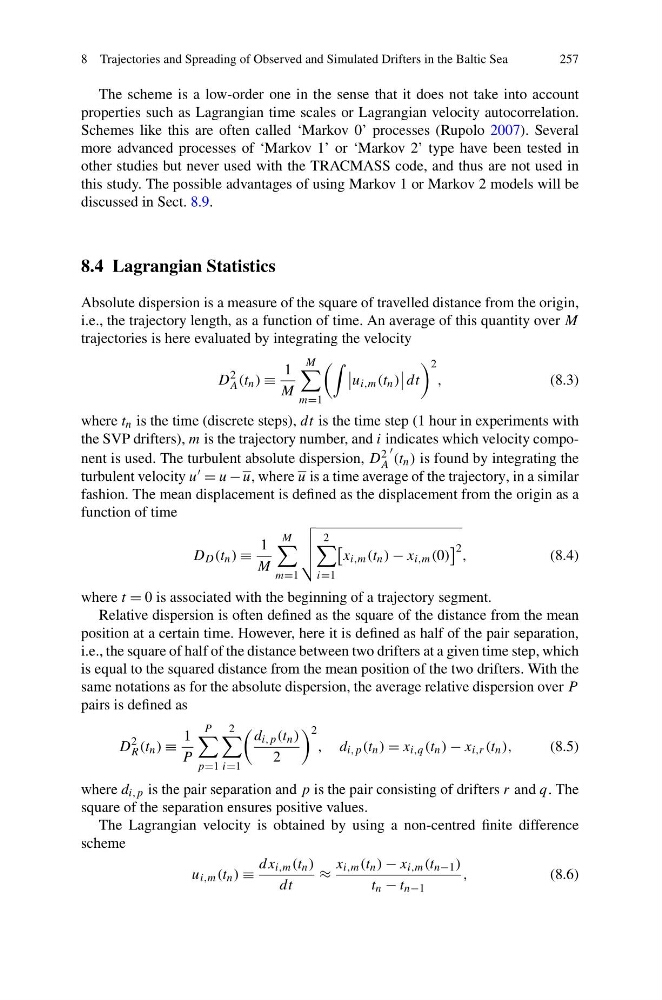
Absolute dispersion is a measure of the square of travelled distance from the origin,
i.e., the trajectory length, as a function of time. An average of this quantity over M
trajectories is here evaluated by integrating the velocity
D
2
A (t n ) ≡
1
M
M
m=1
u i,m (t n )
dt
2
,
(8.3)
where t n is the time (discrete steps), dt is the time step (1 hour in experiments with
the SVP drifters), m is the trajectory number, and i indicates which velocity component is used. The turbulent absolute dispersion, D 2
A
(t n ) is found by integrating the
turbulent velocity u = u − u, where u is a time average of the trajectory, in a similar
fashion. The mean displacement is defined as the displacement from the origin as a
function of time
D D (t n ) ≡
1
M
M
m=1
2
i=1
x i,m (t n ) − x i,m (0)
2 ,
(8.4)
where t = 0 is associated with the beginning of a trajectory segment.
Relative dispersion is often defined as the square of the distance from the mean
position at a certain time. However, here it is defined as half of the pair separation,
i.e., the square of half of the distance between two drifters at a given time step, which
is equal to the squared distance from the mean position of the two drifters. With the
same notations as for the absolute dispersion, the average relative dispersion over P
pairs is defined as
D
2
R (t n ) ≡
1
P
P
p=1
2
i=1
d i,p (t n )
2
2
, d i,p (t n ) = x i,q (t n ) − x i,r (t n ),
(8.5)
where d i,p is the pair separation and p is the pair consisting of drifters r and q. The
square of the separation ensures positive values.
The Lagrangian velocity is obtained by using a non-centred finite difference
scheme
u i,m (t n ) ≡
dx i,m (t n )
dt
≈
x i,m (t n ) − x i,m (t n−1 )
t n − t n−1
,
(8.6)
257
The scheme is a low-order one in the sense that it does not take into account
properties such as Lagrangian time scales or Lagrangian velocity autocorrelation.
Schemes like this are often called ‘Markov 0’ processes (Rupolo 2007). Several
more advanced processes of ‘Markov 1’ or ‘Markov 2’ type have been tested in
other studies but never used with the TRACMASS code, and thus are not used in
this study. The possible advantages of using Markov 1 or Markov 2 models will be
discussed in Sect. 8.9.
8.4 Lagrangian Statistics
Absolute dispersion is a measure of the square of travelled distance from the origin,
i.e., the trajectory length, as a function of time. An average of this quantity over M
trajectories is here evaluated by integrating the velocity
D
2
A (t n ) ≡
1
M
M
m=1
u i,m (t n )
dt
2
,
(8.3)
where t n is the time (discrete steps), dt is the time step (1 hour in experiments with
the SVP drifters), m is the trajectory number, and i indicates which velocity component is used. The turbulent absolute dispersion, D 2
A
(t n ) is found by integrating the
turbulent velocity u = u − u, where u is a time average of the trajectory, in a similar
fashion. The mean displacement is defined as the displacement from the origin as a
function of time
D D (t n ) ≡
1
M
M
m=1
2
i=1
x i,m (t n ) − x i,m (0)
2 ,
(8.4)
where t = 0 is associated with the beginning of a trajectory segment.
Relative dispersion is often defined as the square of the distance from the mean
position at a certain time. However, here it is defined as half of the pair separation,
i.e., the square of half of the distance between two drifters at a given time step, which
is equal to the squared distance from the mean position of the two drifters. With the
same notations as for the absolute dispersion, the average relative dispersion over P
pairs is defined as
D
2
R (t n ) ≡
1
P
P
p=1
2
i=1
d i,p (t n )
2
2
, d i,p (t n ) = x i,q (t n ) − x i,r (t n ),
(8.5)
where d i,p is the pair separation and p is the pair consisting of drifters r and q. The
square of the separation ensures positive values.
The Lagrangian velocity is obtained by using a non-centred finite difference
scheme
u i,m (t n ) ≡
dx i,m (t n )
dt
≈
x i,m (t n ) − x i,m (t n−1 )
t n − t n−1
,
(8.6)