

8 Trajectories and Spreading of Observed and Simulated Drifters in the Baltic Sea
255
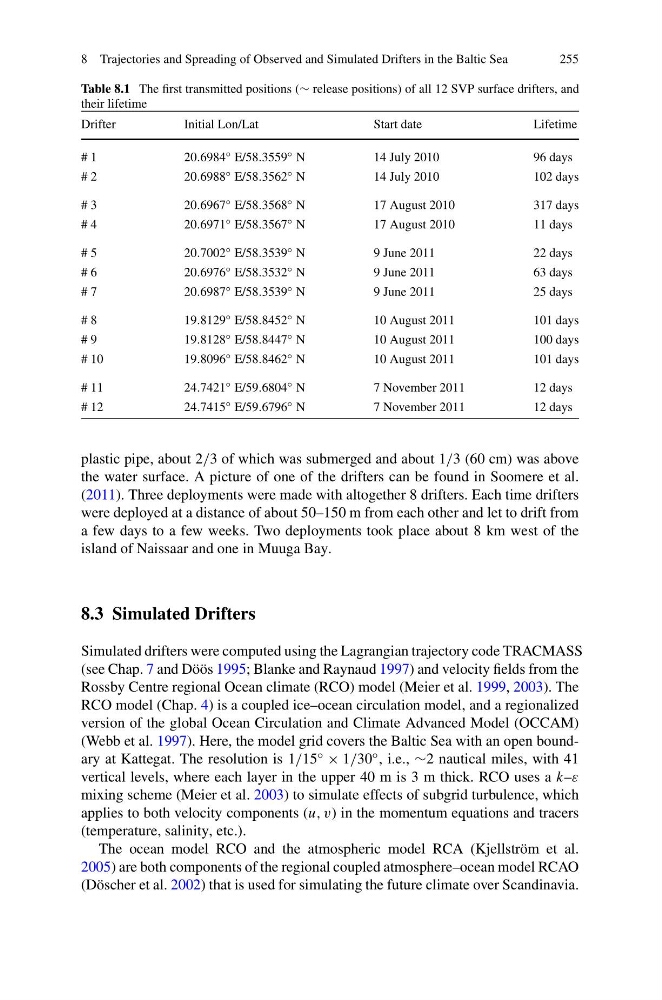
Table 8.1 The first transmitted positions (∼ release positions) of all 12 SVP surface drifters, and
their lifetime
Drifter
Initial Lon/Lat
Start date
Lifetime
# 1
20.6984 ◦ E/58.3559 ◦ N
14 July 2010
96 days
# 2
20.6988 ◦ E/58.3562 ◦ N
14 July 2010
102 days
# 3
20.6967 ◦ E/58.3568 ◦ N
17 August 2010
317 days
# 4
20.6971 ◦ E/58.3567 ◦ N
17 August 2010
11 days
# 5
20.7002 ◦ E/58.3539 ◦ N
9 June 2011
22 days
# 6
20.6976 ◦ E/58.3532 ◦ N
9 June 2011
63 days
# 7
20.6987 ◦ E/58.3539 ◦ N
9 June 2011
25 days
# 8
19.8129 ◦ E/58.8452 ◦ N
10 August 2011
101 days
# 9
19.8128 ◦ E/58.8447 ◦ N
10 August 2011
100 days
# 10
19.8096 ◦ E/58.8462 ◦ N
10 August 2011
101 days
# 11
24.7421 ◦ E/59.6804 ◦ N
7 November 2011
12 days
# 12
24.7415 ◦ E/59.6796 ◦ N
7 November 2011
12 days
plastic pipe, about 2/3 of which was submerged and about 1/3 (60 cm) was above
the water surface. A picture of one of the drifters can be found in Soomere et al.
(2011). Three deployments were made with altogether 8 drifters. Each time drifters
were deployed at a distance of about 50–150 m from each other and let to drift from
a few days to a few weeks. Two deployments took place about 8 km west of the
island of Naissaar and one in Muuga Bay.
8.3 Simulated Drifters
Simulated drifters were computed using the Lagrangian trajectory code TRACMASS
(see Chap. 7 and Döös 1995; Blanke and Raynaud 1997) and velocity fields from the
Rossby Centre regional Ocean climate (RCO) model (Meier et al. 1999, 2003). The
RCO model (Chap. 4) is a coupled ice–ocean circulation model, and a regionalized
version of the global Ocean Circulation and Climate Advanced Model (OCCAM)
(Webb et al. 1997). Here, the model grid covers the Baltic Sea with an open boundary at Kattegat. The resolution is 1/15 ◦ × 1/30 ◦ , i.e., ∼2 nautical miles, with 41
vertical levels, where each layer in the upper 40 m is 3 m thick. RCO uses a k–ε
mixing scheme (Meier et al. 2003) to simulate effects of subgrid turbulence, which
applies to both velocity components (u, v) in the momentum equations and tracers
(temperature, salinity, etc.).
The ocean model RCO and the atmospheric model RCA (Kjellström et al.
2005) are both components of the regional coupled atmosphere–ocean model RCAO
(Döscher et al. 2002) that is used for simulating the future climate over Scandinavia.
255
Table 8.1 The first transmitted positions (∼ release positions) of all 12 SVP surface drifters, and
their lifetime
Drifter
Initial Lon/Lat
Start date
Lifetime
# 1
20.6984 ◦ E/58.3559 ◦ N
14 July 2010
96 days
# 2
20.6988 ◦ E/58.3562 ◦ N
14 July 2010
102 days
# 3
20.6967 ◦ E/58.3568 ◦ N
17 August 2010
317 days
# 4
20.6971 ◦ E/58.3567 ◦ N
17 August 2010
11 days
# 5
20.7002 ◦ E/58.3539 ◦ N
9 June 2011
22 days
# 6
20.6976 ◦ E/58.3532 ◦ N
9 June 2011
63 days
# 7
20.6987 ◦ E/58.3539 ◦ N
9 June 2011
25 days
# 8
19.8129 ◦ E/58.8452 ◦ N
10 August 2011
101 days
# 9
19.8128 ◦ E/58.8447 ◦ N
10 August 2011
100 days
# 10
19.8096 ◦ E/58.8462 ◦ N
10 August 2011
101 days
# 11
24.7421 ◦ E/59.6804 ◦ N
7 November 2011
12 days
# 12
24.7415 ◦ E/59.6796 ◦ N
7 November 2011
12 days
plastic pipe, about 2/3 of which was submerged and about 1/3 (60 cm) was above
the water surface. A picture of one of the drifters can be found in Soomere et al.
(2011). Three deployments were made with altogether 8 drifters. Each time drifters
were deployed at a distance of about 50–150 m from each other and let to drift from
a few days to a few weeks. Two deployments took place about 8 km west of the
island of Naissaar and one in Muuga Bay.
8.3 Simulated Drifters
Simulated drifters were computed using the Lagrangian trajectory code TRACMASS
(see Chap. 7 and Döös 1995; Blanke and Raynaud 1997) and velocity fields from the
Rossby Centre regional Ocean climate (RCO) model (Meier et al. 1999, 2003). The
RCO model (Chap. 4) is a coupled ice–ocean circulation model, and a regionalized
version of the global Ocean Circulation and Climate Advanced Model (OCCAM)
(Webb et al. 1997). Here, the model grid covers the Baltic Sea with an open boundary at Kattegat. The resolution is 1/15 ◦ × 1/30 ◦ , i.e., ∼2 nautical miles, with 41
vertical levels, where each layer in the upper 40 m is 3 m thick. RCO uses a k–ε
mixing scheme (Meier et al. 2003) to simulate effects of subgrid turbulence, which
applies to both velocity components (u, v) in the momentum equations and tracers
(temperature, salinity, etc.).
The ocean model RCO and the atmospheric model RCA (Kjellström et al.
2005) are both components of the regional coupled atmosphere–ocean model RCAO
(Döscher et al. 2002) that is used for simulating the future climate over Scandinavia.