

7 TRACMASS—A Lagrangian Trajectory Model
241
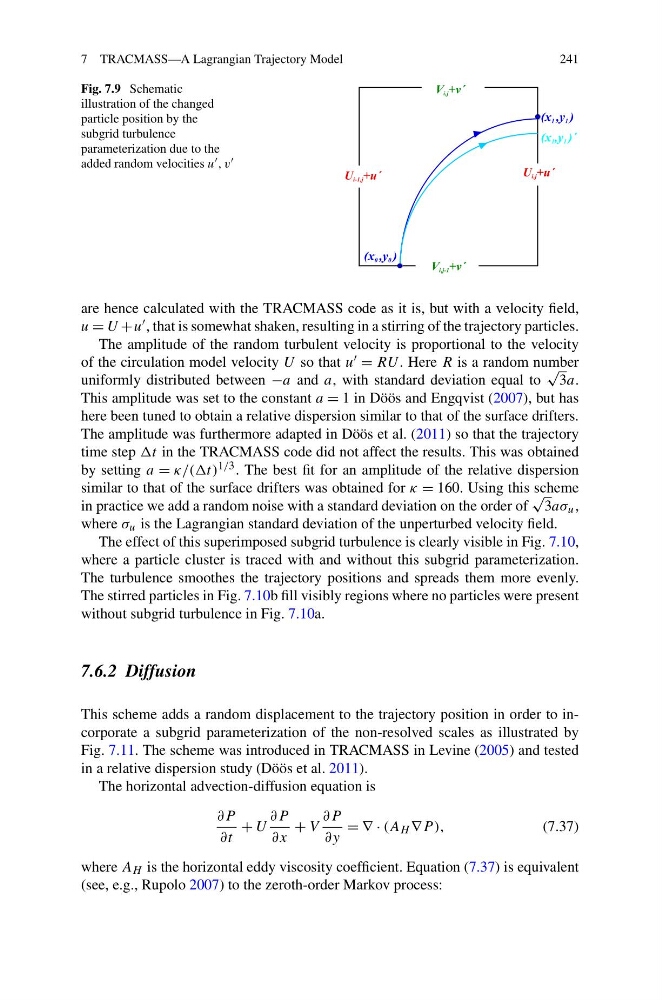
Fig. 7.9 Schematic
illustration of the changed
particle position by the
subgrid turbulence
parameterization due to the
added random velocities u , v
are hence calculated with the TRACMASS code as it is, but with a velocity field,
u = U +u , that is somewhat shaken, resulting in a stirring of the trajectory particles.
The amplitude of the random turbulent velocity is proportional to the velocity
of the circulation model velocity U so that u = RU . Here R is a random number
uniformly distributed between −a and a, with standard deviation equal to
√
3a.
This amplitude was set to the constant a = 1 in Döös and Engqvist (2007), but has
here been tuned to obtain a relative dispersion similar to that of the surface drifters.
The amplitude was furthermore adapted in Döös et al. (2011) so that the trajectory
time step t in the TRACMASS code did not affect the results. This was obtained
by setting a = κ/((t) 1/3 . The best fit for an amplitude of the relative dispersion
similar to that of the surface drifters was obtained for κ = 160. Using this scheme
in practice we add a random noise with a standard deviation on the order of
√
3aσ u ,
where σ u is the Lagrangian standard deviation of the unperturbed velocity field.
The effect of this superimposed subgrid turbulence is clearly visible in Fig. 7.10,
where a particle cluster is traced with and without this subgrid parameterization.
The turbulence smoothes the trajectory positions and spreads them more evenly.
The stirred particles in Fig. 7.10b fill visibly regions where no particles were present
without subgrid turbulence in Fig. 7.10a.
7.6.2 Diffusion
This scheme adds a random displacement to the trajectory position in order to incorporate a subgrid parameterization of the non-resolved scales as illustrated by
Fig. 7.11. The scheme was introduced in TRACMASS in Levine (2005) and tested
in a relative dispersion study (Döös et al. 2011).
The horizontal advection-diffusion equation is
∂P
∂t
+ U
∂P
∂x
+ V
∂P
∂y
= ∇ · (A H ∇P ),
(7.37)
where A H is the horizontal eddy viscosity coefficient. Equation (7.37) is equivalent
(see, e.g., Rupolo 2007) to the zeroth-order Markov process:
241
Fig. 7.9 Schematic
illustration of the changed
particle position by the
subgrid turbulence
parameterization due to the
added random velocities u , v
are hence calculated with the TRACMASS code as it is, but with a velocity field,
u = U +u , that is somewhat shaken, resulting in a stirring of the trajectory particles.
The amplitude of the random turbulent velocity is proportional to the velocity
of the circulation model velocity U so that u = RU . Here R is a random number
uniformly distributed between −a and a, with standard deviation equal to
√
3a.
This amplitude was set to the constant a = 1 in Döös and Engqvist (2007), but has
here been tuned to obtain a relative dispersion similar to that of the surface drifters.
The amplitude was furthermore adapted in Döös et al. (2011) so that the trajectory
time step t in the TRACMASS code did not affect the results. This was obtained
by setting a = κ/((t) 1/3 . The best fit for an amplitude of the relative dispersion
similar to that of the surface drifters was obtained for κ = 160. Using this scheme
in practice we add a random noise with a standard deviation on the order of
√
3aσ u ,
where σ u is the Lagrangian standard deviation of the unperturbed velocity field.
The effect of this superimposed subgrid turbulence is clearly visible in Fig. 7.10,
where a particle cluster is traced with and without this subgrid parameterization.
The turbulence smoothes the trajectory positions and spreads them more evenly.
The stirred particles in Fig. 7.10b fill visibly regions where no particles were present
without subgrid turbulence in Fig. 7.10a.
7.6.2 Diffusion
This scheme adds a random displacement to the trajectory position in order to incorporate a subgrid parameterization of the non-resolved scales as illustrated by
Fig. 7.11. The scheme was introduced in TRACMASS in Levine (2005) and tested
in a relative dispersion study (Döös et al. 2011).
The horizontal advection-diffusion equation is
∂P
∂t
+ U
∂P
∂x
+ V
∂P
∂y
= ∇ · (A H ∇P ),
(7.37)
where A H is the horizontal eddy viscosity coefficient. Equation (7.37) is equivalent
(see, e.g., Rupolo 2007) to the zeroth-order Markov process: