

7 TRACMASS—A Lagrangian Trajectory Model
235
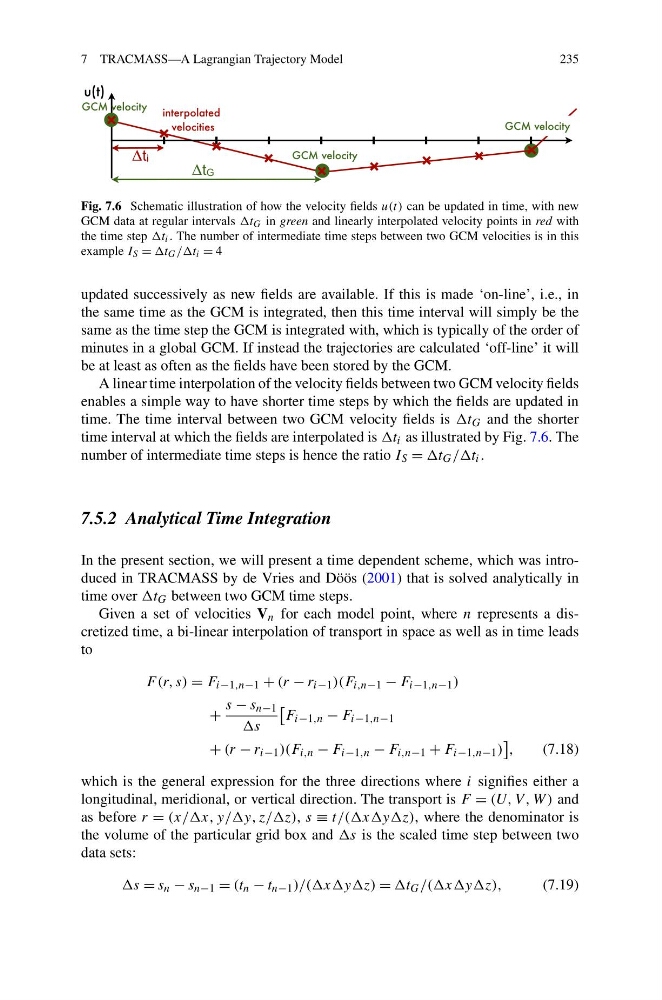
Fig. 7.6 Schematic illustration of how the velocity fields u(t) can be updated in time, with new
GCM data at regular intervals t G in green and linearly interpolated velocity points in red with
the time step t i . The number of intermediate time steps between two GCM velocities is in this
example I S = t G //t i = 4
updated successively as new fields are available. If this is made ‘on-line’, i.e., in
the same time as the GCM is integrated, then this time interval will simply be the
same as the time step the GCM is integrated with, which is typically of the order of
minutes in a global GCM. If instead the trajectories are calculated ‘off-line’ it will
be at least as often as the fields have been stored by the GCM.
A linear time interpolation of the velocity fields between two GCM velocity fields
enables a simple way to have shorter time steps by which the fields are updated in
time. The time interval between two GCM velocity fields is t G and the shorter
time interval at which the fields are interpolated is t i as illustrated by Fig. 7.6. The
number of intermediate time steps is hence the ratio I S = t G //t i .
7.5.2 Analytical Time Integration
In the present section, we will present a time dependent scheme, which was introduced in TRACMASS by de Vries and Döös (2001) that is solved analytically in
time over t G between two GCM time steps.
Given a set of velocities V n for each model point, where n represents a discretized time, a bi-linear interpolation of transport in space as well as in time leads
to
F (r, s) = F i−1,n−1 + (r − r i−1 )(F i,n−1 − F i−1,n−1 )
+
s − s n−1
s
F i−1,n − F i−1,n−1
+ (r − r i−1 )(F i,n − F i−1,n − F i,n−1 + F i−1,n−1 )
,
(7.18)
which is the general expression for the three directions where i signifies either a
longitudinal, meridional, or vertical direction. The transport is F = (U, V , W ) and
as before r = (x//x, y//y, z//z), s ≡ t/((xxyyz), where the denominator is
the volume of the particular grid box and s is the scaled time step between two
data sets:
s = s n − s n−1 = (t n − t n−1 )/((xxyyz) = t G /((xyyz),
(7.19)
235
Fig. 7.6 Schematic illustration of how the velocity fields u(t) can be updated in time, with new
GCM data at regular intervals t G in green and linearly interpolated velocity points in red with
the time step t i . The number of intermediate time steps between two GCM velocities is in this
example I S = t G //t i = 4
updated successively as new fields are available. If this is made ‘on-line’, i.e., in
the same time as the GCM is integrated, then this time interval will simply be the
same as the time step the GCM is integrated with, which is typically of the order of
minutes in a global GCM. If instead the trajectories are calculated ‘off-line’ it will
be at least as often as the fields have been stored by the GCM.
A linear time interpolation of the velocity fields between two GCM velocity fields
enables a simple way to have shorter time steps by which the fields are updated in
time. The time interval between two GCM velocity fields is t G and the shorter
time interval at which the fields are interpolated is t i as illustrated by Fig. 7.6. The
number of intermediate time steps is hence the ratio I S = t G //t i .
7.5.2 Analytical Time Integration
In the present section, we will present a time dependent scheme, which was introduced in TRACMASS by de Vries and Döös (2001) that is solved analytically in
time over t G between two GCM time steps.
Given a set of velocities V n for each model point, where n represents a discretized time, a bi-linear interpolation of transport in space as well as in time leads
to
F (r, s) = F i−1,n−1 + (r − r i−1 )(F i,n−1 − F i−1,n−1 )
+
s − s n−1
s
F i−1,n − F i−1,n−1
+ (r − r i−1 )(F i,n − F i−1,n − F i,n−1 + F i−1,n−1 )
,
(7.18)
which is the general expression for the three directions where i signifies either a
longitudinal, meridional, or vertical direction. The transport is F = (U, V , W ) and
as before r = (x//x, y//y, z//z), s ≡ t/((xxyyz), where the denominator is
the volume of the particular grid box and s is the scaled time step between two
data sets:
s = s n − s n−1 = (t n − t n−1 )/((xxyyz) = t G /((xyyz),
(7.19)