

210
K. Myrberg and T. Soomere
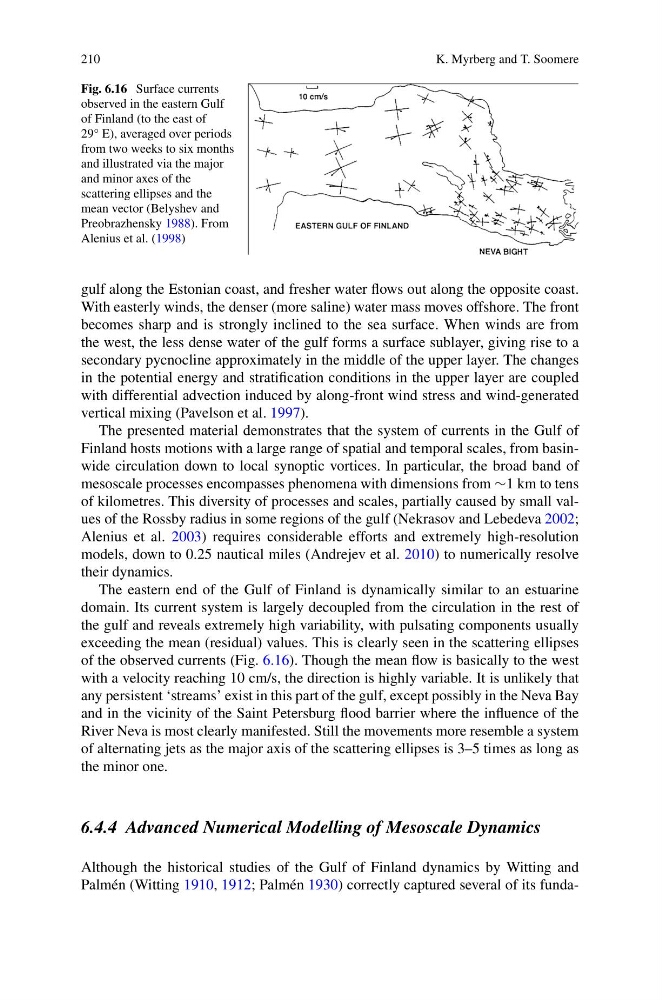
Fig. 6.16 Surface currents
observed in the eastern Gulf
of Finland (to the east of
29° E), averaged over periods
from two weeks to six months
and illustrated via the major
and minor axes of the
scattering ellipses and the
mean vector (Belyshev and
Preobrazhensky 1988). From
Alenius et al. (1998)
gulf along the Estonian coast, and fresher water flows out along the opposite coast.
With easterly winds, the denser (more saline) water mass moves offshore. The front
becomes sharp and is strongly inclined to the sea surface. When winds are from
the west, the less dense water of the gulf forms a surface sublayer, giving rise to a
secondary pycnocline approximately in the middle of the upper layer. The changes
in the potential energy and stratification conditions in the upper layer are coupled
with differential advection induced by along-front wind stress and wind-generated
vertical mixing (Pavelson et al. 1997).
The presented material demonstrates that the system of currents in the Gulf of
Finland hosts motions with a large range of spatial and temporal scales, from basinwide circulation down to local synoptic vortices. In particular, the broad band of
mesoscale processes encompasses phenomena with dimensions from ∼1 km to tens
of kilometres. This diversity of processes and scales, partially caused by small values of the Rossby radius in some regions of the gulf (Nekrasov and Lebedeva 2002;
Alenius et al. 2003) requires considerable efforts and extremely high-resolution
models, down to 0.25 nautical miles (Andrejev et al. 2010) to numerically resolve
their dynamics.
The eastern end of the Gulf of Finland is dynamically similar to an estuarine
domain. Its current system is largely decoupled from the circulation in the rest of
the gulf and reveals extremely high variability, with pulsating components usually
exceeding the mean (residual) values. This is clearly seen in the scattering ellipses
of the observed currents (Fig. 6.16). Though the mean flow is basically to the west
with a velocity reaching 10 cm/s, the direction is highly variable. It is unlikely that
any persistent ‘streams’ exist in this part of the gulf, except possibly in the Neva Bay
and in the vicinity of the Saint Petersburg flood barrier where the influence of the
River Neva is most clearly manifested. Still the movements more resemble a system
of alternating jets as the major axis of the scattering ellipses is 3–5 times as long as
the minor one.
6.4.4 Advanced Numerical Modelling of Mesoscale Dynamics
Although the historical studies of the Gulf of Finland dynamics by Witting and
Palmén (Witting 1910, 1912; Palmén 1930) correctly captured several of its funda-
K. Myrberg and T. Soomere
Fig. 6.16 Surface currents
observed in the eastern Gulf
of Finland (to the east of
29° E), averaged over periods
from two weeks to six months
and illustrated via the major
and minor axes of the
scattering ellipses and the
mean vector (Belyshev and
Preobrazhensky 1988). From
Alenius et al. (1998)
gulf along the Estonian coast, and fresher water flows out along the opposite coast.
With easterly winds, the denser (more saline) water mass moves offshore. The front
becomes sharp and is strongly inclined to the sea surface. When winds are from
the west, the less dense water of the gulf forms a surface sublayer, giving rise to a
secondary pycnocline approximately in the middle of the upper layer. The changes
in the potential energy and stratification conditions in the upper layer are coupled
with differential advection induced by along-front wind stress and wind-generated
vertical mixing (Pavelson et al. 1997).
The presented material demonstrates that the system of currents in the Gulf of
Finland hosts motions with a large range of spatial and temporal scales, from basinwide circulation down to local synoptic vortices. In particular, the broad band of
mesoscale processes encompasses phenomena with dimensions from ∼1 km to tens
of kilometres. This diversity of processes and scales, partially caused by small values of the Rossby radius in some regions of the gulf (Nekrasov and Lebedeva 2002;
Alenius et al. 2003) requires considerable efforts and extremely high-resolution
models, down to 0.25 nautical miles (Andrejev et al. 2010) to numerically resolve
their dynamics.
The eastern end of the Gulf of Finland is dynamically similar to an estuarine
domain. Its current system is largely decoupled from the circulation in the rest of
the gulf and reveals extremely high variability, with pulsating components usually
exceeding the mean (residual) values. This is clearly seen in the scattering ellipses
of the observed currents (Fig. 6.16). Though the mean flow is basically to the west
with a velocity reaching 10 cm/s, the direction is highly variable. It is unlikely that
any persistent ‘streams’ exist in this part of the gulf, except possibly in the Neva Bay
and in the vicinity of the Saint Petersburg flood barrier where the influence of the
River Neva is most clearly manifested. Still the movements more resemble a system
of alternating jets as the major axis of the scattering ellipses is 3–5 times as long as
the minor one.
6.4.4 Advanced Numerical Modelling of Mesoscale Dynamics
Although the historical studies of the Gulf of Finland dynamics by Witting and
Palmén (Witting 1910, 1912; Palmén 1930) correctly captured several of its funda-