

164
E.V. Stanev and X. Lu
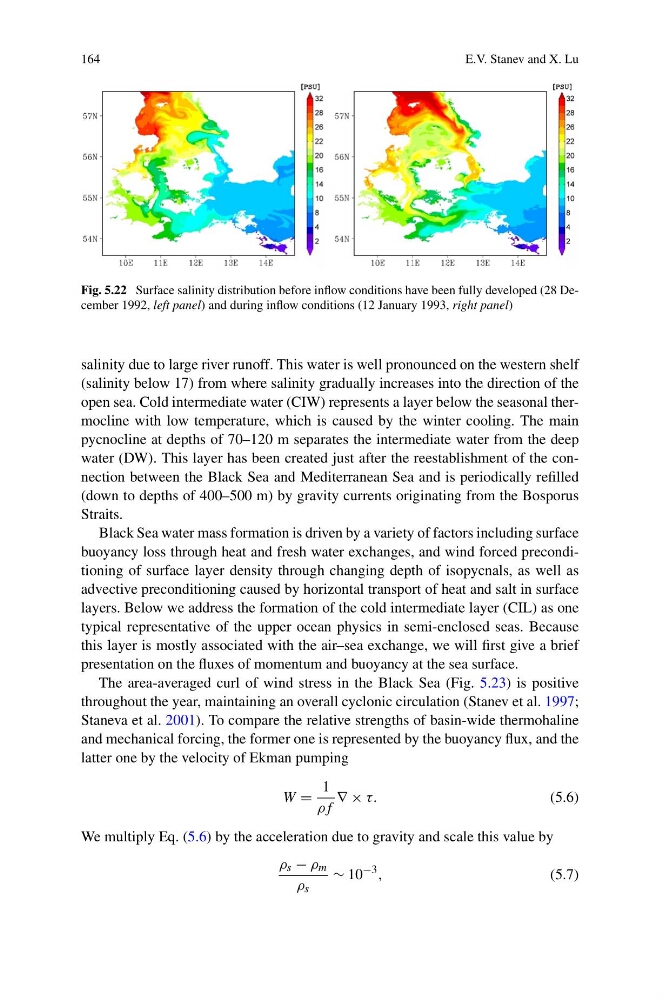
Fig. 5.22 Surface salinity distribution before inflow conditions have been fully developed (28 December 1992, left panel) and during inflow conditions (12 January 1993, right panel)
salinity due to large river runoff. This water is well pronounced on the western shelf
(salinity below 17) from where salinity gradually increases into the direction of the
open sea. Cold intermediate water (CIW) represents a layer below the seasonal thermocline with low temperature, which is caused by the winter cooling. The main
pycnocline at depths of 70–120 m separates the intermediate water from the deep
water (DW). This layer has been created just after the reestablishment of the connection between the Black Sea and Mediterranean Sea and is periodically refilled
(down to depths of 400–500 m) by gravity currents originating from the Bosporus
Straits.
Black Sea water mass formation is driven by a variety of factors including surface
buoyancy loss through heat and fresh water exchanges, and wind forced preconditioning of surface layer density through changing depth of isopycnals, as well as
advective preconditioning caused by horizontal transport of heat and salt in surface
layers. Below we address the formation of the cold intermediate layer (CIL) as one
typical representative of the upper ocean physics in semi-enclosed seas. Because
this layer is mostly associated with the air–sea exchange, we will first give a brief
presentation on the fluxes of momentum and buoyancy at the sea surface.
The area-averaged curl of wind stress in the Black Sea (Fig. 5.23) is positive
throughout the year, maintaining an overall cyclonic circulation (Stanev et al. 1997;
Staneva et al. 2001). To compare the relative strengths of basin-wide thermohaline
and mechanical forcing, the former one is represented by the buoyancy flux, and the
latter one by the velocity of Ekman pumping
W =
1
ρf
∇ × τ.
(5.6)
We multiply Eq. (5.6) by the acceleration due to gravity and scale this value by
ρ s − ρ m
ρ s
∼ 10
−3 ,
(5.7)
E.V. Stanev and X. Lu
Fig. 5.22 Surface salinity distribution before inflow conditions have been fully developed (28 December 1992, left panel) and during inflow conditions (12 January 1993, right panel)
salinity due to large river runoff. This water is well pronounced on the western shelf
(salinity below 17) from where salinity gradually increases into the direction of the
open sea. Cold intermediate water (CIW) represents a layer below the seasonal thermocline with low temperature, which is caused by the winter cooling. The main
pycnocline at depths of 70–120 m separates the intermediate water from the deep
water (DW). This layer has been created just after the reestablishment of the connection between the Black Sea and Mediterranean Sea and is periodically refilled
(down to depths of 400–500 m) by gravity currents originating from the Bosporus
Straits.
Black Sea water mass formation is driven by a variety of factors including surface
buoyancy loss through heat and fresh water exchanges, and wind forced preconditioning of surface layer density through changing depth of isopycnals, as well as
advective preconditioning caused by horizontal transport of heat and salt in surface
layers. Below we address the formation of the cold intermediate layer (CIL) as one
typical representative of the upper ocean physics in semi-enclosed seas. Because
this layer is mostly associated with the air–sea exchange, we will first give a brief
presentation on the fluxes of momentum and buoyancy at the sea surface.
The area-averaged curl of wind stress in the Black Sea (Fig. 5.23) is positive
throughout the year, maintaining an overall cyclonic circulation (Stanev et al. 1997;
Staneva et al. 2001). To compare the relative strengths of basin-wide thermohaline
and mechanical forcing, the former one is represented by the buoyancy flux, and the
latter one by the velocity of Ekman pumping
W =
1
ρf
∇ × τ.
(5.6)
We multiply Eq. (5.6) by the acceleration due to gravity and scale this value by
ρ s − ρ m
ρ s
∼ 10
−3 ,
(5.7)