

5 European Semi-enclosed Seas
163
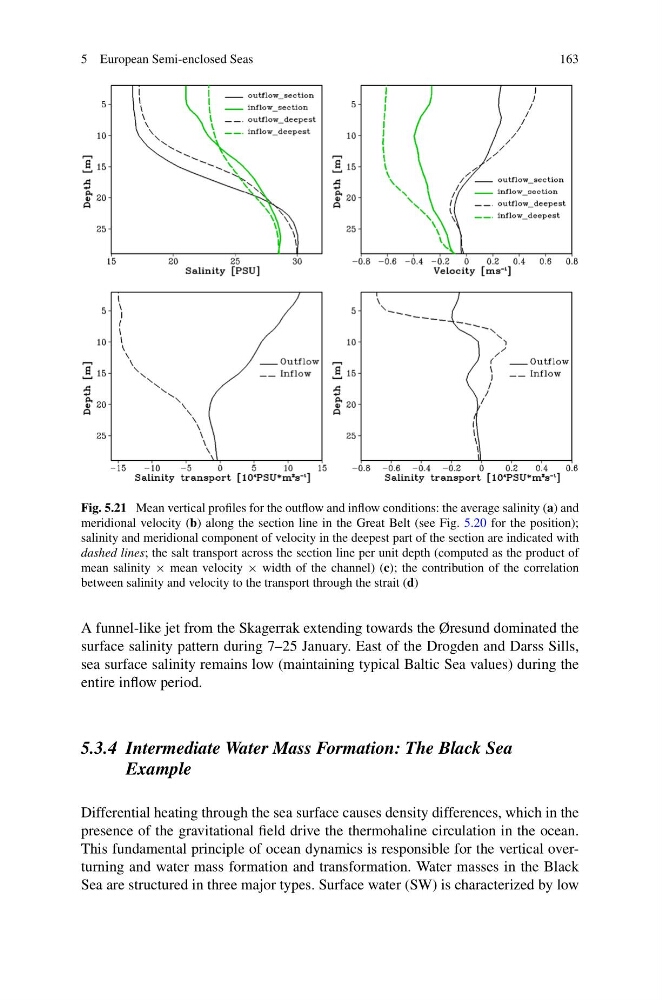
Fig. 5.21 Mean vertical profiles for the outflow and inflow conditions: the average salinity (a) and
meridional velocity (b) along the section line in the Great Belt (see Fig. 5.20 for the position);
salinity and meridional component of velocity in the deepest part of the section are indicated with
dashed lines; the salt transport across the section line per unit depth (computed as the product of
mean salinity × mean velocity × width of the channel) (c); the contribution of the correlation
between salinity and velocity to the transport through the strait (d)
A funnel-like jet from the Skagerrak extending towards the Øresund dominated the
surface salinity pattern during 7–25 January. East of the Drogden and Darss Sills,
sea surface salinity remains low (maintaining typical Baltic Sea values) during the
entire inflow period.
5.3.4 Intermediate Water Mass Formation: The Black Sea
Example
Differential heating through the sea surface causes density differences, which in the
presence of the gravitational field drive the thermohaline circulation in the ocean.
This fundamental principle of ocean dynamics is responsible for the vertical overturning and water mass formation and transformation. Water masses in the Black
Sea are structured in three major types. Surface water (SW) is characterized by low
163
Fig. 5.21 Mean vertical profiles for the outflow and inflow conditions: the average salinity (a) and
meridional velocity (b) along the section line in the Great Belt (see Fig. 5.20 for the position);
salinity and meridional component of velocity in the deepest part of the section are indicated with
dashed lines; the salt transport across the section line per unit depth (computed as the product of
mean salinity × mean velocity × width of the channel) (c); the contribution of the correlation
between salinity and velocity to the transport through the strait (d)
A funnel-like jet from the Skagerrak extending towards the Øresund dominated the
surface salinity pattern during 7–25 January. East of the Drogden and Darss Sills,
sea surface salinity remains low (maintaining typical Baltic Sea values) during the
entire inflow period.
5.3.4 Intermediate Water Mass Formation: The Black Sea
Example
Differential heating through the sea surface causes density differences, which in the
presence of the gravitational field drive the thermohaline circulation in the ocean.
This fundamental principle of ocean dynamics is responsible for the vertical overturning and water mass formation and transformation. Water masses in the Black
Sea are structured in three major types. Surface water (SW) is characterized by low