

5 European Semi-enclosed Seas
165
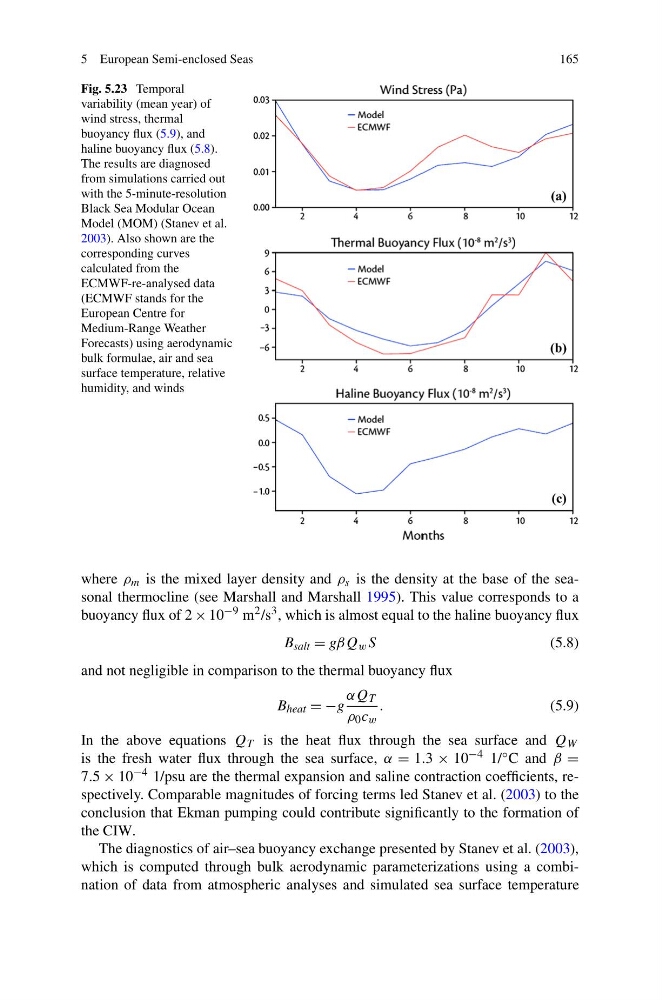
Fig. 5.23 Temporal
variability (mean year) of
wind stress, thermal
buoyancy flux (5.9), and
haline buoyancy flux (5.8).
The results are diagnosed
from simulations carried out
with the 5-minute-resolution
Black Sea Modular Ocean
Model (MOM) (Stanev et al.
2003). Also shown are the
corresponding curves
calculated from the
ECMWF-re-analysed data
(ECMWF stands for the
European Centre for
Medium-Range Weather
Forecasts) using aerodynamic
bulk formulae, air and sea
surface temperature, relative
humidity, and winds
where ρ m is the mixed layer density and ρ s is the density at the base of the seasonal thermocline (see Marshall and Marshall 1995). This value corresponds to a
buoyancy flux of 2 × 10 −9 m 2 /s 3 , which is almost equal to the haline buoyancy flux
B salt = gβQ w S
(5.8)
and not negligible in comparison to the thermal buoyancy flux
B heat = −g
αQ T
ρ 0 c w
.
(5.9)
In the above equations Q T is the heat flux through the sea surface and Q W
is the fresh water flux through the sea surface, α = 1.3 × 10 −4 1/ ◦ C and β =
7.5 × 10 −4 1/psu are the thermal expansion and saline contraction coefficients, respectively. Comparable magnitudes of forcing terms led Stanev et al. (2003) to the
conclusion that Ekman pumping could contribute significantly to the formation of
the CIW.
The diagnostics of air–sea buoyancy exchange presented by Stanev et al. (2003),
which is computed through bulk aerodynamic parameterizations using a combination of data from atmospheric analyses and simulated sea surface temperature
165
Fig. 5.23 Temporal
variability (mean year) of
wind stress, thermal
buoyancy flux (5.9), and
haline buoyancy flux (5.8).
The results are diagnosed
from simulations carried out
with the 5-minute-resolution
Black Sea Modular Ocean
Model (MOM) (Stanev et al.
2003). Also shown are the
corresponding curves
calculated from the
ECMWF-re-analysed data
(ECMWF stands for the
European Centre for
Medium-Range Weather
Forecasts) using aerodynamic
bulk formulae, air and sea
surface temperature, relative
humidity, and winds
where ρ m is the mixed layer density and ρ s is the density at the base of the seasonal thermocline (see Marshall and Marshall 1995). This value corresponds to a
buoyancy flux of 2 × 10 −9 m 2 /s 3 , which is almost equal to the haline buoyancy flux
B salt = gβQ w S
(5.8)
and not negligible in comparison to the thermal buoyancy flux
B heat = −g
αQ T
ρ 0 c w
.
(5.9)
In the above equations Q T is the heat flux through the sea surface and Q W
is the fresh water flux through the sea surface, α = 1.3 × 10 −4 1/ ◦ C and β =
7.5 × 10 −4 1/psu are the thermal expansion and saline contraction coefficients, respectively. Comparable magnitudes of forcing terms led Stanev et al. (2003) to the
conclusion that Ekman pumping could contribute significantly to the formation of
the CIW.
The diagnostics of air–sea buoyancy exchange presented by Stanev et al. (2003),
which is computed through bulk aerodynamic parameterizations using a combination of data from atmospheric analyses and simulated sea surface temperature