

148
E.V. Stanev and X. Lu
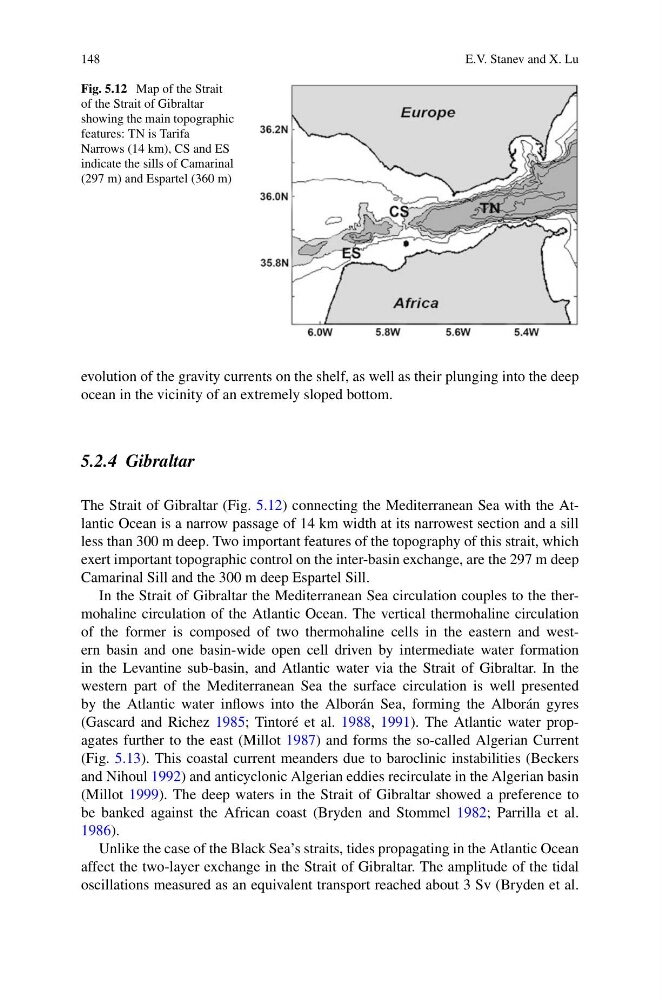
Fig. 5.12 Map of the Strait
of the Strait of Gibraltar
showing the main topographic
features: TN is Tarifa
Narrows (14 km), CS and ES
indicate the sills of Camarinal
(297 m) and Espartel (360 m)
evolution of the gravity currents on the shelf, as well as their plunging into the deep
ocean in the vicinity of an extremely sloped bottom.
5.2.4 Gibraltar
The Strait of Gibraltar (Fig. 5.12) connecting the Mediterranean Sea with the Atlantic Ocean is a narrow passage of 14 km width at its narrowest section and a sill
less than 300 m deep. Two important features of the topography of this strait, which
exert important topographic control on the inter-basin exchange, are the 297 m deep
Camarinal Sill and the 300 m deep Espartel Sill.
In the Strait of Gibraltar the Mediterranean Sea circulation couples to the thermohaline circulation of the Atlantic Ocean. The vertical thermohaline circulation
of the former is composed of two thermohaline cells in the eastern and western basin and one basin-wide open cell driven by intermediate water formation
in the Levantine sub-basin, and Atlantic water via the Strait of Gibraltar. In the
western part of the Mediterranean Sea the surface circulation is well presented
by the Atlantic water inflows into the Alborán Sea, forming the Alborán gyres
(Gascard and Richez 1985; Tintoré et al. 1988, 1991). The Atlantic water propagates further to the east (Millot 1987) and forms the so-called Algerian Current
(Fig. 5.13). This coastal current meanders due to baroclinic instabilities (Beckers
and Nihoul 1992) and anticyclonic Algerian eddies recirculate in the Algerian basin
(Millot 1999). The deep waters in the Strait of Gibraltar showed a preference to
be banked against the African coast (Bryden and Stommel 1982; Parrilla et al.
1986).
Unlike the case of the Black Sea’s straits, tides propagating in the Atlantic Ocean
affect the two-layer exchange in the Strait of Gibraltar. The amplitude of the tidal
oscillations measured as an equivalent transport reached about 3 Sv (Bryden et al.
E.V. Stanev and X. Lu
Fig. 5.12 Map of the Strait
of the Strait of Gibraltar
showing the main topographic
features: TN is Tarifa
Narrows (14 km), CS and ES
indicate the sills of Camarinal
(297 m) and Espartel (360 m)
evolution of the gravity currents on the shelf, as well as their plunging into the deep
ocean in the vicinity of an extremely sloped bottom.
5.2.4 Gibraltar
The Strait of Gibraltar (Fig. 5.12) connecting the Mediterranean Sea with the Atlantic Ocean is a narrow passage of 14 km width at its narrowest section and a sill
less than 300 m deep. Two important features of the topography of this strait, which
exert important topographic control on the inter-basin exchange, are the 297 m deep
Camarinal Sill and the 300 m deep Espartel Sill.
In the Strait of Gibraltar the Mediterranean Sea circulation couples to the thermohaline circulation of the Atlantic Ocean. The vertical thermohaline circulation
of the former is composed of two thermohaline cells in the eastern and western basin and one basin-wide open cell driven by intermediate water formation
in the Levantine sub-basin, and Atlantic water via the Strait of Gibraltar. In the
western part of the Mediterranean Sea the surface circulation is well presented
by the Atlantic water inflows into the Alborán Sea, forming the Alborán gyres
(Gascard and Richez 1985; Tintoré et al. 1988, 1991). The Atlantic water propagates further to the east (Millot 1987) and forms the so-called Algerian Current
(Fig. 5.13). This coastal current meanders due to baroclinic instabilities (Beckers
and Nihoul 1992) and anticyclonic Algerian eddies recirculate in the Algerian basin
(Millot 1999). The deep waters in the Strait of Gibraltar showed a preference to
be banked against the African coast (Bryden and Stommel 1982; Parrilla et al.
1986).
Unlike the case of the Black Sea’s straits, tides propagating in the Atlantic Ocean
affect the two-layer exchange in the Strait of Gibraltar. The amplitude of the tidal
oscillations measured as an equivalent transport reached about 3 Sv (Bryden et al.