

5 European Semi-enclosed Seas
149
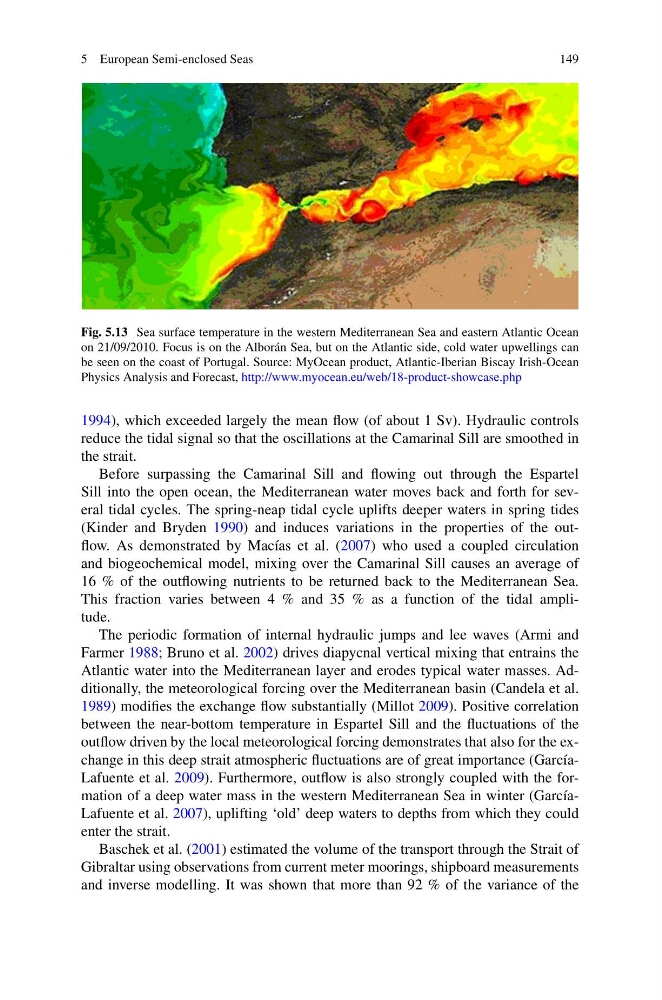
Fig. 5.13 Sea surface temperature in the western Mediterranean Sea and eastern Atlantic Ocean
on 21/09/2010. Focus is on the Alborán Sea, but on the Atlantic side, cold water upwellings can
be seen on the coast of Portugal. Source: MyOcean product, Atlantic-Iberian Biscay Irish-Ocean
Physics Analysis and Forecast, http://www.myocean.eu/web/18-product-showcase.php
1994), which exceeded largely the mean flow (of about 1 Sv). Hydraulic controls
reduce the tidal signal so that the oscillations at the Camarinal Sill are smoothed in
the strait.
Before surpassing the Camarinal Sill and flowing out through the Espartel
Sill into the open ocean, the Mediterranean water moves back and forth for several tidal cycles. The spring-neap tidal cycle uplifts deeper waters in spring tides
(Kinder and Bryden 1990) and induces variations in the properties of the outflow. As demonstrated by Macías et al. (2007) who used a coupled circulation
and biogeochemical model, mixing over the Camarinal Sill causes an average of
16 % of the outflowing nutrients to be returned back to the Mediterranean Sea.
This fraction varies between 4 % and 35 % as a function of the tidal amplitude.
The periodic formation of internal hydraulic jumps and lee waves (Armi and
Farmer 1988; Bruno et al. 2002) drives diapycnal vertical mixing that entrains the
Atlantic water into the Mediterranean layer and erodes typical water masses. Additionally, the meteorological forcing over the Mediterranean basin (Candela et al.
1989) modifies the exchange flow substantially (Millot 2009). Positive correlation
between the near-bottom temperature in Espartel Sill and the fluctuations of the
outflow driven by the local meteorological forcing demonstrates that also for the exchange in this deep strait atmospheric fluctuations are of great importance (GarcíaLafuente et al. 2009). Furthermore, outflow is also strongly coupled with the formation of a deep water mass in the western Mediterranean Sea in winter (GarcíaLafuente et al. 2007), uplifting ‘old’ deep waters to depths from which they could
enter the strait.
Baschek et al. (2001) estimated the volume of the transport through the Strait of
Gibraltar using observations from current meter moorings, shipboard measurements
and inverse modelling. It was shown that more than 92 % of the variance of the
149
Fig. 5.13 Sea surface temperature in the western Mediterranean Sea and eastern Atlantic Ocean
on 21/09/2010. Focus is on the Alborán Sea, but on the Atlantic side, cold water upwellings can
be seen on the coast of Portugal. Source: MyOcean product, Atlantic-Iberian Biscay Irish-Ocean
Physics Analysis and Forecast, http://www.myocean.eu/web/18-product-showcase.php
1994), which exceeded largely the mean flow (of about 1 Sv). Hydraulic controls
reduce the tidal signal so that the oscillations at the Camarinal Sill are smoothed in
the strait.
Before surpassing the Camarinal Sill and flowing out through the Espartel
Sill into the open ocean, the Mediterranean water moves back and forth for several tidal cycles. The spring-neap tidal cycle uplifts deeper waters in spring tides
(Kinder and Bryden 1990) and induces variations in the properties of the outflow. As demonstrated by Macías et al. (2007) who used a coupled circulation
and biogeochemical model, mixing over the Camarinal Sill causes an average of
16 % of the outflowing nutrients to be returned back to the Mediterranean Sea.
This fraction varies between 4 % and 35 % as a function of the tidal amplitude.
The periodic formation of internal hydraulic jumps and lee waves (Armi and
Farmer 1988; Bruno et al. 2002) drives diapycnal vertical mixing that entrains the
Atlantic water into the Mediterranean layer and erodes typical water masses. Additionally, the meteorological forcing over the Mediterranean basin (Candela et al.
1989) modifies the exchange flow substantially (Millot 2009). Positive correlation
between the near-bottom temperature in Espartel Sill and the fluctuations of the
outflow driven by the local meteorological forcing demonstrates that also for the exchange in this deep strait atmospheric fluctuations are of great importance (GarcíaLafuente et al. 2009). Furthermore, outflow is also strongly coupled with the formation of a deep water mass in the western Mediterranean Sea in winter (GarcíaLafuente et al. 2007), uplifting ‘old’ deep waters to depths from which they could
enter the strait.
Baschek et al. (2001) estimated the volume of the transport through the Strait of
Gibraltar using observations from current meter moorings, shipboard measurements
and inverse modelling. It was shown that more than 92 % of the variance of the