

5 European Semi-enclosed Seas
147
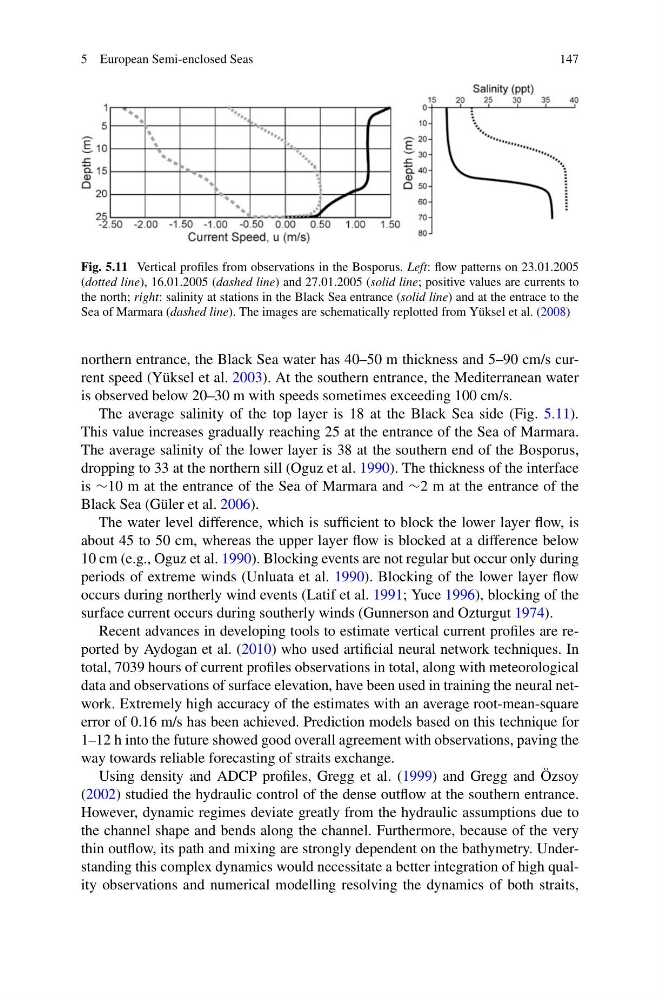
Fig. 5.11 Vertical profiles from observations in the Bosporus. Left: flow patterns on 23.01.2005
(dotted line), 16.01.2005 (dashed line) and 27.01.2005 (solid line; positive values are currents to
the north; right: salinity at stations in the Black Sea entrance (solid line) and at the entrace to the
Sea of Marmara (dashed line). The images are schematically replotted from Yüksel et al. (2008)
northern entrance, the Black Sea water has 40–50 m thickness and 5–90 cm/s current speed (Yüksel et al. 2003). At the southern entrance, the Mediterranean water
is observed below 20–30 m with speeds sometimes exceeding 100 cm/s.
The average salinity of the top layer is 18 at the Black Sea side (Fig. 5.11).
This value increases gradually reaching 25 at the entrance of the Sea of Marmara.
The average salinity of the lower layer is 38 at the southern end of the Bosporus,
dropping to 33 at the northern sill (Oguz et al. 1990). The thickness of the interface
is ∼10 m at the entrance of the Sea of Marmara and ∼2 m at the entrance of the
Black Sea (Güler et al. 2006).
The water level difference, which is sufficient to block the lower layer flow, is
about 45 to 50 cm, whereas the upper layer flow is blocked at a difference below
10 cm (e.g., Oguz et al. 1990). Blocking events are not regular but occur only during
periods of extreme winds (Unluata et al. 1990). Blocking of the lower layer flow
occurs during northerly wind events (Latif et al. 1991; Yuce 1996), blocking of the
surface current occurs during southerly winds (Gunnerson and Ozturgut 1974).
Recent advances in developing tools to estimate vertical current profiles are reported by Aydogan et al. (2010) who used artificial neural network techniques. In
total, 7039 hours of current profiles observations in total, along with meteorological
data and observations of surface elevation, have been used in training the neural network. Extremely high accuracy of the estimates with an average root-mean-square
error of 0.16 m/s has been achieved. Prediction models based on this technique for
1–12 h into the future showed good overall agreement with observations, paving the
way towards reliable forecasting of straits exchange.
Using density and ADCP profiles, Gregg et al. (1999) and Gregg and Özsoy
(2002) studied the hydraulic control of the dense outflow at the southern entrance.
However, dynamic regimes deviate greatly from the hydraulic assumptions due to
the channel shape and bends along the channel. Furthermore, because of the very
thin outflow, its path and mixing are strongly dependent on the bathymetry. Understanding this complex dynamics would necessitate a better integration of high quality observations and numerical modelling resolving the dynamics of both straits,
147
Fig. 5.11 Vertical profiles from observations in the Bosporus. Left: flow patterns on 23.01.2005
(dotted line), 16.01.2005 (dashed line) and 27.01.2005 (solid line; positive values are currents to
the north; right: salinity at stations in the Black Sea entrance (solid line) and at the entrace to the
Sea of Marmara (dashed line). The images are schematically replotted from Yüksel et al. (2008)
northern entrance, the Black Sea water has 40–50 m thickness and 5–90 cm/s current speed (Yüksel et al. 2003). At the southern entrance, the Mediterranean water
is observed below 20–30 m with speeds sometimes exceeding 100 cm/s.
The average salinity of the top layer is 18 at the Black Sea side (Fig. 5.11).
This value increases gradually reaching 25 at the entrance of the Sea of Marmara.
The average salinity of the lower layer is 38 at the southern end of the Bosporus,
dropping to 33 at the northern sill (Oguz et al. 1990). The thickness of the interface
is ∼10 m at the entrance of the Sea of Marmara and ∼2 m at the entrance of the
Black Sea (Güler et al. 2006).
The water level difference, which is sufficient to block the lower layer flow, is
about 45 to 50 cm, whereas the upper layer flow is blocked at a difference below
10 cm (e.g., Oguz et al. 1990). Blocking events are not regular but occur only during
periods of extreme winds (Unluata et al. 1990). Blocking of the lower layer flow
occurs during northerly wind events (Latif et al. 1991; Yuce 1996), blocking of the
surface current occurs during southerly winds (Gunnerson and Ozturgut 1974).
Recent advances in developing tools to estimate vertical current profiles are reported by Aydogan et al. (2010) who used artificial neural network techniques. In
total, 7039 hours of current profiles observations in total, along with meteorological
data and observations of surface elevation, have been used in training the neural network. Extremely high accuracy of the estimates with an average root-mean-square
error of 0.16 m/s has been achieved. Prediction models based on this technique for
1–12 h into the future showed good overall agreement with observations, paving the
way towards reliable forecasting of straits exchange.
Using density and ADCP profiles, Gregg et al. (1999) and Gregg and Özsoy
(2002) studied the hydraulic control of the dense outflow at the southern entrance.
However, dynamic regimes deviate greatly from the hydraulic assumptions due to
the channel shape and bends along the channel. Furthermore, because of the very
thin outflow, its path and mixing are strongly dependent on the bathymetry. Understanding this complex dynamics would necessitate a better integration of high quality observations and numerical modelling resolving the dynamics of both straits,