

136
E.V. Stanev and X. Lu
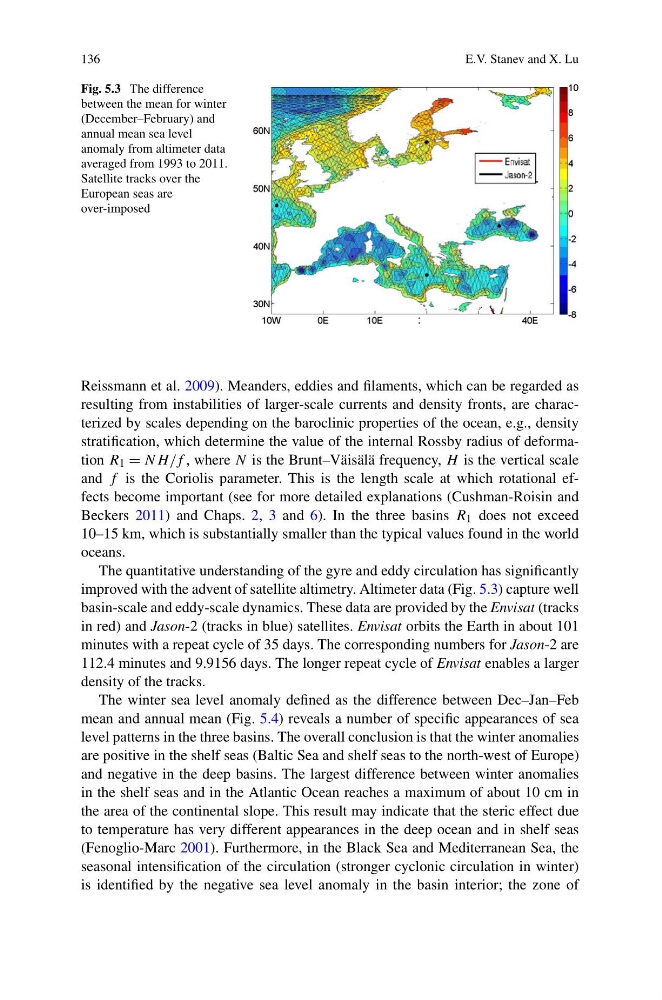
Fig. 5.3 The difference
between the mean for winter
(December–February) and
annual mean sea level
anomaly from altimeter data
averaged from 1993 to 2011.
Satellite tracks over the
European seas are
over-imposed
Reissmann et al. 2009). Meanders, eddies and filaments, which can be regarded as
resulting from instabilities of larger-scale currents and density fronts, are characterized by scales depending on the baroclinic properties of the ocean, e.g., density
stratification, which determine the value of the internal Rossby radius of deformation R 1 = NH/f , where N is the Brunt–Väisälä frequency, H is the vertical scale
and f is the Coriolis parameter. This is the length scale at which rotational effects become important (see for more detailed explanations (Cushman-Roisin and
Beckers 2011) and Chaps. 2, 3 and 6). In the three basins R 1 does not exceed
10–15 km, which is substantially smaller than the typical values found in the world
oceans.
The quantitative understanding of the gyre and eddy circulation has significantly
improved with the advent of satellite altimetry. Altimeter data (Fig. 5.3) capture well
basin-scale and eddy-scale dynamics. These data are provided by the Envisat (tracks
in red) and Jason-2 (tracks in blue) satellites. Envisat orbits the Earth in about 101
minutes with a repeat cycle of 35 days. The corresponding numbers for Jason-2 are
112.4 minutes and 9.9156 days. The longer repeat cycle of Envisat enables a larger
density of the tracks.
The winter sea level anomaly defined as the difference between Dec–Jan–Feb
mean and annual mean (Fig. 5.4) reveals a number of specific appearances of sea
level patterns in the three basins. The overall conclusion is that the winter anomalies
are positive in the shelf seas (Baltic Sea and shelf seas to the north-west of Europe)
and negative in the deep basins. The largest difference between winter anomalies
in the shelf seas and in the Atlantic Ocean reaches a maximum of about 10 cm in
the area of the continental slope. This result may indicate that the steric effect due
to temperature has very different appearances in the deep ocean and in shelf seas
(Fenoglio-Marc 2001). Furthermore, in the Black Sea and Mediterranean Sea, the
seasonal intensification of the circulation (stronger cyclonic circulation in winter)
is identified by the negative sea level anomaly in the basin interior; the zone of
E.V. Stanev and X. Lu
Fig. 5.3 The difference
between the mean for winter
(December–February) and
annual mean sea level
anomaly from altimeter data
averaged from 1993 to 2011.
Satellite tracks over the
European seas are
over-imposed
Reissmann et al. 2009). Meanders, eddies and filaments, which can be regarded as
resulting from instabilities of larger-scale currents and density fronts, are characterized by scales depending on the baroclinic properties of the ocean, e.g., density
stratification, which determine the value of the internal Rossby radius of deformation R 1 = NH/f , where N is the Brunt–Väisälä frequency, H is the vertical scale
and f is the Coriolis parameter. This is the length scale at which rotational effects become important (see for more detailed explanations (Cushman-Roisin and
Beckers 2011) and Chaps. 2, 3 and 6). In the three basins R 1 does not exceed
10–15 km, which is substantially smaller than the typical values found in the world
oceans.
The quantitative understanding of the gyre and eddy circulation has significantly
improved with the advent of satellite altimetry. Altimeter data (Fig. 5.3) capture well
basin-scale and eddy-scale dynamics. These data are provided by the Envisat (tracks
in red) and Jason-2 (tracks in blue) satellites. Envisat orbits the Earth in about 101
minutes with a repeat cycle of 35 days. The corresponding numbers for Jason-2 are
112.4 minutes and 9.9156 days. The longer repeat cycle of Envisat enables a larger
density of the tracks.
The winter sea level anomaly defined as the difference between Dec–Jan–Feb
mean and annual mean (Fig. 5.4) reveals a number of specific appearances of sea
level patterns in the three basins. The overall conclusion is that the winter anomalies
are positive in the shelf seas (Baltic Sea and shelf seas to the north-west of Europe)
and negative in the deep basins. The largest difference between winter anomalies
in the shelf seas and in the Atlantic Ocean reaches a maximum of about 10 cm in
the area of the continental slope. This result may indicate that the steric effect due
to temperature has very different appearances in the deep ocean and in shelf seas
(Fenoglio-Marc 2001). Furthermore, in the Black Sea and Mediterranean Sea, the
seasonal intensification of the circulation (stronger cyclonic circulation in winter)
is identified by the negative sea level anomaly in the basin interior; the zone of