

5 European Semi-enclosed Seas
135
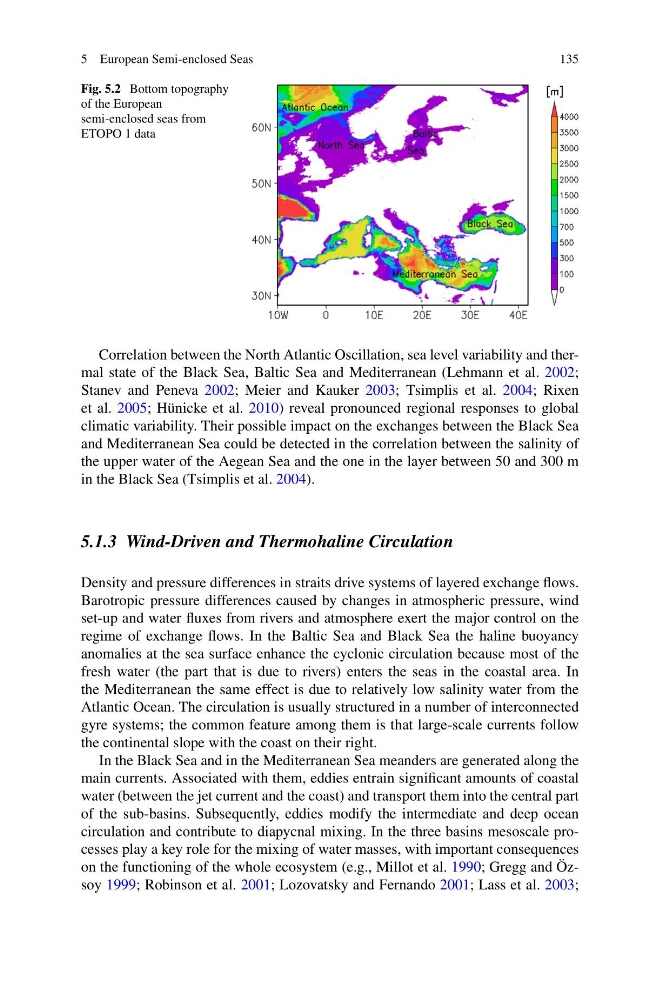
Fig. 5.2 Bottom topography
of the European
semi-enclosed seas from
ETOPO 1 data
Correlation between the North Atlantic Oscillation, sea level variability and thermal state of the Black Sea, Baltic Sea and Mediterranean (Lehmann et al. 2002;
Stanev and Peneva 2002; Meier and Kauker 2003; Tsimplis et al. 2004; Rixen
et al. 2005; Hünicke et al. 2010) reveal pronounced regional responses to global
climatic variability. Their possible impact on the exchanges between the Black Sea
and Mediterranean Sea could be detected in the correlation between the salinity of
the upper water of the Aegean Sea and the one in the layer between 50 and 300 m
in the Black Sea (Tsimplis et al. 2004).
5.1.3 Wind-Driven and Thermohaline Circulation
Density and pressure differences in straits drive systems of layered exchange flows.
Barotropic pressure differences caused by changes in atmospheric pressure, wind
set-up and water fluxes from rivers and atmosphere exert the major control on the
regime of exchange flows. In the Baltic Sea and Black Sea the haline buoyancy
anomalies at the sea surface enhance the cyclonic circulation because most of the
fresh water (the part that is due to rivers) enters the seas in the coastal area. In
the Mediterranean the same effect is due to relatively low salinity water from the
Atlantic Ocean. The circulation is usually structured in a number of interconnected
gyre systems; the common feature among them is that large-scale currents follow
the continental slope with the coast on their right.
In the Black Sea and in the Mediterranean Sea meanders are generated along the
main currents. Associated with them, eddies entrain significant amounts of coastal
water (between the jet current and the coast) and transport them into the central part
of the sub-basins. Subsequently, eddies modify the intermediate and deep ocean
circulation and contribute to diapycnal mixing. In the three basins mesoscale processes play a key role for the mixing of water masses, with important consequences
on the functioning of the whole ecosystem (e.g., Millot et al. 1990; Gregg and Özsoy 1999; Robinson et al. 2001; Lozovatsky and Fernando 2001; Lass et al. 2003;
135
Fig. 5.2 Bottom topography
of the European
semi-enclosed seas from
ETOPO 1 data
Correlation between the North Atlantic Oscillation, sea level variability and thermal state of the Black Sea, Baltic Sea and Mediterranean (Lehmann et al. 2002;
Stanev and Peneva 2002; Meier and Kauker 2003; Tsimplis et al. 2004; Rixen
et al. 2005; Hünicke et al. 2010) reveal pronounced regional responses to global
climatic variability. Their possible impact on the exchanges between the Black Sea
and Mediterranean Sea could be detected in the correlation between the salinity of
the upper water of the Aegean Sea and the one in the layer between 50 and 300 m
in the Black Sea (Tsimplis et al. 2004).
5.1.3 Wind-Driven and Thermohaline Circulation
Density and pressure differences in straits drive systems of layered exchange flows.
Barotropic pressure differences caused by changes in atmospheric pressure, wind
set-up and water fluxes from rivers and atmosphere exert the major control on the
regime of exchange flows. In the Baltic Sea and Black Sea the haline buoyancy
anomalies at the sea surface enhance the cyclonic circulation because most of the
fresh water (the part that is due to rivers) enters the seas in the coastal area. In
the Mediterranean the same effect is due to relatively low salinity water from the
Atlantic Ocean. The circulation is usually structured in a number of interconnected
gyre systems; the common feature among them is that large-scale currents follow
the continental slope with the coast on their right.
In the Black Sea and in the Mediterranean Sea meanders are generated along the
main currents. Associated with them, eddies entrain significant amounts of coastal
water (between the jet current and the coast) and transport them into the central part
of the sub-basins. Subsequently, eddies modify the intermediate and deep ocean
circulation and contribute to diapycnal mixing. In the three basins mesoscale processes play a key role for the mixing of water masses, with important consequences
on the functioning of the whole ecosystem (e.g., Millot et al. 1990; Gregg and Özsoy 1999; Robinson et al. 2001; Lozovatsky and Fernando 2001; Lass et al. 2003;