

4 Studying the Baltic Sea Circulation with Eulerian Tracers
103
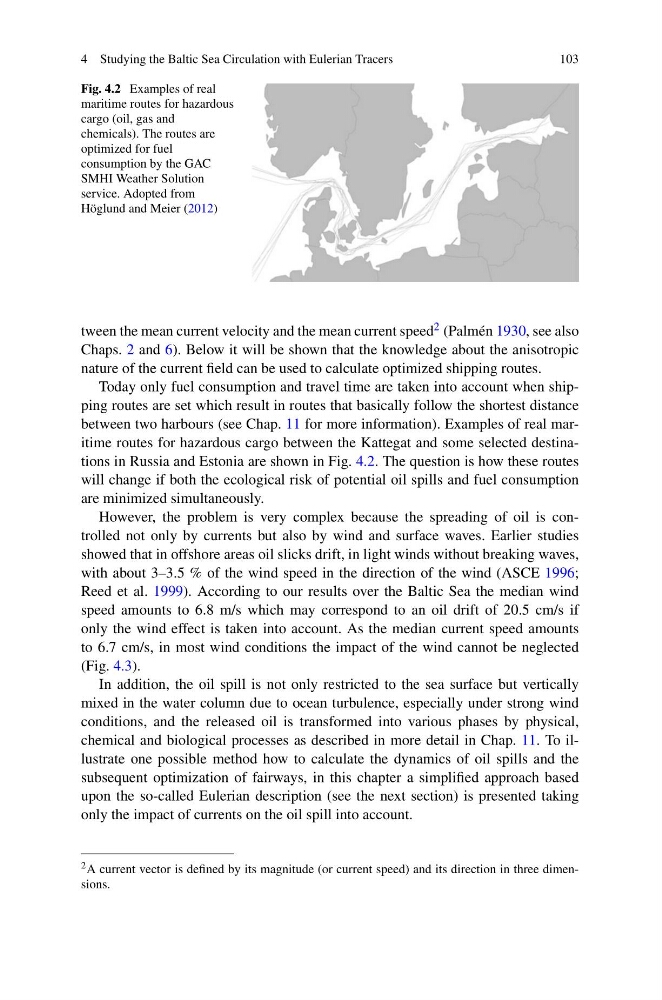
Fig. 4.2 Examples of real
maritime routes for hazardous
cargo (oil, gas and
chemicals). The routes are
optimized for fuel
consumption by the GAC
SMHI Weather Solution
service. Adopted from
Höglund and Meier (2012)
tween the mean current velocity and the mean current speed 2 (Palmén 1930, see also
Chaps. 2 and 6). Below it will be shown that the knowledge about the anisotropic
nature of the current field can be used to calculate optimized shipping routes.
Today only fuel consumption and travel time are taken into account when shipping routes are set which result in routes that basically follow the shortest distance
between two harbours (see Chap. 11 for more information). Examples of real maritime routes for hazardous cargo between the Kattegat and some selected destinations in Russia and Estonia are shown in Fig. 4.2. The question is how these routes
will change if both the ecological risk of potential oil spills and fuel consumption
are minimized simultaneously.
However, the problem is very complex because the spreading of oil is controlled not only by currents but also by wind and surface waves. Earlier studies
showed that in offshore areas oil slicks drift, in light winds without breaking waves,
with about 3–3.5 % of the wind speed in the direction of the wind (ASCE 1996;
Reed et al. 1999). According to our results over the Baltic Sea the median wind
speed amounts to 6.8 m/s which may correspond to an oil drift of 20.5 cm/s if
only the wind effect is taken into account. As the median current speed amounts
to 6.7 cm/s, in most wind conditions the impact of the wind cannot be neglected
(Fig. 4.3).
In addition, the oil spill is not only restricted to the sea surface but vertically
mixed in the water column due to ocean turbulence, especially under strong wind
conditions, and the released oil is transformed into various phases by physical,
chemical and biological processes as described in more detail in Chap. 11. To illustrate one possible method how to calculate the dynamics of oil spills and the
subsequent optimization of fairways, in this chapter a simplified approach based
upon the so-called Eulerian description (see the next section) is presented taking
only the impact of currents on the oil spill into account.
2 A current vector is defined by its magnitude (or current speed) and its direction in three dimensions.
103
Fig. 4.2 Examples of real
maritime routes for hazardous
cargo (oil, gas and
chemicals). The routes are
optimized for fuel
consumption by the GAC
SMHI Weather Solution
service. Adopted from
Höglund and Meier (2012)
tween the mean current velocity and the mean current speed 2 (Palmén 1930, see also
Chaps. 2 and 6). Below it will be shown that the knowledge about the anisotropic
nature of the current field can be used to calculate optimized shipping routes.
Today only fuel consumption and travel time are taken into account when shipping routes are set which result in routes that basically follow the shortest distance
between two harbours (see Chap. 11 for more information). Examples of real maritime routes for hazardous cargo between the Kattegat and some selected destinations in Russia and Estonia are shown in Fig. 4.2. The question is how these routes
will change if both the ecological risk of potential oil spills and fuel consumption
are minimized simultaneously.
However, the problem is very complex because the spreading of oil is controlled not only by currents but also by wind and surface waves. Earlier studies
showed that in offshore areas oil slicks drift, in light winds without breaking waves,
with about 3–3.5 % of the wind speed in the direction of the wind (ASCE 1996;
Reed et al. 1999). According to our results over the Baltic Sea the median wind
speed amounts to 6.8 m/s which may correspond to an oil drift of 20.5 cm/s if
only the wind effect is taken into account. As the median current speed amounts
to 6.7 cm/s, in most wind conditions the impact of the wind cannot be neglected
(Fig. 4.3).
In addition, the oil spill is not only restricted to the sea surface but vertically
mixed in the water column due to ocean turbulence, especially under strong wind
conditions, and the released oil is transformed into various phases by physical,
chemical and biological processes as described in more detail in Chap. 11. To illustrate one possible method how to calculate the dynamics of oil spills and the
subsequent optimization of fairways, in this chapter a simplified approach based
upon the so-called Eulerian description (see the next section) is presented taking
only the impact of currents on the oil spill into account.
2 A current vector is defined by its magnitude (or current speed) and its direction in three dimensions.