

104
H.E.M. Meier and A. Höglund
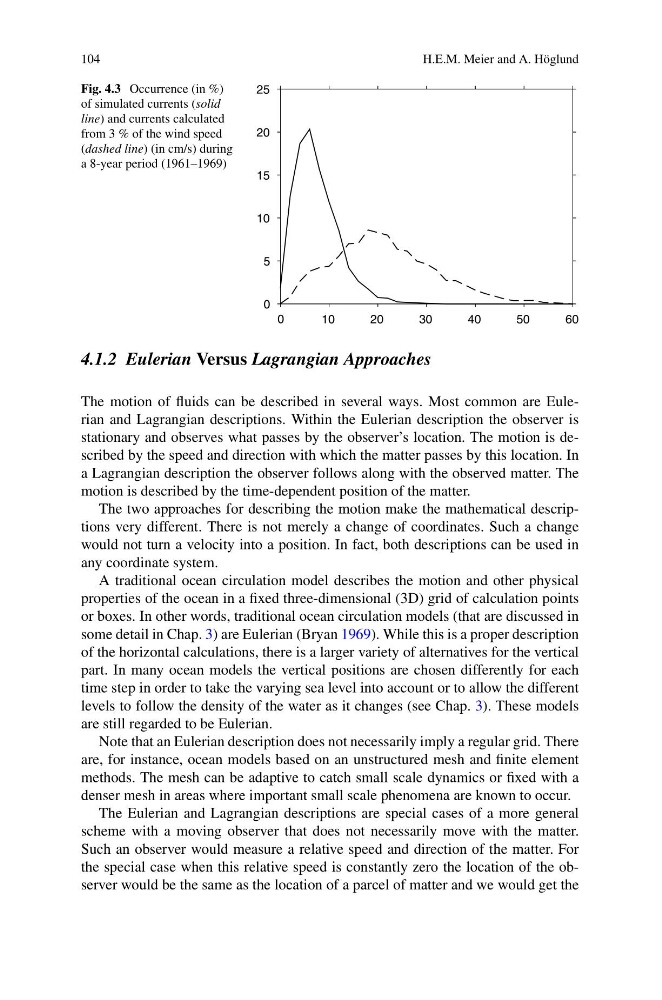
Fig. 4.3 Occurrence (in %)
of simulated currents (solid
line) and currents calculated
from 3 % of the wind speed
(dashed line) (in cm/s) during
a 8-year period (1961–1969)
4.1.2 Eulerian Versus Lagrangian Approaches
The motion of fluids can be described in several ways. Most common are Eulerian and Lagrangian descriptions. Within the Eulerian description the observer is
stationary and observes what passes by the observer’s location. The motion is described by the speed and direction with which the matter passes by this location. In
a Lagrangian description the observer follows along with the observed matter. The
motion is described by the time-dependent position of the matter.
The two approaches for describing the motion make the mathematical descriptions very different. There is not merely a change of coordinates. Such a change
would not turn a velocity into a position. In fact, both descriptions can be used in
any coordinate system.
A traditional ocean circulation model describes the motion and other physical
properties of the ocean in a fixed three-dimensional (3D) grid of calculation points
or boxes. In other words, traditional ocean circulation models (that are discussed in
some detail in Chap. 3) are Eulerian (Bryan 1969). While this is a proper description
of the horizontal calculations, there is a larger variety of alternatives for the vertical
part. In many ocean models the vertical positions are chosen differently for each
time step in order to take the varying sea level into account or to allow the different
levels to follow the density of the water as it changes (see Chap. 3). These models
are still regarded to be Eulerian.
Note that an Eulerian description does not necessarily imply a regular grid. There
are, for instance, ocean models based on an unstructured mesh and finite element
methods. The mesh can be adaptive to catch small scale dynamics or fixed with a
denser mesh in areas where important small scale phenomena are known to occur.
The Eulerian and Lagrangian descriptions are special cases of a more general
scheme with a moving observer that does not necessarily move with the matter.
Such an observer would measure a relative speed and direction of the matter. For
the special case when this relative speed is constantly zero the location of the observer would be the same as the location of a parcel of matter and we would get the
H.E.M. Meier and A. Höglund
Fig. 4.3 Occurrence (in %)
of simulated currents (solid
line) and currents calculated
from 3 % of the wind speed
(dashed line) (in cm/s) during
a 8-year period (1961–1969)
4.1.2 Eulerian Versus Lagrangian Approaches
The motion of fluids can be described in several ways. Most common are Eulerian and Lagrangian descriptions. Within the Eulerian description the observer is
stationary and observes what passes by the observer’s location. The motion is described by the speed and direction with which the matter passes by this location. In
a Lagrangian description the observer follows along with the observed matter. The
motion is described by the time-dependent position of the matter.
The two approaches for describing the motion make the mathematical descriptions very different. There is not merely a change of coordinates. Such a change
would not turn a velocity into a position. In fact, both descriptions can be used in
any coordinate system.
A traditional ocean circulation model describes the motion and other physical
properties of the ocean in a fixed three-dimensional (3D) grid of calculation points
or boxes. In other words, traditional ocean circulation models (that are discussed in
some detail in Chap. 3) are Eulerian (Bryan 1969). While this is a proper description
of the horizontal calculations, there is a larger variety of alternatives for the vertical
part. In many ocean models the vertical positions are chosen differently for each
time step in order to take the varying sea level into account or to allow the different
levels to follow the density of the water as it changes (see Chap. 3). These models
are still regarded to be Eulerian.
Note that an Eulerian description does not necessarily imply a regular grid. There
are, for instance, ocean models based on an unstructured mesh and finite element
methods. The mesh can be adaptive to catch small scale dynamics or fixed with a
denser mesh in areas where important small scale phenomena are known to occur.
The Eulerian and Lagrangian descriptions are special cases of a more general
scheme with a moving observer that does not necessarily move with the matter.
Such an observer would measure a relative speed and direction of the matter. For
the special case when this relative speed is constantly zero the location of the observer would be the same as the location of a parcel of matter and we would get the