

90
T. Torsvik
3.3.2.2 The Hydrostatic Approximation
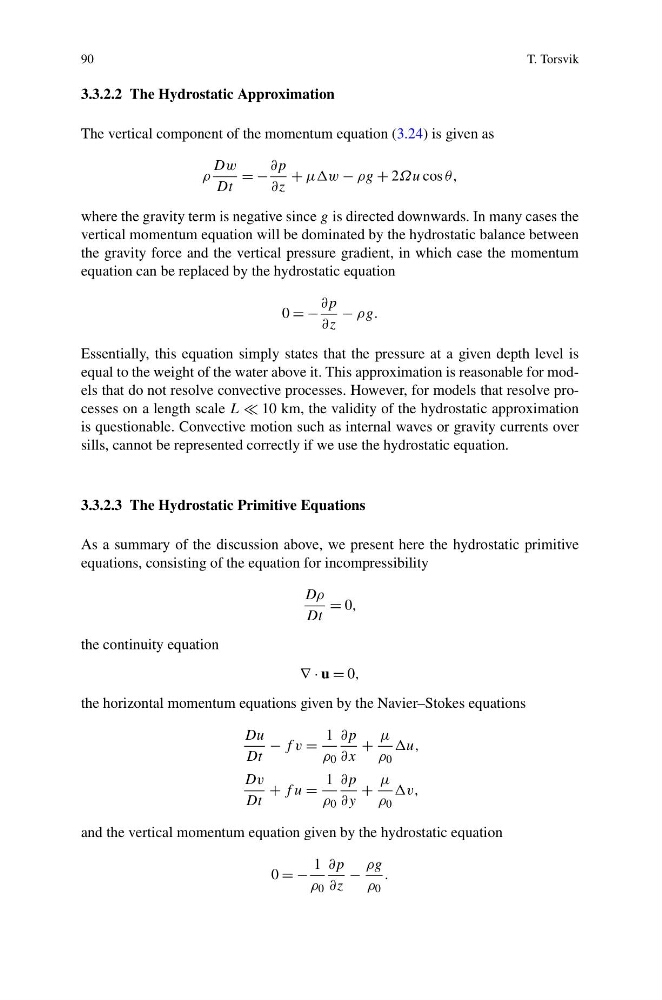
The vertical component of the momentum equation (3.24) is given as
ρ
Dw
Dt
= −
∂p
∂z
+ μμw − ρg + 2Ωu cos θ,
where the gravity term is negative since g is directed downwards. In many cases the
vertical momentum equation will be dominated by the hydrostatic balance between
the gravity force and the vertical pressure gradient, in which case the momentum
equation can be replaced by the hydrostatic equation
0 = −
∂p
∂z
− ρg.
Essentially, this equation simply states that the pressure at a given depth level is
equal to the weight of the water above it. This approximation is reasonable for models that do not resolve convective processes. However, for models that resolve processes on a length scale L 10 km, the validity of the hydrostatic approximation
is questionable. Convective motion such as internal waves or gravity currents over
sills, cannot be represented correctly if we use the hydrostatic equation.
3.3.2.3 The Hydrostatic Primitive Equations
As a summary of the discussion above, we present here the hydrostatic primitive
equations, consisting of the equation for incompressibility
Dρ
Dt
= 0,
the continuity equation
∇ · u = 0,
the horizontal momentum equations given by the Navier–Stokes equations
Du
Dt
− f v =
1
ρ 0
∂p
∂x
+
μ
ρ 0
u,
Dv
Dt
+ f u =
1
ρ 0
∂p
∂y
+
μ
ρ 0
v,
and the vertical momentum equation given by the hydrostatic equation
0 = −
1
ρ 0
∂p
∂z
−
ρg
ρ 0
.
T. Torsvik
3.3.2.2 The Hydrostatic Approximation
The vertical component of the momentum equation (3.24) is given as
ρ
Dw
Dt
= −
∂p
∂z
+ μμw − ρg + 2Ωu cos θ,
where the gravity term is negative since g is directed downwards. In many cases the
vertical momentum equation will be dominated by the hydrostatic balance between
the gravity force and the vertical pressure gradient, in which case the momentum
equation can be replaced by the hydrostatic equation
0 = −
∂p
∂z
− ρg.
Essentially, this equation simply states that the pressure at a given depth level is
equal to the weight of the water above it. This approximation is reasonable for models that do not resolve convective processes. However, for models that resolve processes on a length scale L 10 km, the validity of the hydrostatic approximation
is questionable. Convective motion such as internal waves or gravity currents over
sills, cannot be represented correctly if we use the hydrostatic equation.
3.3.2.3 The Hydrostatic Primitive Equations
As a summary of the discussion above, we present here the hydrostatic primitive
equations, consisting of the equation for incompressibility
Dρ
Dt
= 0,
the continuity equation
∇ · u = 0,
the horizontal momentum equations given by the Navier–Stokes equations
Du
Dt
− f v =
1
ρ 0
∂p
∂x
+
μ
ρ 0
u,
Dv
Dt
+ f u =
1
ρ 0
∂p
∂y
+
μ
ρ 0
v,
and the vertical momentum equation given by the hydrostatic equation
0 = −
1
ρ 0
∂p
∂z
−
ρg
ρ 0
.